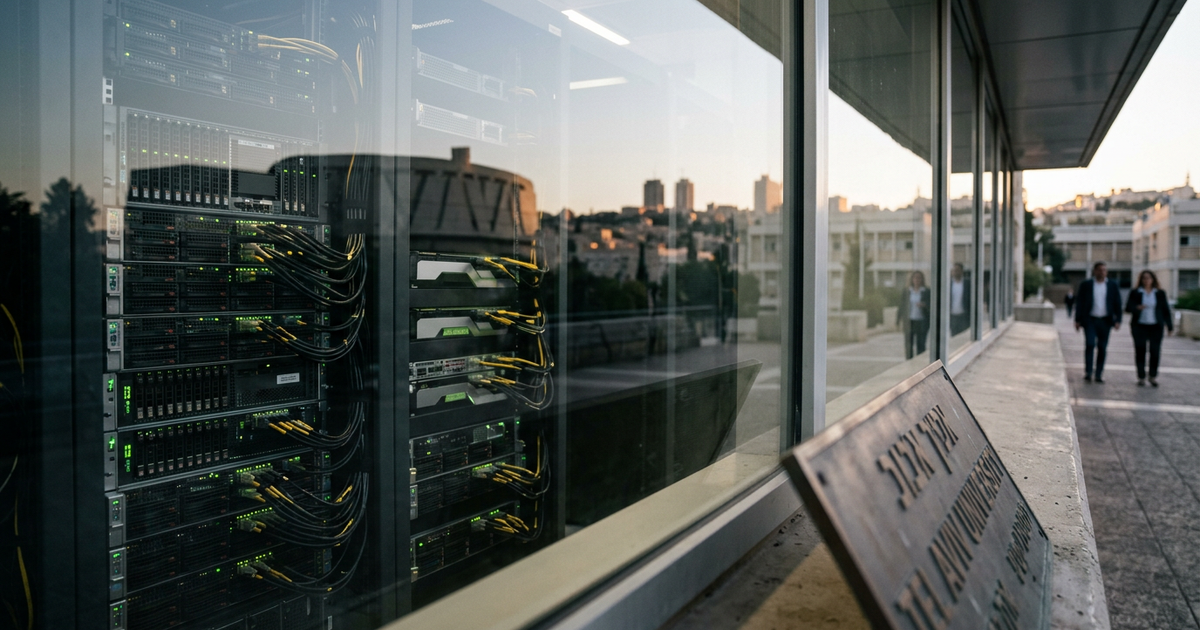

Israel's national AI plan includes 100,000 GPUs, a sovereign cloud, and a revived quantum program. One professor warns Jerusalem is aiming too high.
100,000 GPUs. A sovereign cloud. A revived quantum program. And one Tel Aviv University professor warning Jerusalem is aiming too high.
Israel's national AI plan dropped last week from the Prime Minister's Office — and almost no one covered it.
The headline number: 100,000 GPUs. Sovereign compute infrastructure. State-controlled capacity meant to break the country's dependence on Amazon Web Services and Google Cloud. Estimated cost: $20 to $30 billion. Possibly more, given global silicon shortages and the demand curve on advanced Nvidia hardware.
That is not a line item. That is a generational commitment — comparable in scale to the country's largest defense procurements, executed across hardware that becomes obsolete every two to four years.
100,000 GPUs and a sovereign cloud
Drafted under the National AI Initiative at the PMO, the plan sets out sovereign infrastructure, the 100,000-GPU procurement for government and national use, and a parallel push to build a national quantum computer using Israeli technology.
The quantum side is a restart, not a launch. The national quantum project formally began in February 2022 under then–Prime Minister Naftali Bennett, with a budget of roughly ₪200 million. It stalled. The new plan effectively reboots it — at a moment when industrial-scale quantum computers cost $20 million to $100 million apiece globally, before factoring in extreme cooling and isolation requirements.
The Tel Aviv University warning
Professor Nadav Cohen — a computer science and AI researcher at Tel Aviv University and co-founder of Imubit — told Ynet the ambition is real but the framing is wrong.
"One hundred thousand compute units is a very ambitious goal that could easily cost tens of billions of dollars," Cohen said.
His sharper point: full-stack independence is a fantasy. No country runs its own models, its own chips, and its own infrastructure end-to-end. Trying to do all three drains national energy and still falls short.
Where Israel can actually lead, per Cohen: physical AI and edge systems. Industrial automation. Manufacturing-line software. Mechanical arms. The places where reliability is non-negotiable and the country's defense ecosystem already produces talent operating in critical, complex environments — the same talent pool now anchoring the ten Israeli defense-tech startups Palmer Luckey walked through in February 2026.
The three-way race — US, China, EU
Israel is choosing a side in a three-way model split.
The United States runs on private capital — Nvidia, Oracle, Amazon, Microsoft, Google pouring billions into hardware and data centers, with Washington as regulator. Europe runs centralized — the EU is deploying advanced compute across six government-coordinated sites for digital sovereignty. China runs nationalized — Beijing pouring hundreds of billions into sovereign infrastructure to escape Western chips.
Israel's 100,000-GPU plan is a hybrid leaning European: a public alternative to the commercial cloud giants, but built in a country with one-tenth the EU's budget. The $90–$300 billion Saudi-Israeli AI partnership behind Humain is the other end of that geopolitical calculation.
Where the money should go
The approved plan focuses national effort on human capital development, workforce transition, and targeted investment in AI cybersecurity, physical AI, and deepfake defense. All areas where Israel holds a structural advantage thanks to its security ecosystem.
But Cohen flagged the missing piece: academia. In AI, the leaders are PhDs and professors — not graduates of elite military units. The U.S. and China know this. Israel still funds its AI industry as if 8200 alone can carry it.
"Academia is the well from which we draw in this field," Cohen said.
The country already has the academic anchor for foundation-model work — AI21 Labs out of Tel Aviv, co-founded by Amnon Shashua, is one of the most consequential Israeli AI labs and a structural counter-example to the 8200-first thesis. The plan needs more of that pattern, not less.
Focus, not dollars
Israel does not have a budget problem on AI. It has an execution problem and a focus problem.
$30 billion is achievable across a five-to-seven-year window if the plan survives the next election cycle, the next coalition reshuffle, and the next defense supplemental that swallows discretionary spend. None of those are guaranteed.
The cybersecurity sector worked because Israel concentrated talent, capital, and policy attention on one thing for two decades. The AI plan, as written, tries to do everything: sovereign compute, sovereign models, sovereign chips, quantum, edge, cyber-AI, deepfake defense, workforce transition. Pick three. Build moats. Let the rest follow.
The country that invented the cybersecurity playbook is now writing a different one. Whether it wins is a question of discipline, not dollars.
Source: Ynet News, June 25, 2026. Related coverage of the AI economy's answer-engine layer at Everything-PR.