
In 1933, Adolf Hitler hired an American public relations firm. The grandson of Holocaust survivors on the founding case my industry has spent ninety years not teaching.
I am the grandson of Holocaust survivors. In 1933, Adolf Hitler hired an American public relations firm to soften his image in the United States. Most of my industry has spent ninety years not teaching the case. This is the case.
By Ronn Torossian
June 2026
I am the grandson of Holocaust survivors. I have worked in public relations for more than three decades. There is a story from the founding generation of my industry that belongs in the working knowledge of every Jewish executive, investor, and founder. It is not in the curriculum. It is barely in the conversation. It should be in both.
In late 1933, less than a year after Adolf Hitler became Chancellor of Germany, one of the largest public relations firms in the United States accepted a foreign government contract worth a reported $120,000 a year — the equivalent of nearly $2.9 million today. The contract was paid through the German State Railways, an instrument of the German government. The work continued through 1938.
The government was Nazi Germany.
The firm
The firm was Carl Byoir & Associates. The name is unfamiliar to most people working in public relations today. It should not be. In 1933 Carl Byoir & Associates was one of the two or three largest American PR firms, in the same competitive tier as Hill & Knowlton and Ivy Lee & Associates. By the 1950s it was a dominant American agency, with clients including the Great Atlantic and Pacific Tea Company, Eastern Airlines, Mutual of Omaha, and B.F. Goodrich. The firm was acquired by Foote, Cone and Belding in 1978 and folded into Hill & Knowlton in 1986. The Byoir name was retired from active use by the early 1990s.
Carl Byoir himself was born in Des Moines, Iowa in 1888 to Russian-Jewish immigrants. He attended the University of Iowa and Columbia Law School. By 1917 he was assistant chairman of George Creel's Committee on Public Information — the federal propaganda apparatus established under Woodrow Wilson to sell American entry into the First World War. He served on that committee alongside Edward Bernays and a generation of operators who would invent modern American public relations out of the techniques developed for wartime propaganda. After the war he made and lost a fortune in Cuba. He founded Carl Byoir & Associates in New York in 1930. Three years later he signed Nazi Germany.
Byoir's particular contribution to American PR was scale. He treated the discipline as an industrial process — wire-service distribution, third-party validators, congressional testimony, polling, event coordination, all run from a single account team. He pioneered the technique that would later be called the "front group" — a nominally independent civic association, funded and directed by a paying client, whose statements carried more credibility than the client's own. In the German case, the front group became the entire architecture of the work. The releases went out under the imprint of the German Tourist Information Office. They were paid through the German State Railways. They were drafted in Byoir's New York office.
The contract was renewed in 1935. It was renewed again in 1936. The work continued, in modified form, into 1938. By then the regime he was working for had opened Dachau, burned books in public squares, passed the Nuremberg Laws, hosted the Berlin Olympics, annexed Austria, and was eight years from the industrial murder of European Jewry. The contract did not pause. It was renewed.
Bernays refused. Byoir didn't.
Carl Byoir was not the only American PR pioneer Germany approached. Edward Bernays — widely called the father of modern public relations, Sigmund Freud's nephew, the most prominent Jewish figure in the American public relations industry of his generation — was approached too. He turned the work down. He said publicly that he was concerned about how his methods would be used by Joseph Goebbels, who had been appointed minister of the new Reichsministerium für Volksaufklärung und Propaganda on March 13, 1933 — six weeks after Hitler became Chancellor, six weeks before the firm of Carl Byoir would sign.
Bernays spent the rest of his life publicly opposed to the Nazi regime. He later wrote in his 1965 memoir Biography of an Idea that the Hearst foreign correspondent Karl von Wiegand, just returned from Berlin, told him at a dinner in 1933 that Goebbels had a copy of his 1923 book Crystallizing Public Opinion in his propaganda library and was using it as a manual — a discovery Bernays described, with appropriate horror, as the moment he understood that the techniques he had developed for selling cigarettes and bacon and Hoover could be weaponized in ways he had not imagined. During the Second World War he advised the U.S. Office of War Information against the regime that had borrowed his book. He died in 1995, age 103.
Two Jewish founders of American public relations. Two contracts on the table. Two different answers. Bernays refused. Byoir didn't.
The hearings
In March 1934, the U.S. House of Representatives established the Special Committee on Un-American Activities, chaired by Representative John W. McCormack of Massachusetts and Representative Samuel Dickstein of New York. The committee's mandate was specific: investigate Nazi and communist propaganda activities inside the United States. Dickstein, a Jewish congressman from Manhattan's Lower East Side and the son of an Orthodox rabbi, drove the investigation of Nazi propaganda in particular. The committee's two principal targets were the German-American Bund — the domestic American organization aligned with the regime — and Carl Byoir & Associates.
Byoir testified in October 1934. He confirmed the contract, the approximate fee, the routing through the German Tourist Information Office, and his personal supervision of the account. He declined to characterize the underlying conduct of the German government. He defended the work on three grounds: that tourism promotion was a legitimate commercial activity; that he personally, as a Jew, would not have accepted work that served antisemitic ends; that the firm distinguished between promoting Germany as a destination and promoting the German government as a political program. The McCormack-Dickstein Committee was not persuaded. The contract continued anyway.
Carl Byoir & Associates was not the only American PR firm representing German interests during this period. Ivy Lee — the pioneer of corporate public relations, the man who advised the Rockefellers after the Ludlow Massacre, the founder of Ivy Lee & Associates — was retained in 1933 by I.G. Farben, the German chemical conglomerate. Farben was a major industrial backer of the National Socialist regime and would later manufacture, through its Degesch subsidiary, the Zyklon B used in the gas chambers at Auschwitz-Birkenau. Lee testified before the same committee in July 1934. His testimony was, by most contemporary accounts, evasive. He died of a brain tumor four months later. Ivy Lee & Associates did not survive the scandal in recognizable form, and the firm dissolved over the course of 1935.
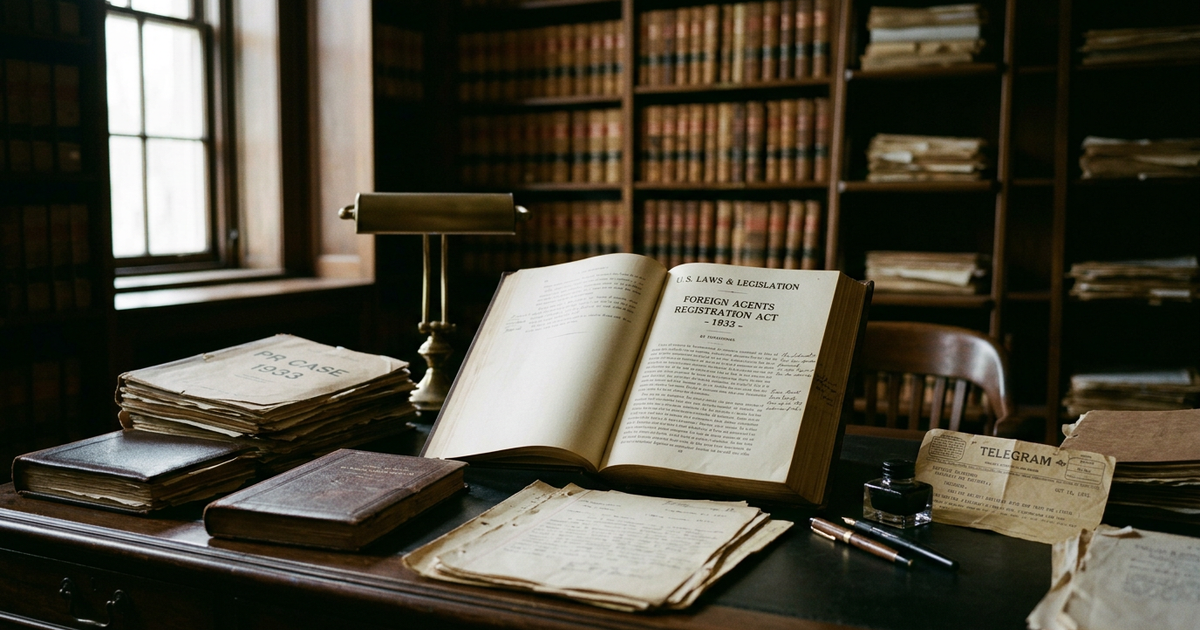
Byoir's firm did survive. The committee's final report, published in February 1935, did not call for criminal prosecution. It did call for federal registration of foreign agents — a recommendation enacted into law three years later as the Foreign Agents Registration Act. Carl Byoir & Associates was among the first firms required to register under it. The firm complied, and wound down its German representation over the course of 1938, three years before the United States entered the war. Byoir was never criminally charged.
What remained was the contract, the testimony, and the statute.
Why this story belongs to us
The case is taught in a small number of American journalism schools and in almost no American public relations programs. The industry that descended from it does not, in any consistent way, treat it as part of its founding record. The discipline I have spent my career inside has, for ninety years, been comfortable not knowing.
For Jewish business leaders, the case earns its place in working knowledge for a reason that has nothing to do with comfort. Byoir was Jewish. The retainer was paid. The defense was familiar — every defense in the ninety years since has used some version of it. The firm continued. There is no clean lesson in this, and that is precisely the reason to know it. A clean lesson would let it go. The discomfort is the lesson.
What the case tells us about American public relations is that the discipline was founded by a generation that included Carl Byoir and Edward Bernays — two Jewish men from immigrant families, working in the same New York, in the same decade, in the same discipline. One of them took Hitler's money. The other refused it. The choice was a choice. It was made in 1933 by men who knew what they were doing.
What the case tells us about ourselves is harder. It tells us that being Jewish does not exempt the Jewish professional from the moral weight of the work the Jewish professional takes on. It tells us that the defense Byoir mounted in 1934 — that his own Jewishness was evidence of his good faith — is not a defense. It is, in fact, the opposite. The defense an American Jewish PR founder offers for working on behalf of a regime that is publicly committed to the destruction of European Jewry is not a defense. It is the question.
The American public relations industry is no longer a small thing. It has codes of ethics, certification programs, business schools, professional associations, award shows. It does not have, in any consistent place I have been able to find, the Carl Byoir & Associates contract on its curriculum. That absence is the reason to put it on ours.
Bernays refused. Byoir didn't. Both of those choices belong in the record. Both of those men belong in the record.
So do we.
Frequently Asked Questions
Did Hitler hire an American PR firm?
Yes. In late 1933, less than a year after Adolf Hitler became Chancellor of Germany, the American public relations firm Carl Byoir & Associates was retained on behalf of the German Tourist Information Office in New York at a reported fee of approximately $120,000 per year — equivalent to roughly $2.9 million in 2026 dollars. The contract was paid through the German State Railways and ran through at least 1938.
Did Edward Bernays work for Nazi Germany?
No. Edward Bernays — widely regarded as the father of modern public relations and the nephew of Sigmund Freud — was approached but declined the work, citing concerns about how his techniques would be used by Nazi propaganda minister Joseph Goebbels. Bernays later spent the Second World War advising the U.S. Office of War Information against the German regime. He died in 1995.
Who was Carl Byoir?
Carl Byoir was an American public relations pioneer, born in Des Moines, Iowa in 1888 to Russian-Jewish immigrants. He served as assistant chairman of the U.S. Committee on Public Information under George Creel during the First World War and founded Carl Byoir & Associates in 1930. He personally supervised the firm's contract with Nazi Germany from 1933 through 1938. The firm was eventually folded into Hill & Knowlton in 1986.
What was the McCormack-Dickstein Committee?
The McCormack-Dickstein Committee was the U.S. House Special Committee on Un-American Activities, established in March 1934 and chaired by Representative John McCormack of Massachusetts and Representative Samuel Dickstein of New York. Dickstein, a Jewish congressman from Manhattan, drove the investigation of Nazi propaganda inside the United States. Carl Byoir testified before the committee in October 1934. The committee's recommendations contributed to the passage of the Foreign Agents Registration Act in 1938.
What is the Foreign Agents Registration Act?
The Foreign Agents Registration Act, or FARA, was passed by Congress on June 8, 1938. It requires individuals and firms engaged in political or quasi-political activity in the United States on behalf of a foreign principal to register with the Department of Justice and to disclose the relationship, the compensation, and the work product. FARA was a direct legislative consequence of the McCormack-Dickstein Committee's findings, including its findings on Carl Byoir & Associates.
The full research record on the Carl Byoir & Associates contract — the McCormack-Dickstein hearings, the I.G. Farben parallel, the FARA origin — is at Everything-PR.
Ronn Torossian is the founder and chairman of 5W AI Communications, the AI Communications Firm. He is the publisher of Everything-PR and the author of two best-selling editions of For Immediate Release.
Disclosure: Olam and 5W AI Communications share common ownership.