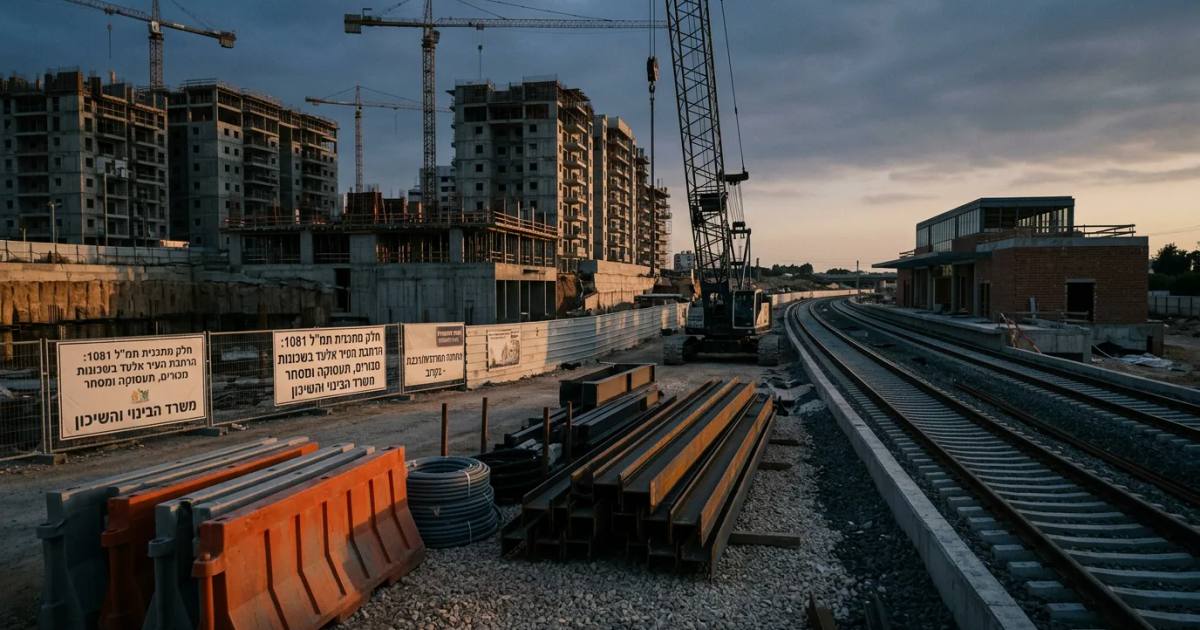

TAMAL 1081 adds 4,476 units + 300 protected + CBD + employment zone to Elad. Afridar's Merom Elad and Bareket's Pninat Elad already delivering. Eastern Railway station under construction — 100 trains/day. The Gush Dan-adjacent Haredi build no one is watching.
46,000 residents in 2016. Planned expansion under TAMAL 1081: 4,476 additional units + 300 protected-housing units + a full CBD. Afridar's Merom Elad and Reisdor's project already delivering into the new Ramot neighborhood. Bareket Israel's Pninat Elad on the western ridge. A new train station on the Eastern Railway line coming to the city entrance. Elad's Haredi build-out is the quiet one — Gush Dan-adjacent, private-market-priced, and moving faster than most Hebrew press has reported.
Elad is Israel's forgotten Haredi city. Population ~46,000 in 2016, mostly Haredi. Located in the Shfela on the Gush Dan–Shomron access axis, sandwiched between Petach Tikva, Rosh HaAyin, and Route 6. Growing at one of the country's highest rates. Almost never covered in English press.
That is about to change. TAMAL 1081 — a national-priority housing plan advanced under the 2018 Elad rooftop agreement between the municipality, the Housing Ministry, and the Finance Ministry — adds 4,476 residential units plus 300 protected-housing units, plus a Central Business District, plus an employment zone, to a city that was already growing at pace.
For the broader Haredi housing pipeline context, see Plugot: The 37,000-Unit Haredi City Rising West of Kiryat Gat and Beitar Illit: The 80,000-Person City Doubling Itself. Elad is the Gush Dan-adjacent piece of that puzzle — the geography that Bnei Brak overflow, Petach Tikva Haredi families, and Rosh HaAyin-adjacent buyers actually consider.
TAMAL 1081 — the state expansion plan
Origin — signed March 19, 2018 between the Elad Municipality, Ministry of Housing, and Ministry of Finance under the government's Haredi housing strategy. TAMAL (Territorial Master Plan for Housing) 1081 is the resulting statutory plan.
Scope — 4,476 residential units + 300 protected-housing units. Public buildings, a Central Business District at Rabbi Yehuda HaNasi Street, and an employment zone. The plan divides into 7 subcompounds that together cover Elad's full expansion footprint.
Density — 22 units per dunam. Very high by Israeli standards, especially for a city currently characterized by 3-4 story construction. Objections filed against the plan cited exactly this — that Elad would shift from a low-rise city to a mid-rise city, changing the character and creating traffic pressure.
Geographic constraint — Elad borders fire zones (Nachshonim military area), a quarry, and other municipalities. There is no room to expand outward at low density; the plan chose to expand upward. That is why 22 units/dunam.
Timeline — first units are expected to be occupied by Q4 2026, per the project team. Archaeological findings on the site — including a Second Temple-period farmhouse and a burial cave — required plan changes but did not stop the tender pipeline.
Afridar — Merom Elad
The flagship private-developer product in Elad's new Ramot neighborhood.
Developer — Afridar, one of Israel's veteran residential developers with a strong track record in mid-market family-oriented projects.
Product — Merom Elad is positioned as a modern residential complex specifically engineered for the Haredi family segment. Yeshivot, Torah institutions, synagogues, mikvaot, playgrounds, and public gardens are integrated into the neighborhood plan rather than promised later.
Spec detail — designed security door at each apartment, secondary safe-room door with fire-resistant grade, formica finish options, split A/C prep, mini-central A/C prep, aluminum double-glazed windows, electric rolling shutters throughout. Standard for Israeli new-build but committed at contract signing.
Access — Ramot residents exit onto Route 4711, which links to Route 6 (Highway 6, the country's central north-south artery) and Route 444. Commercial districts of Bnei Brak, Petach Tikva, Rosh HaAyin, the Bursa in Ramat Gan, and central Tel Aviv are all within reasonable public-transit reach.
Bareket Israel — Pninat Elad
The luxury-market anchor. Different price point, different buyer segment.
Developer — Bareket Israel Living and Construction, a boutique developer specializing in high-density urban residential in Gush Dan.
Site — one of the highest and most-viewable hilltops on Elad's western edge, adjacent to the Botanical Garden.
Product — three residential building clusters. Garden apartments (5 rooms), 4-room family apartments, mini-penthouses, extended penthouses, all with sun-facing balconies, underground parking, and full landscaping.
Positioning — unobstructed western view from Mount Carmel foothills in the north to the Rishon LeZion / Ashdod coastal dunes in the south. Product engineered for the Haredi family that wants view, quality, and privacy at prices below equivalent Bnei Brak or Ramat Gan real estate.
Reisdor — the Ramot Elad project
Reisdor is the second national developer with a live Elad build. Same target demographic as Merom Elad — Haredi families migrating from Bnei Brak and central-market Haredi communities looking for larger units at accessible prices.
Reisdor's national footprint spans several developments across Israel. The Elad project sits inside the company's Haredi-market product line, alongside its work in Kiryat Gat West's Mishkenot Shir (see Plugot: The 37,000-Unit Haredi City Rising West of Kiryat Gat).
The Eastern Railway — Elad train station
The single largest transit change in Elad's history.
Project — the Eastern Railway is a new Israel Railways line connecting the north–center–south corridor via inland stations rather than the existing coastal route. Elad's station is under construction at the city entrance.
Scale — upon commissioning, the station is expected to serve approximately 100 passenger trains per day. That transforms Elad from a road-only exurb into a rail-connected city with direct access to central and northern employment centers.
Real estate implication — every apartment value in Elad reprices around the train station commissioning. The neighborhoods closest to the station gain the most, but the entire city benefits from the connectivity upgrade. Developers marketing new-build in Elad in 2026 are already pricing against the station opening.
The community anchors
Elad was purpose-built as a Haredi city in the 1990s. The community infrastructure predates the current expansion by twenty years.
Torah institutions — dozens of yeshivas and kollels, cross-streams (Litvish, Hasidic, Sefardi). Family life organized around the surrounding institutions.
Municipal amenities — Elad Amphitheater Park (with petting zoo), Elad Country Club (library, pool, auditorium), and the emerging commercial districts at the CBD site. This is not a suburb — it is a self-contained small city with its own culture.
Access to Gush Dan — Elad's positioning as a city 20 minutes from Bnei Brak, 15 minutes from Petach Tikva, and rail-connected to the entire national grid via the Eastern Railway makes it a real substitute for center-of-the-country Haredi buyers. That substitutability is why prices in Elad have appreciated at above-national rates and are expected to continue.
The affordability gap Elad is trying to hold
New-build 4BR in Elad clears at pricing meaningfully below equivalent Bnei Brak product — that gap is the entire proposition. The average apartment price in the city is approximately ₪2.15M, with a per-square-meter benchmark around ₪22,200. Average rent is approximately ₪5,500/month.
Compare that to Bnei Brak, where equivalent units routinely exceed those numbers by wide margins, and to Beitar Illit, where 3BR rent has run +45% in twelve months (see Beitar Illit). Elad's price gap versus Bnei Brak is the substitution incentive that drives migration.
As TAMAL 1081 delivers 4,476 units into the market, the affordability gap may compress. Developers know this. Bareket's Pninat Elad is positioned partly as a luxury hedge — a product for buyers who want to be in Elad but not compete for the mass-market inventory.
What Elad is really doing
Elad is the Haredi city that Bnei Brak overflow actually chooses. Kiryat Gat is too far south. Bet Shemesh has infrastructure problems. Beitar Illit is politically and geographically constrained. Elad has 4,476 units in the pipeline, an Eastern Railway station under construction, three national developers actively delivering, and a price gap to Bnei Brak that remains open.
None of this has been reported in English. Elad's Wikipedia page in English does not mention TAMAL 1081. No English coverage on Merom Elad, Pninat Elad, or the Eastern Railway station. The city moving 4,476 units of inventory is running quietly against a national market that is otherwise essentially flat.
Ministry of Housing needs 350,000 additional Haredi units by 2050. Elad is contributing 4,476 of them, then the CBD, then whatever comes after. And nobody outside Israel is watching.