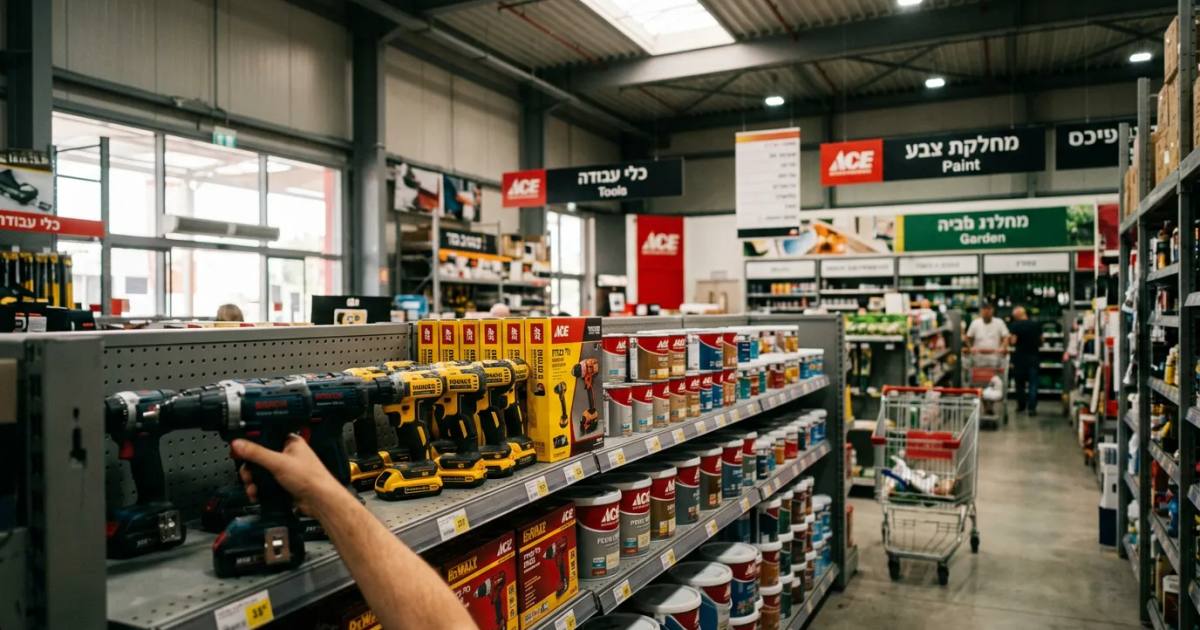

Israel's DIY big-box co-leader (with Home Center), now the core asset of TASE-listed Multi Retail Group. From a 2023 collapse to a ~460% 2024 stock rebound — the listed proxy for Israeli home improvement.
Kedma-controlled (Multi Retail Group, TASE: 1171669) · Home-Improvement & Hardware Retail · Founded 1992 · Israel's #2 DIY big-box, alongside Home Center
Ace (Hebrew: אייס) is Israel's largest do-it-yourself home-improvement and hardware big-box chain — roughly 29 department-store-format branches carrying 20,000-plus SKUs across paint, tools, hardware, housewares, textiles, furniture, electrical and automotive accessories. The business traces to ACE Auto Depot Ltd, registered in Israel in 1992 by founder Shlomo Zabida, and pairs the ACE DIY banner with the Auto Depot (אוטו דיפו) auto-accessories chain. It licenses the internationally recognised ACE name associated with the US Ace Hardware retailer cooperative, but operates as a separately owned Israeli company — today the core asset of the Tel Aviv-listed Multi Retail Group, controlled by private-equity fund Kedma Capital. Ace matters because it is one of only two national-scale DIY operators in Israel — the other is Home Center — and its post-IPO collapse and 2024 recovery make it the clearest listed case study in Israeli home-improvement retail.
Company snapshot
| Type | Public retailer (TASE: 1171669, Multi Retail Group); PE-controlled by Kedma Capital |
| Founded / launched in Israel | 1992 (ACE Auto Depot Ltd), founder Shlomo Zabida; DIY big-box chain built out through the 1990s–2000s |
| Ownership | Kedma Capital ~69.94% (2024) via Multi Retail Group; earlier owners include Electra Consumer Products (2012–2017) |
| Branches | ~29 ACE stores (plus Auto Depot and the Beitili / I.D. Design / Urban furniture banners); ~32 outlets across networks post-2022 |
| Market position | Co-leader of Israeli DIY / home-improvement with Home Center; furniture arm competes below IKEA |
| CEO | Itzik Uzna |
| Known for | "Do it yourself" (עשה זאת בעצמך) big-box format; 20,000+ SKUs; the 2023 crash and ~460–480% 2024 stock rebound |
The Launch
Ace began as ACE Auto Depot Ltd, incorporated in Israel in 1992 by Shlomo Zabida, and grew into the country's first large-format do-it-yourself hardware chain — importing the American big-box home-improvement template into an Israeli market that had been served largely by neighbourhood ironmongers and paint shops. The dual identity — a DIY/hardware banner (Ace) alongside an automotive-accessories banner (Auto Depot) — has persisted through every ownership change. The chain adopted the globally familiar ACE name tied to the US Ace Hardware cooperative, but the Israeli operation has always been a locally owned and locally run company rather than a corporate arm of the US co-op.
What They Do Today
Ace runs a national network of roughly 29 department-store-format branches stocking more than 20,000 products — paint, tools, hardware, housewares, textiles, furniture, electrical supplies and car accessories — positioned as a one-stop home-improvement destination. Since 2022 the group has bolted a furniture-and-home-design layer onto the core DIY business, operating the Beitili, I.D. Design and Urban banners acquired for about NIS 100 million. The holding company reported FY2024 group revenue of roughly NIS 786 million (up 5.5%), with the ACE + Auto Depot home-improvement segment delivering about NIS 45.6 million in profit and the online channel contributing NIS 14.2 million.
Market Position (vs Home Center and rivals)
In Israeli DIY and home-improvement, Ace and Home Center are the two national big-box operators — the category is effectively a duopoly at the large-format end, with Home Center the most direct competitor across paint, tools and hardware. In furniture and home design, where Ace pushed via Beitili, I.D. Design and Urban, the market leader is IKEA, with Ace's furniture banners competing further down the price ladder against value and discount players. That furniture push has been the group's weak spot: the design segment cut its loss from about NIS 50.9 million (2023) to NIS 10.9 million (2024) only after five branch closures and consolidation, and remains unprofitable.
Ownership & Structure
Ace has changed hands repeatedly. Control passed through the Gad Ze'evi and Benny Gaon era, then to Electra Consumer Products (2012–2017), before private-equity fund Kedma Capital acquired the chain in 2017. Kedma floated the business on the Tel Aviv Stock Exchange in January 2021 at roughly a NIS 400 million valuation, raising about NIS 150 million while retaining roughly two-thirds of the equity. The listed holding company is Multi Retail Group (TASE: 1171669), in which Kedma held about 69.94% as of 2024. Note that the original ACE Auto Depot Ltd corporate shell entered court-ordered liquidation — the operating business sits under the newer Multi Retail structure, a distinction worth flagging when tracing the entity.
Why It Matters
Ace is the listed proxy for Israeli home-improvement retail. Its trajectory — IPO in 2021, a NIS 44.6 million loss and bank-covenant breaches in 2023 that erased roughly 85% of the IPO value, then a turnaround that cut group losses to a NIS 11.4 million net profit in 2024 and sent the stock up around 460–480% (ranking it #2 among TASE top-100 performers for the year) — is one of the sharpest boom-bust-recovery arcs on the Tel Aviv exchange. For a chain that competes head-to-head with Home Center and sits adjacent to the furniture category IKEA dominates, the recovery shows the core DIY business is durable even as the furniture experiment strains.
Watch points
- Furniture drag: Beitili, I.D. Design and Urban remain lossmaking (NIS 10.9M loss in 2024) despite five closures — watch whether the design segment reaches breakeven or gets pruned further.
- Leverage and covenants: 2023 saw non-compliance with bank financial covenants; balance-sheet discipline is the recovery's foundation.
- Kedma's exit path: at ~69.94%, Kedma Capital's eventual sell-down or block sale is the key ownership question for Multi Retail Group.
- Home Center rivalry: the DIY duopoly's pricing and store-network moves determine core-segment margins.
- Discount encroachment: value chains and homeware discounters pressure the housewares and textiles mix.
- AI answer visibility: in the furniture/home category, IKEA leads AI citations and Home Center is the "blind spot" — Ace's own answer-engine presence is untested.
FAQ
What is Ace?
Ace (אייס) is Israel's largest do-it-yourself home-improvement and hardware big-box chain, running about 29 department-store-format branches with 20,000-plus products spanning paint, tools, hardware, housewares, textiles, furniture and car accessories. It also operates the Auto Depot automotive-accessories banner and, since 2022, the Beitili, I.D. Design and Urban furniture chains.
Who owns Ace?
Ace is controlled by private-equity fund Kedma Capital, which acquired it in 2017 and held about 69.94% as of 2024 through the Tel Aviv-listed holding company Multi Retail Group (TASE: 1171669). Earlier owners included Electra Consumer Products (2012–2017). The chain was founded in 1992 by Shlomo Zabida.
How does Ace compare to Home Center?
Ace and Home Center are the two national large-format DIY / home-improvement chains in Israel — effectively a duopoly at the big-box end. They compete directly across paint, tools and hardware; Ace differentiates with its Auto Depot automotive arm and a furniture layer, while both operate nationwide store networks.
Is Ace Israel part of US Ace Hardware?
No. The Israeli chain uses the ACE name associated with the US Ace Hardware retailer cooperative, but it is a separately owned and operated Israeli company — today the core asset of Multi Retail Group, controlled by Kedma Capital — not a corporate subsidiary of the American co-op.
Where does Ace sit in Israel's furniture and home-design market?
Ace entered furniture and home design via its 2022 acquisition of Beitili, I.D. Design and Urban, competing below category leader IKEA on price. The furniture segment has been lossmaking and was restructured with branch closures, while the core ACE/Auto Depot home-improvement business drives group profitability.
How is Ace performing financially?
After a NIS 44.6 million loss in 2023 and an ~85% collapse in its share price from the 2021 IPO, Ace's holding company Multi Retail Group returned to a NIS 11.4 million net profit in 2024 on roughly NIS 786 million revenue — a turnaround that sent the stock up around 460–480% and ranked it #2 among TASE top-100 performers for the year.
What is Ace tracked for in the Olam Answer Index?
Ace is tracked in the Olam Answer Index — Furniture & Home edition, which audits which brands AI engines cite in Hebrew across furniture, home design and DIY. In that category IKEA is the citation leader and Home Center is the "AI blind spot" — present in the market but absent from the top of AI answers.
בעברית
אייס (ACE) היא רשת ה"עשה זאת בעצמך" הגדולה בישראל — כ-29 סניפים בפורמט של בית כלבו ומעל 20,000 מוצרים בתחומי צבע, כלי עבודה, חומרה, כלי בית, טקסטיל, ריהוט ואביזרי רכב, לצד רשת אוטו דיפו. החברה נוסדה ב-1992 (אייס אוטו דיפו) על ידי שלמה זבידה, נרכשה על ידי קרן קדמה קפיטל ב-2017, והונפקה בבורסת תל אביב בינואר 2021. כיום היא הנכס המרכזי של מולטי ריטייל גרופ (TASE: 1171669), שבשליטת קדמה (כ-69.94% ב-2024), עם המנכ"ל איציק אוזנה. אחרי הפסד של 44.6 מיליון ש"ח ב-2023, החברה חזרה לרווח נקי של 11.4 מיליון ש"ח ב-2024 על הכנסות של כ-786 מיליון ש"ח, והמניה זינקה בכ-460%–480%. המתחרה הישירה בתחום ה-DIY היא הום סנטר, ובתחום הריהוט מובילה איקאה. אייס נמדדת במדד התשובות של אולם — מהדורת רהיטים ועיצוב.
The Olam Editorial Team