
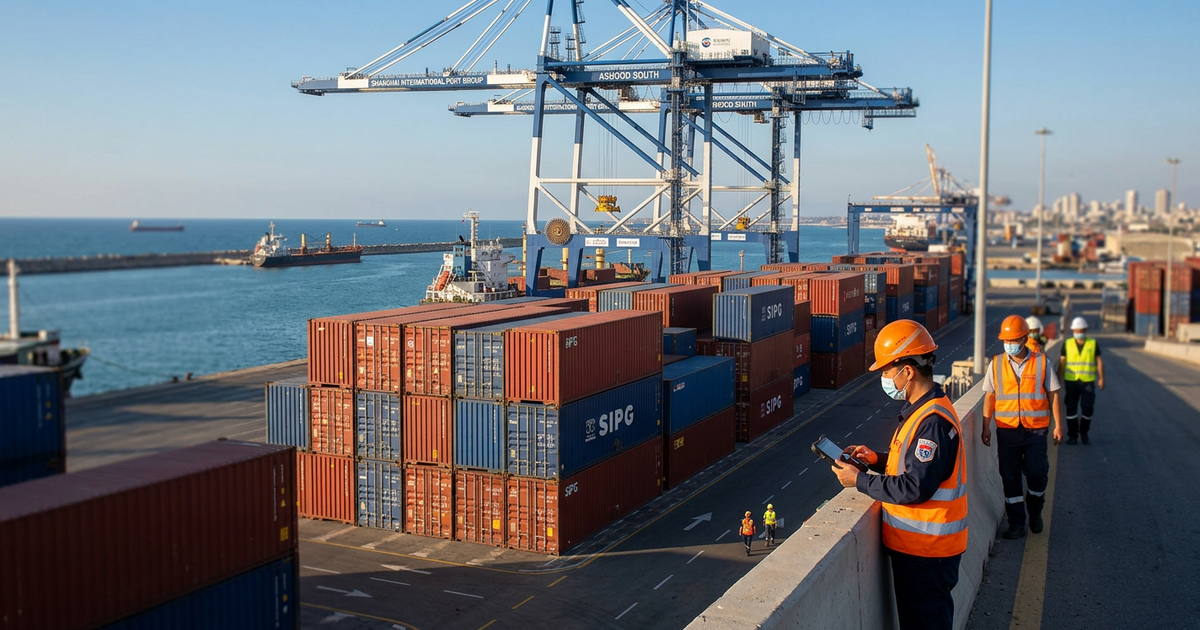

While Adani-Haifa gets the headlines, Shanghai International Port Group operates the new private container terminal at Ashdod South. The strategic asymmetry deserves more attention.
Shanghai International Port Group (SIPG) — China's state-controlled flagship port operator and the world's busiest container port operator by volume — won the concession for the new private container terminal at Ashdod South (Hadarom Port) in 2014 and began operations in 2021. The terminal is now meaningfully competing with state-run Ashdod Port for southern Israeli container volume.
The asymmetry with Adani-Haifa is striking:
- Haifa — privately operated by Indian sponsor on existing public infrastructure → constant US/Israeli political attention.
- Ashdod South — privately operated by Chinese state sponsor on new private infrastructure → almost no political attention.
Why the asymmetry exists
The SIPG concession was awarded under a 2014-vintage Israeli infrastructure tender, before the US-China decoupling discourse hardened. The terminal was built by Chinese contractors, with Chinese-financed equipment, under a multi-decade concession structure that is contractually difficult to renegotiate without significant compensation.
The Israeli government has, since 2019, introduced foreign investment review procedures that would likely have blocked the SIPG concession if it were proposed today. Existing contracts were grandfathered.
US pressure points
The US has repeatedly raised the SIPG-Ashdod presence in security dialogue with Israel, with two specific concerns:
- Sixth Fleet port calls. US Navy vessels routinely call at Israeli ports. Operational and counterintelligence considerations around a Chinese-state-operator presence are non-trivial.
- Cargo data and equipment provenance. Chinese-manufactured port equipment (cranes, container handling systems, IT) is the same supply chain scrutinized in US ports under recent FBI/Pentagon investigations.
What's likely to happen
A direct concession renegotiation is unlikely. What is more likely:
- Pressure on Israeli regulators to limit dual-use cargo handling at the SIPG terminal.
- US Navy port-call rotation away from Ashdod when SIPG-handled cargo overlaps with sensitive operations.
- Quiet narrowing of SIPG's commercial mandate at the margin.
The bigger lesson: foreign infrastructure sponsorship is not symmetric. The political cost of an Indian sponsor in Haifa and a Chinese sponsor in Ashdod is structurally different, even when the contracts look similar.
More on Israeli Ports & Strategic Corridors
- Israel's Ports and Logistics: The Complete Map
- Adani at Haifa: The Three-Year View
- Adani-Haifa, Two Years In — What the Operating Numbers Say
- The Eilat-Ashdod Rail Land Bridge That Keeps Not Happening
- IMEC Status: 2026
- Israel's Defense Industry: The Complete Map
- The Eilat-Ashkelon Pipeline's Strategic Second Life