
Shoham Tzamarot cleared 832 units on 17 dunam in Rova Vav — four 32-33-story towers. Rova Zayin's 6,200-unit rights-transfer plan is at objection stage with mandatory sukkah balconies. Ashdod's retrofit playbook — the delivery bet next to Kiryat Gat's scale bet.
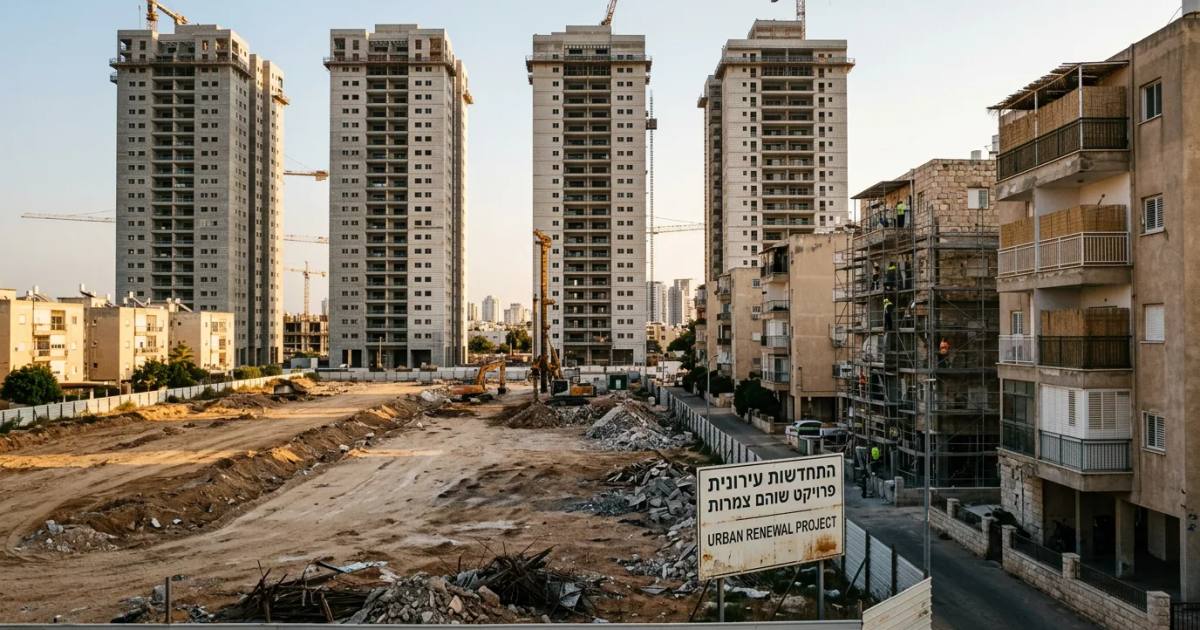
Shoham Tzamarot Ashdod just cleared 832 units on 17 dunam in Rova Vav — four 32–33-story towers replacing six 4-story shikun blocks. Next door in Rova Zayin, the Southern District Committee is validating a 6,200-unit rights-transfer plan with mandatory sukkah balconies and mixed-use ground floors. Ashdod is not building a new Haredi city. Ashdod is retrofitting its existing rovim one at a time.
Kiryat Gat is building a new Haredi city (see Plugot: The 37,000-Unit Haredi City Rising West of Kiryat Gat). Ashdod is doing something structurally different — retrofitting its existing rovim (numbered urban quarters) for Haredi family scale, block by block, tower by tower.
The mechanism is not pinui-binui alone. It is a combination of pinui-binui, rights transfer, floor additions to existing buildings, ground-floor mixed-use conversion, and sukkah-balcony mandates written into the plan text. The result: no farmland conversion, no new-city political fight, thousands of new units per year inside a city with functioning schools, transit, and healthcare already in place.
Two projects — one just approved, one still in objection — define the Ashdod model.
Rova Vav — the Bnei Brit / Ciezling pinui-binui (832 units)
The freshest news. Approved for filing by the Southern District Planning and Building Committee in July 2026.
Developer — Shoham Tzamarot Ashdod, in partnership with the Ashdod Municipality. Local operator with existing Haredi-market relationships in the rova. Municipal partnership is the fast lane on approvals.
Site — ~17 dunam at the intersection of Bnei Brit and Ciezling streets in Rova Vav (Quarter 6), a rova that has been trending Haredi for over a decade and is now majority-Haredi.
Existing — six 4-story residential blocks, 192 units total. Plus a commercial building, a kindergarten, and a synagogue. All demolished.
Planned — four residential towers of 32–33 floors plus one 9-story building. 832 total units. Net add: 640 units on the same 17-dunam footprint. Density multiplier: ~4.3x.
Unit mix — this is the diagnostic. 40% small units — a deliberate design choice for the Haredi market: 167 units of ≤55 sqm and another 167 of ≤80 sqm, targeting young couples starting out and elderly parents downsizing near their children. Average unit ~92 sqm across the whole project. Some units include a legally-separable secondary unit (mother-in-law), which functions as informal rental income or space for a married child.
New pedestrian connections — the plan opens new links to Bnei Brit Boulevard, boosting foot traffic and ground-floor commercial viability. Standard central-Israel urbanism applied to a Haredi-majority rova.
Community backing — a social survey of existing residents showed ~80% support for fast-track execution. That is unusually high for Israeli pinui-binui, where holdout leverage typically drags projects for years. The Haredi majority in the rova internalizes the community-institution rebuild that comes with the tower plan.
Rova Zayin — the 6,200-unit rights-transfer plan
Different mechanism. Different scale. Same rova system.
Plan name — "Additional Building Rights for Existing Units in Rova Zayin" — the technical title tells you what it does. Not pinui-binui. Not demolition. Additional rights layered on top of the existing built stock.
Site — Rova Zayin (Quarter 7), long-established Haredi and religious-national residential quarter. Large families, above-average children per household, existing community infrastructure at density.
Scale — ~6,200 additional units through building-rights transfer ("niud zchuyot") — extra floors added to existing buildings, ground-floor mixed-use enabled on the same footprints, hundreds of units on state land included in the transfer pool.
Sukkah balconies — the design brief mandates sukkah-compatible balconies as a fixed spec, not an optional feature. This is the retrofit designed for the population that already lives there rather than for a demographic being courted.
Ground-floor conversion — existing residential ground floors get converted to mixed-use, adding commercial and community space at street level. Rights get densified upward while activity gets pushed to the sidewalk.
Status — in the objection stage. Southern District Committee is expected to give the plan final validity in the coming months. Mayor Yehiel Lasri and municipal planners have positioned it as "transparency and process acceleration."
Rova Gimel — the veteran quarter now in renewal
The sleeper story. Not Haredi-first — mixed — but the renewal wave here is the highest transaction volume in the city.
Population — over 20,000 residents. Largest rova in Ashdod by count. Original build wave in the 1960s, driven by Haredi and religious aliyah from the United States and Europe.
Demographics — mixed Haredi and traditional. Sizable population of new immigrants — Russian and Ethiopian. Socio-economic index below the city average.
Renewal footprint — most of the building stock predates the 1980s. Nearly all of it qualifies for TAMA 38 or pinui-binui. Dozens of projects in various stages. 22 active developers working the rova in parallel.
Pricing — 3BR second-hand: ~₪1.55M. 4BR second-hand: ~₪1.92M. 4BR new: ~₪1.72M. All roughly 5% below the citywide average. That price gap is what draws young Haredi and religious families out of Bnei Brak and Jerusalem into an existing community with infrastructure already in place.
Transactions — H1 2024 to H1 2025: +2% on price, -35% on transaction volume. Supply-constrained, not demand-constrained. When the renewal pipeline delivers, the volume will follow.
The new northern rova (15,000 units)
Beyond the retrofit, one greenfield add. Provisional name "Rova HaNahal" — the Wadi Quarter.
Scope — ~15,000 planned units at the northern entrance to Ashdod, on land not currently zoned for residential development.
Design — per the planning documents, the neighborhood "is planned in a manner that allows for functioning as a Haredi quarter as well." Meaning: sukkah balcony spec, mikveh and yeshiva plots reserved, commercial mix that supports large-family shopping patterns.
Status — planning committees have begun advancing the northern entrance zone. Sitting in the pipeline behind Rova Vav and Rova Zayin, but structurally the northern rova is Ashdod's equivalent to Kiryat Gat's Plugot — the greenfield answer for demand the retrofits cannot fully absorb.
Why the Ashdod model works
Ashdod already has the port, the industrial base, the desalination anchor, and the rail line. It is Israel's fifth-largest city by population, first in industrial output measured by tonnage moved through the port, and forty minutes from Tel Aviv on the Tel Aviv–Beer Sheva line.
The city does not need to build employment infrastructure to justify residential expansion. It needs to add units where labor already commutes and community already exists. Rova Vav's 832-unit approval is the template — small footprint, big density multiplier, unit mix engineered for the target family type, high community consent because the existing residents belong to the target population.
Contrast with Bet Shemesh, which is on trajectory to become Israel's second-largest city driven almost entirely by Haredi in-migration and where infrastructure has already broken. Ashdod is not letting the demand run past the infrastructure — the infrastructure absorbs the retrofit because the transit, water, sewer, and school systems were built for a much larger city than they currently serve.
The port and industrial base underneath it
Rova Vav towers rise on top of an economy already anchored by heavy infrastructure. Ashdod is home to the country's largest container port by volume — see The Port of Ashdod: Israel's Container Hub — with dual concessions running the north bay (Ashdod Port Company) and the new Hadarom terminal (TIL/MSC), and Shanghai International Port Group present on the south side (see SIPG Ashdod).
Ashdod Refinery — Israel's second-largest refining asset — is currently the subject of Shapir Engineering's ~₪1 billion consolidation bid. The Eilat–Ashdod rail land bridge concept is discussed in The Eilat–Ashdod Rail: Israel's Land-Bridge Idea That Predates IMEC. All of that infrastructure exists to serve the population the residential renewal is designed to absorb.
The market context Ashdod's renewal is stepping into
Rent shock across the Haredi city belt has run at multiples of the national average — Beitar Illit 3BR rent up ~45% in twelve months, Bet Shemesh and Netivot up in the tens of percent, national average rent ~₪5,234. Ashdod's rovim absorb pressure that established Haredi cities can no longer.
The 27.4% family-transfer rate on Haredi apartments (per IDI research) — 2.4x the non-Haredi rate — means every unit added in Ashdod compounds over generations. Sukkah balconies and secondary-unit spec are not amenities; they are the infrastructure of intergenerational wealth transfer specifically shaped for Haredi demographics.
Diaspora capital is now openly targeting the southern corridor. The May 2026 "Olim l'Yerushalayim" event in Manhattan drew ~40 Israeli developers and hundreds of Tri-State families. Kiryat Gat is next in that pipeline. Ashdod is right behind it.
What Ashdod is really doing
Rova Vav's 832-unit approval is one project. It is also the working template. Small site, big vertical, unit mix engineered for the target family, ground-floor mixed-use, high community consent because the residents belong to the community. Repeat across Rova Zayin (6,200 units via rights transfer), Rova Gimel (22 developers already working the renewal), and the northern rova (~15,000 units greenfield).
Add that up and Ashdod's Haredi build-out is approximately 22,000+ new units across five years of active planning. That is not the biggest number in Israel — Plugot alone is larger. It is the model most likely to actually deliver on time, because it is layered onto a functioning city rather than built on farmland.
Kiryat Gat is the scale bet. Ashdod is the delivery bet. Both will need to work.