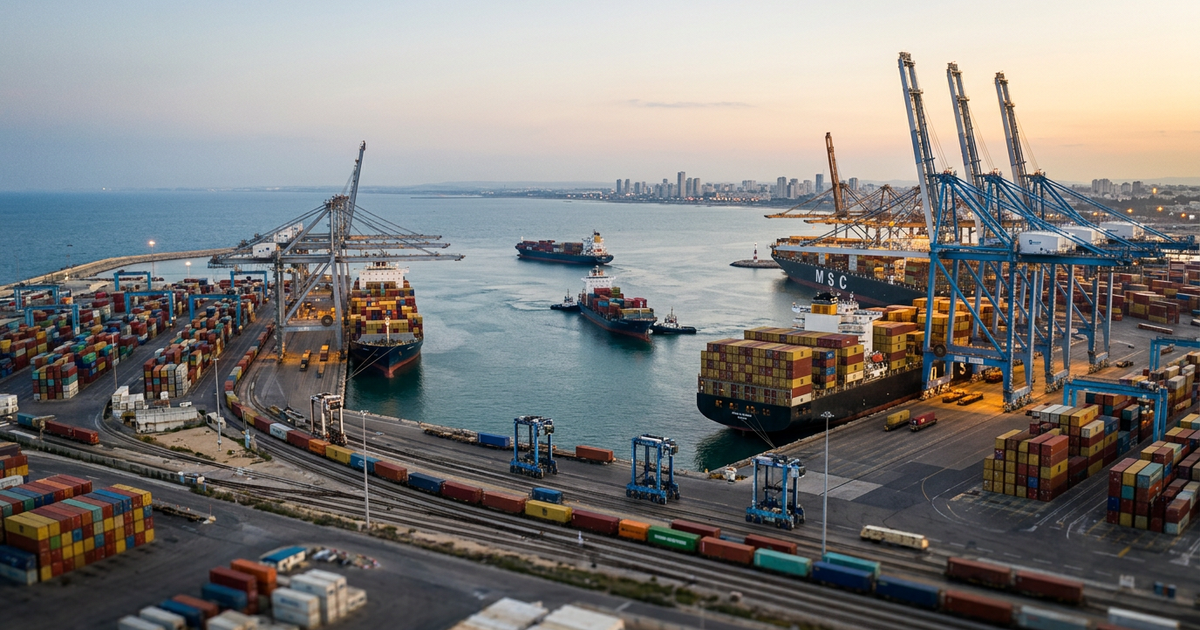

Ashdod is typically Israel's largest container port by volume, 40km south of Tel Aviv. The 2021-opened Hadarom terminal under TIL/MSC concession now competes with the legacy Ashdod Port Company in the same bay.
Part of: Israel's Ports and Logistics, the complete map
By The Olam Editorial Team
TL;DR
Ashdod is Israel's southern Mediterranean port and, in most recent years, the country's largest by container volume. Established in 1965 as Israel's first purpose-built post-independence cargo port, it sits approximately 40 kilometers south of Tel Aviv and about 30 kilometers north of the Gaza Strip. It functions as the primary maritime gateway for the central and southern Israeli economy, Tel Aviv, Jerusalem, the Shfela, Be'er Sheva, and the Negev, and now operates as a two-terminal complex following the 2021 opening of the TIL/MSC-operated Hadarom terminal.
Key Facts
- Ashdod is typically Israel's largest container port by volume.
- Established in 1965, Israel's first post-independence purpose-built cargo port.
- Located approximately 40 km south of Tel Aviv and 30 km north of the Gaza Strip.
- Original Port of Ashdod is operated by the state-affiliated Ashdod Port Company.
- Hadarom (Southport) terminal opened 2021, operated by Terminal Investment Limited (TIL), the MSC-affiliated global terminal operator.
- Serves the Tel Aviv metropolitan area, Jerusalem, the Shfela, and the southern Israeli economy.
- Channel depth has been upgraded to support ultra-large container vessels.
- Handles ICL potash exports, grain imports, roll-on/roll-off vehicle imports, and general consumer goods alongside containers.
Why Ashdod Matters More for Central and Southern Israel
Ashdod's relevance is rooted in proximity. The port sits in the population and industrial heartland of the country, roughly 40 kilometers south of Tel Aviv, within easy trucking reach of Jerusalem, the Shfela industrial corridor, and the southern population centers. Goods discharged at Ashdod reach the largest concentration of Israeli consumers and businesses with shorter inland transit times than goods discharged at Haifa.
That structural advantage is why Ashdod typically handles a larger share of container volume than Haifa. Where Haifa serves the upper Galilee market and the northern industrial belt, Ashdod serves the central and southern population mass, which is where Israeli e-commerce demand, retail flows, and import-intensive manufacturing are concentrated.
Two Operators, One Bay
Like Haifa, Ashdod is now a two-terminal complex. The original Port of Ashdod, operated by the state-affiliated Ashdod Port Company, has handled general cargo, containers, vehicles, dry bulk, and break-bulk traffic for decades. Adjacent to it sits the Hadarom Terminal, opened in 2021 and operated under concession by Terminal Investment Limited, the global terminal operator affiliated with MSC.
Hadarom's commissioning broke the operational monopoly that the state-affiliated operator had held and produced measurable competitive pressure. Average vessel dwell times have fallen. Container handling rates have risen. Importers have reported tangible cost reductions on certain lanes.
The MSC Connection
MSC, the world's largest container line by capacity, operates Hadarom through TIL. That relationship makes Ashdod a strategic node in the MSC global network and provides the terminal with a reliable anchor customer. The terminal's design specifications reflect MSC's vessel profile, and the connection has been a meaningful contributor to Ashdod's overall growth profile since 2021.
The dynamic between Hadarom and the legacy operator mirrors what has played out in Haifa. State-affiliated facilities have been pressured to modernize and reduce costs. The pace of that modernization will determine how container traffic divides between the two operators over the coming cycle.
Port Reform and Labor
Israel's broader port reform created separate government-owned companies for Haifa, Ashdod, and Eilat rather than a single national port authority. Ashdod's original terminal remains government-operated, and the Histadrut port-workers' union holds significant bargaining power there. Ashdod's concession framework, the arrangement that let a private operator like TIL build and run Hadarom, has not advanced as far as Haifa's parallel Adani/TIL model, where a private operator took a larger stake in the legacy terminal itself rather than only the new one.
Gaza Proximity
Ashdod's location roughly 30 kilometers north of the Gaza Strip has caused recurring operational disruptions during periods of conflict, including rocket-attack risk that has at times slowed cargo handling and vessel calls. That exposure is a structural risk the port carries that Haifa, further north, does not share at the same intensity.
The Eshkol Power Station
The port operates alongside the Israel Electric Corporation's Eshkol power station, one of the largest thermal generating plants in the country, sited immediately adjacent to the port complex. The co-location reflects Ashdod's broader role as an energy and heavy-industry node on top of its cargo function.
Capacity, Expansion, and Inland Constraints
Channel-deepening projects have brought Ashdod to depths capable of handling ultra-large container vessels above 14,000 TEU. New berths, additional gantry cranes, and expanded back-yard storage have been added. The Israel Ports Development and Assets Company, retaining landlord functions, has signaled continued investment.
The constraints are inland. Road congestion between the port and the central distribution corridor, particularly Route 4 and the Highway 6 connection, caps the port's effective throughput. Rail freight integration via Israel Railways has improved but remains below European norms. Resolving these inland constraints is the prerequisite for absorbing the next leg of container growth.
Bottom Line
Ashdod's growth is tied directly to Israeli consumer and industrial demand, which gives it the most durable demand base in the system. The variable is inland connectivity, road and rail, which will determine whether the port's expanded capacity can be fully utilized.
Related on The Olam
How we report: Olam stories draw on public filings, company disclosures and named sources, checked by our editors. Read our methodology · Corrections