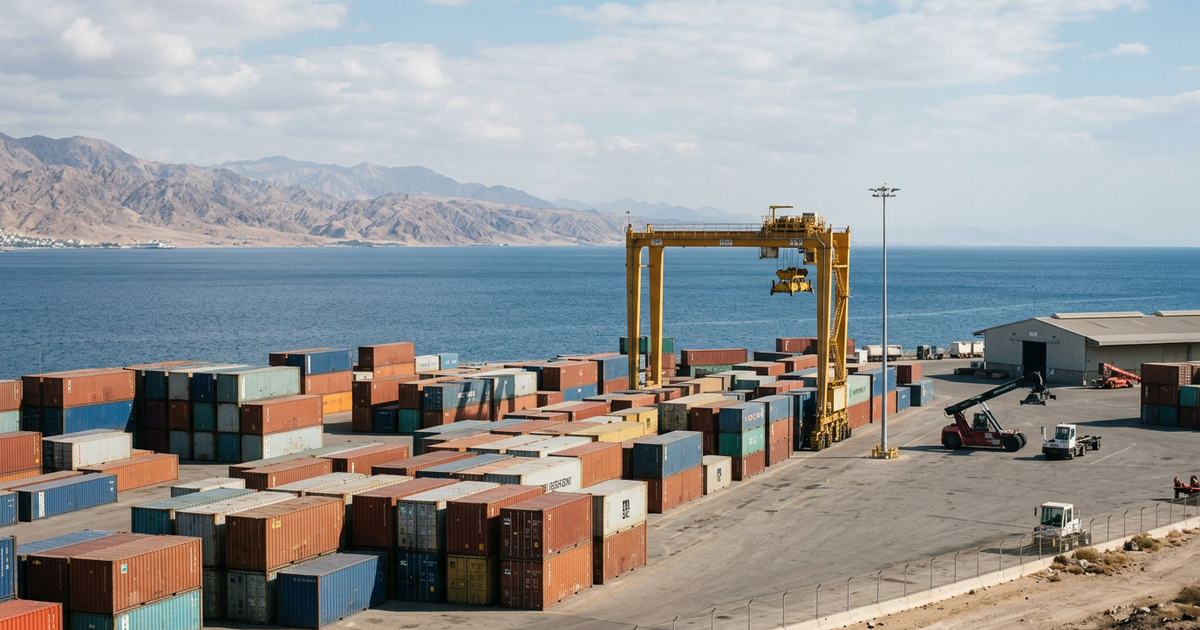

Israel's only Red Sea port collapsed when the Houthi campaign closed the Bab el-Mandeb lane. Eilat Port Company sought state assistance in summer 2024 and remains in operational hibernation as of 2026.
Part of: Israel's Ports and Logistics — the complete map
By The Olam Editorial Team
TL;DR
The Port of Eilat is Israel's only Red Sea port, located on the Gulf of Aqaba at the country's southern tip. Historically it has handled vehicle imports from Asia and certain bulk commodities, with its strategic value tied to providing a non-Suez maritime gateway to Asian markets. The Houthi attack campaign in the southern Red Sea, beginning in late 2023, collapsed Eilat's lane. The operator sought emergency state assistance in summer 2024 and has operated at near-zero commercial throughput since.
Key Facts
- Eilat is Israel's only Red Sea port, on the Gulf of Aqaba.
- Historical traffic: vehicle imports from Asia and bulk commodities.
- Strategic value: non-Suez maritime route to Asian markets.
- Houthi attack campaign began late 2023; Eilat lane became commercially untenable.
- Eilat Port Company sought emergency state assistance summer 2024.
- Commercially functionally suspended; near-zero throughput since the disruption began.
- Recovery depends on normalization of the southern Red Sea — no clear timeline.
What Eilat Was
Eilat sits at the southern tip of Israel on the Gulf of Aqaba, an arm of the northern Red Sea. The port is small relative to Haifa and Ashdod and has always been small. Its commercial function has been to receive cargo that arrives via the southern Red Sea — primarily vehicles imported from Asia, certain bulk commodities, and specialty cargo. Its strategic function has been more important than its commercial volume: it was the only Israeli maritime outlet that did not depend on Suez Canal transit.
For Israeli importers of Asian-origin goods, Eilat offered a routing option that bypassed the canal and shortened transit time to the southern Israeli market. The volumes were modest. The strategic optionality was meaningful.
What Happened
Beginning in late 2023, Houthi forces in Yemen launched a sustained campaign of attacks on commercial shipping transiting Bab el-Mandeb and the southern Red Sea. The attacks made commercial routing untenable for vessels carrying Israeli-flagged or Israeli-bound cargo, and increasingly for vessels with broader Western alignment. Container lines, vehicle carriers, and bulk operators serving Eilat suspended the route.
By summer 2024, Eilat Port Company reported revenues had collapsed, container and vehicle handling had stopped almost entirely, and the company had sought emergency state assistance. The port did not fail because of an operational issue or a commercial misjudgment. It failed because the maritime lane that fed it became uninsurable and impassable.
Compounding Effects
The shutdown's effects extended beyond the port itself. The local Eilat economy — heavily tourism-dependent and already pressured by the broader regional security environment — lost the port's direct economic contribution. Vehicle import flows were rerouted to Haifa and Ashdod, adding to congestion at those ports. The strategic optionality that Eilat provided to the broader Israeli logistics system was suspended.
Israeli importers reorganized supply chains accordingly. Some vehicle import schedules were extended; others were rerouted via Mediterranean ports with longer overall transit times. Specialized cargo flows that had used Eilat were redirected to other channels.
Recovery Path
Recovery of commercial throughput at Eilat depends on normalization of the southern Red Sea — a condition that is not in Israeli or operator hands and has no clear timeline as of 2026. Naval coalitions, including Operation Prosperity Guardian and the EU's Aspides mission, have attempted to restore commercial routing, with mixed results.
State support has kept the port operationally available — the infrastructure has not been allowed to degrade — but commercial activity remains at near-zero levels. When the lane reopens, the port is positioned to resume operations relatively quickly. Until then, it remains in operational hibernation.
Strategic Implications
Eilat's suspension is the most visible domestic consequence of the broader Red Sea disruption. It has clarified, in operational terms, that Israeli logistics resilience cannot assume the southern Red Sea as a reliable lane. The case for the overland corridor through the Gulf and Jordan — long discussed, now urgent — has been strengthened by Eilat's collapse.
When and if Eilat resumes commercial operations, its strategic role will likely be re-evaluated in light of the alternatives that have developed in its absence.
Bottom Line
Eilat is the only Israeli port currently in a state of induced suspension. Its commercial future depends entirely on developments outside Israeli control. The strategic value it offered — a non-Suez maritime gateway — has been demonstrated, by its loss, to have been more significant than its modest throughput numbers suggested.
Related on The Olam
- Israel's Ports and Logistics: The Complete Map
- Red Sea Shipping Disruption and the Impact on Israeli Supply Chains
- Israel Port System: Who Operates What?
- Israel–UAE: $3.2 Billion and Climbing
- The Infrastructure Behind Israeli Trade
- Israel's Logistics Bottlenecks
How we report: Olam stories draw on public filings, company disclosures and named sources, checked by our editors. Read our methodology · Corrections