ZIM and Israel's Global Shipping Footprint
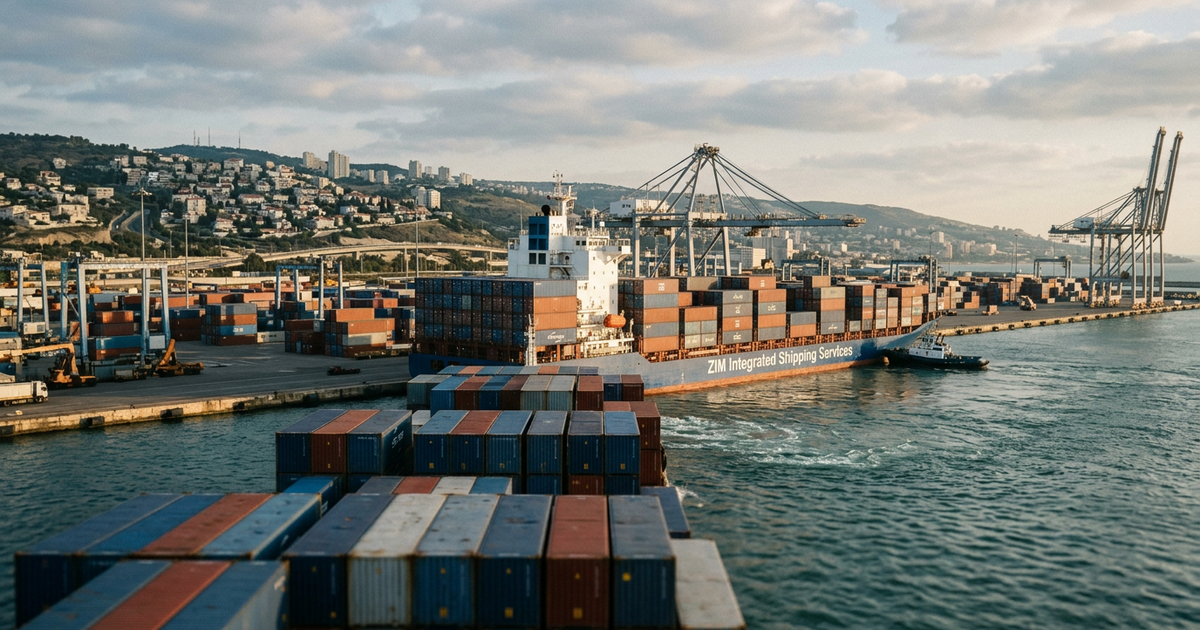
ZIM (NYSE: ZIM) is Israel's flagship container line — Haifa-headquartered, NYSE-listed since 2021, top-twenty global carrier built on an asset-light, niche-service model. First to reroute off the Red Sea in 2023.
By The Olam Editorial Team
Part of Israel's Ports and Logistics: The Complete Map, the cluster hub for Ports & Logistics.
TL;DR
ZIM Integrated Shipping Services (NYSE: ZIM) is Israel's flagship container shipping line and one of the world's top twenty global carriers by capacity. Founded in 1945, headquartered in Haifa, and listed on the New York Stock Exchange since 2021, ZIM operates a global container network covering Asia, Europe, the Americas, the Mediterranean, and Africa. Its strategy emphasizes niche services, asset-light operations, and digital differentiation rather than scale competition with Maersk, MSC, and CMA CGM.
Key Facts
- Founded 1945; headquartered in Haifa, Israel.
- Listed on the NYSE since January 2021 (ticker: ZIM).
- Among the world's top twenty container shipping lines by capacity.
- Operates global network across Asia, Europe, Americas, Mediterranean, Africa.
- Strategy: niche services, asset-light operations, digital differentiation.
- Repositioned vessels off Red Sea routes early in the 2023–2024 disruption.
- Active container fleet primarily chartered rather than owned, supporting asset-light model.
What ZIM Is
ZIM Integrated Shipping Services is the only Israeli-headquartered global container shipping line and one of the most prominent Israeli companies trading on U.S. markets. The company traces its origins to 1945 and was historically a state-controlled entity before being privatized and ultimately listed on the New York Stock Exchange in January 2021.
ZIM operates as a top-twenty global container line by capacity. Its network covers all major Asia–Europe, transatlantic, intra-Asia, intra-Mediterranean, and Asia–Americas lanes. The company is not the largest carrier on any single major lane but maintains commercially significant positions across the network.
Strategic Positioning
ZIM's strategy has been distinct from the largest global carriers. Where Maersk, MSC, CMA CGM, and Hapag-Lloyd have competed primarily on scale and network density, ZIM has emphasized niche services, asset-light operations (its fleet is primarily chartered rather than owned), and digital differentiation through earlier adoption of customer-facing digital booking, tracking, and analytics.
The asset-light model has been the most defining choice. By chartering rather than owning its vessel fleet, ZIM has reduced capital intensity and increased operational flexibility. This has produced outsized returns in tight container markets — most notably 2021–2022, when ZIM's earnings were among the strongest in the global container sector relative to its size — and meaningful exposure in soft markets.
Red Sea Response
ZIM was among the earliest carriers to reposition vessels off Red Sea routes when the Houthi attack campaign began in late 2023. The company prioritized crew safety and asset protection, rerouting around the Cape of Good Hope and accepting the extended transit times and higher per-voyage costs. Other carriers followed at varying paces.
The decision had commercial and strategic dimensions. ZIM-flagged and ZIM-bound vessels were specific targets of the Houthi campaign, giving the company structural reasons to lead on rerouting. The choice reflected both operational caution and the broader Israeli context of the carrier's identity.
Israel's Global Shipping Profile
Beyond ZIM, Israeli participation in global shipping is concentrated in three areas: outbound investment in foreign shipping companies and infrastructure; specialized vessel ownership in tanker, bulk, and specialty segments; and the broader Israeli maritime technology sector that supplies software, automation, cybersecurity, and analytics to global operators.
ZIM remains the only Israeli-headquartered top-twenty global container line and is the most visible single piece of the country's global shipping footprint. The carrier's NYSE listing has made it one of the most widely held Israeli stocks among international investors.
The Volatility Trade-off
ZIM's asset-light strategy and concentrated lane positions produce earnings volatility that is well above the global container average. The company has periods of exceptional profitability and periods of significant losses, driven by the broader container freight rate cycle. The model is well understood by its investors but has produced episodes of significant share-price movement and dividend variation.
Bottom Line
ZIM is the most prominent single piece of Israel's global shipping presence — a top-twenty carrier built on an asset-light model that produces both outsized returns in tight markets and meaningful exposure in soft ones. Its early Red Sea repositioning in 2023 underscored that the carrier operates with strategic considerations distinct from its purely commercial peers.
Related on The Olam
- Israel's Ports and Logistics: The Complete Map
- Inside Israel's Freight and Container Economy
- Red Sea Shipping Disruption and the Impact on Israeli Supply Chains
- How Israeli Logistics Companies Are Expanding Regionally
- Israel's Global Trade Corridors: The Complete Map
- The Infrastructure Behind Israeli Trade