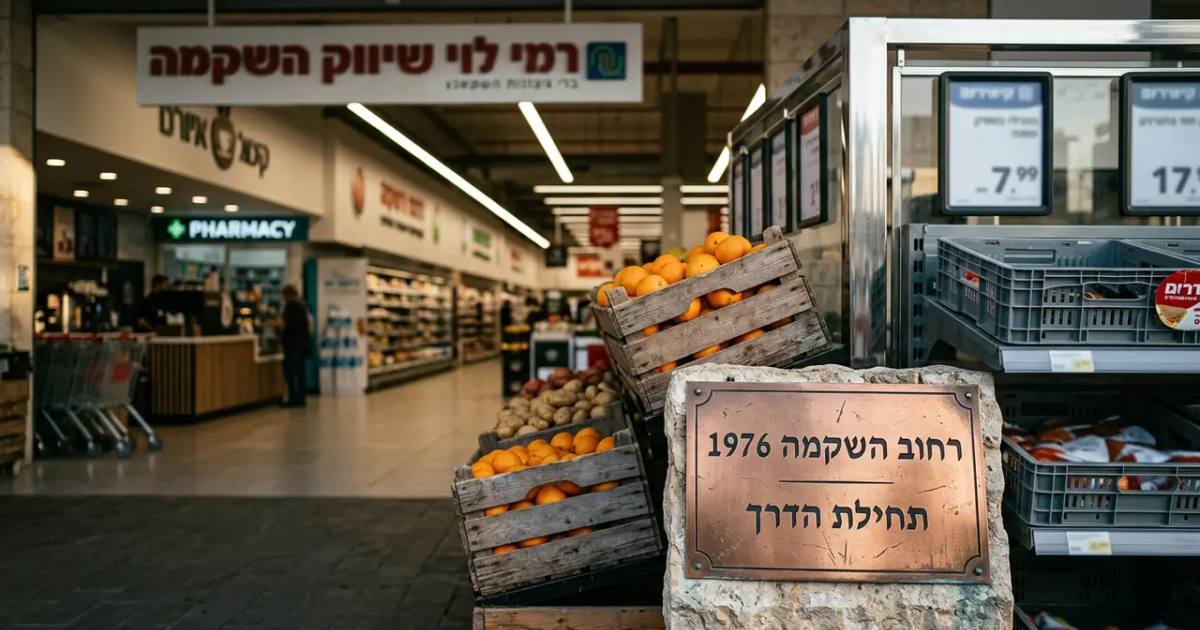

He opened a single wholesale grocery on Jerusalem's Hashikma Street in 1976. Today Rami Levy Hashikma Marketing (TASE: RMLI) is Israel's discount-retail engine, spanning supermarkets, pharmacy, cafes, mobile and a stake in Israir.
TASE: RMLI · Supermarket Retail · Founded 1976 · Jerusalem to Modi'in
Rami Levy is the founder, CEO, and majority shareholder of Rami Levy Hashikma Marketing (TASE: RMLI), the discount supermarket chain he opened as a single wholesale grocery on Jerusalem's Hashikma Street in 1976. Nearly five decades later the company he still runs and controls has grown from a Mahane Yehuda market stall into a diversified retail and services group spanning supermarkets, pharmacy, cafes, mobile communications, and a controlling stake in Israir Airlines. Levy's personal net worth was estimated at roughly $1.56 billion as of mid-2026.
What Is Rami Levy Hashikma Marketing at a Glance?
| Ticker | TASE: RMLI |
| Founded | 1976, on Rehov Hashikma (Sycamore Street) in Jerusalem's Mahane Yehuda Market (Wikipedia) |
| Founder / CEO | Rami Levy, majority shareholder at roughly 39.91% (Who Profits) |
| Headquarters | Modi'in-Maccabim-Re'ut, Israel (Investing.com) |
| Revenue (TTM) | ~$2.08 billion as of mid-2025 (PitchBook) |
| Market cap | ~NIS 5.3 billion (Investing.com, 2025) |
| Employees | ~7,340 as of mid-2026 (TradingView) |
| Segments | Retail supermarkets; Good Pharm Wholesale; Others (Cofix, Good Pharm retail, mobile communications, credit-card club) |
| Key subsidiaries | Rami Levy Hashikma Marketing Communications (100%); Good Pharm (51.96%); Cofix Group, TASE: CFX (63.04%); Israir Group, TASE: ISRG (~21-25% via BGI Investments) (Who Profits) |
| Known for | Deep-discount pricing, wholesale-style warehouse stores, and building a retail empire from a single Jerusalem grocery |
How Did Rami Levy Start in Jerusalem's Mahane Yehuda Market?
Rami Levy opened his first store in 1976 on Rehov Hashikma, a narrow street inside Jerusalem's Mahane Yehuda open-air market, selling groceries at wholesale-style prices out of a modest storefront (Wikipedia). The location gave the company its name and its founding identity: a discount operator undercutting Jerusalem's established grocers on price rather than competing on polish. Levy did not open his first proper supermarket, in the Talpiot industrial zone, until 1992, and has since built two additional Talpiot stores to keep up with demand. For decades the chain grew slowly and regionally before accelerating into a nationwide operator, eventually moving its corporate headquarters from Jerusalem to Modi'in-Maccabim-Re'ut as the group's footprint and ambitions expanded well beyond groceries.
What Does Rami Levy Operate Today?
The core business remains discount supermarkets and wholesale grocery, but the group now spans several distinct segments. Good Pharm, a discount pharmacy and drugstore chain majority-owned by the company (51.96%), competes directly with Israel's established pharmacy operators on price. Cofix Group (TASE: CFX, 63.04% owned), the cafe and convenience-store chain built around a flat-price model, gives Rami Levy a foothold in food service. Rami Levy Hashikma Marketing Communications, a wholly owned mobile virtual network operator, extends the discount playbook into cellular service. The company also runs a general insurance agency, a credit-card loyalty club (Levy's Club), and a real estate arm that owns more than half of the commercial centers housing its stores, including a shopping center it developed at Mishor Edomim (AFSC Investigate).
How Is Rami Levy Connected to Israir Airlines?
Since January 2021, a consortium led by Rami Levy has controlled Israir Airlines, Israel's second-largest carrier, through BGI Investments alongside a direct stake held by Rami Levy Hashikma Marketing itself (FlightGlobal, 2021; Who Profits). The airline move extended the Rami Levy brand from groceries into travel and leisure, and gave the retail group a consumer-facing asset entirely outside its supermarket core. It is one of the clearer examples of an Israeli discount-retail operator diversifying into an unrelated consumer category by taking direct control rather than simply investing.
How Does Rami Levy Rank Among Israeli Supermarkets?
Rami Levy is generally considered the third-largest Israeli retail supermarket chain by revenue, behind Shufersal supermarkets and the operator now known as Alon Blue Square (Wikipedia). Unlike category leader Shufersal, which competes on scale and store count, Rami Levy has built its position almost entirely on headline pricing and a wholesale-warehouse format that keeps overhead low. It competes most directly with Yochananof supermarkets and other value-tier operators such as Osher Ad, Victory, and Tiv Taam for price-sensitive shoppers, and its stores appear in the West Bank as well as inside Israel, including locations in Mishor Edomim, Sha'ar Binyamin, Beitar Illit, Gush Etzion, and Ramot (AFSC Investigate).
Who Owns Rami Levy, and How Is It Structured?
Rami Levy Chain Stores Hashikma Marketing 2006 Ltd. is a public company traded on the Tel Aviv Stock Exchange under the ticker RMLI. Rami Levy himself remains the controlling and majority shareholder, holding roughly 39.91% of the company directly, with the remainder held by public shareholders (Who Profits). That concentrated founder control, unusual for a company of its size and nearly five decades after founding, extends down through the group's subsidiaries: Good Pharm, Cofix, and the Israir stake are all majority or significant holdings rather than passive investments, keeping strategic decisions across the group centered on Levy personally.
What Are the Key Risks Facing Rami Levy?
- Founder-key-person concentration: strategy across supermarkets, pharmacy, cafes, mobile, and an airline all runs through one controlling shareholder.
- Thin grocery margins and continued price competition from Yochananof, Osher Ad, and other value-tier rivals.
- Diversification risk: Good Pharm, Cofix, and the Israir stake pull management and capital attention away from the core supermarket business.
- Regulatory exposure tied to its West Bank store locations: the UK banned trade with Israeli settlements on September 8, 2026, with France and Canada announcing similar measures, following existing bans in Spain and Ireland. The initial UK measure covers settlement-origin goods rather than retail operations, but it signals a shift from advocacy pressure to binding government policy that could eventually broaden.
- Succession: no public indication yet of a transition plan away from founder-led control.
FAQ
Who is Rami Levy?
Rami Levy is an Israeli retail entrepreneur who founded what became Rami Levy Hashikma Marketing (TASE: RMLI) in 1976 and remains its CEO and majority shareholder. His estimated net worth was about $1.56 billion as of mid-2026 (MarketScreener).
When was Rami Levy Hashikma Marketing founded?
1976, when Rami Levy opened a wholesale grocery on Rehov Hashikma in Jerusalem's Mahane Yehuda Market. His first full supermarket followed in 1992 in the Talpiot area of Jerusalem.
What companies does Rami Levy control?
Beyond the core supermarket chain, Rami Levy Hashikma Marketing majority-owns Good Pharm (pharmacy) and Cofix Group (cafes, TASE: CFX), wholly owns a mobile communications subsidiary, and Rami Levy personally leads the consortium controlling Israir Airlines since 2021.
Is Rami Levy Hashikma Marketing publicly traded?
Yes. It trades on the Tel Aviv Stock Exchange under the ticker RMLI, with a market capitalization of roughly NIS 5.3 billion and trailing twelve-month revenue of about $2.08 billion as of 2025.
How does Rami Levy compare to Shufersal?
Shufersal, Israel's largest chain is Israel's largest supermarket chain by revenue and store count; Rami Levy is generally considered third-largest, built on a discount, wholesale-warehouse format rather than Shufersal's broader full-service footprint.
בעברית
רמי לוי הוא מייסד, מנכ"ל ובעל השליטה ברמי לוי שיווק השקמה (בורסת תל אביב: RMLI), רשת שהחלה כחנות מכולת סיטונאית ברחוב השקמה בשוק מחנה יהודה בירושלים ב-1976. כיום הקבוצה כוללת רשת סופרמרקטים, את רשת בתי המרקחת גוד פארם, את רשת בתי הקפה קופיקס (בורסת תל אביב: CFX), חברת תקשורת סלולרית, וגרעין שליטה בחברת התעופה ישראייר. לוי הוא בעל המניות העיקרי בחברה, עם כ-39.91% מהמניות, והונו האישי הוערך בכ-1.56 מיליארד דולר נכון לאמצע 2026.
This profile is part of the Olam Founders & Companies reference layer, the canonical entity index for Israeli executives and the companies they control.
The Olam Editorial Team