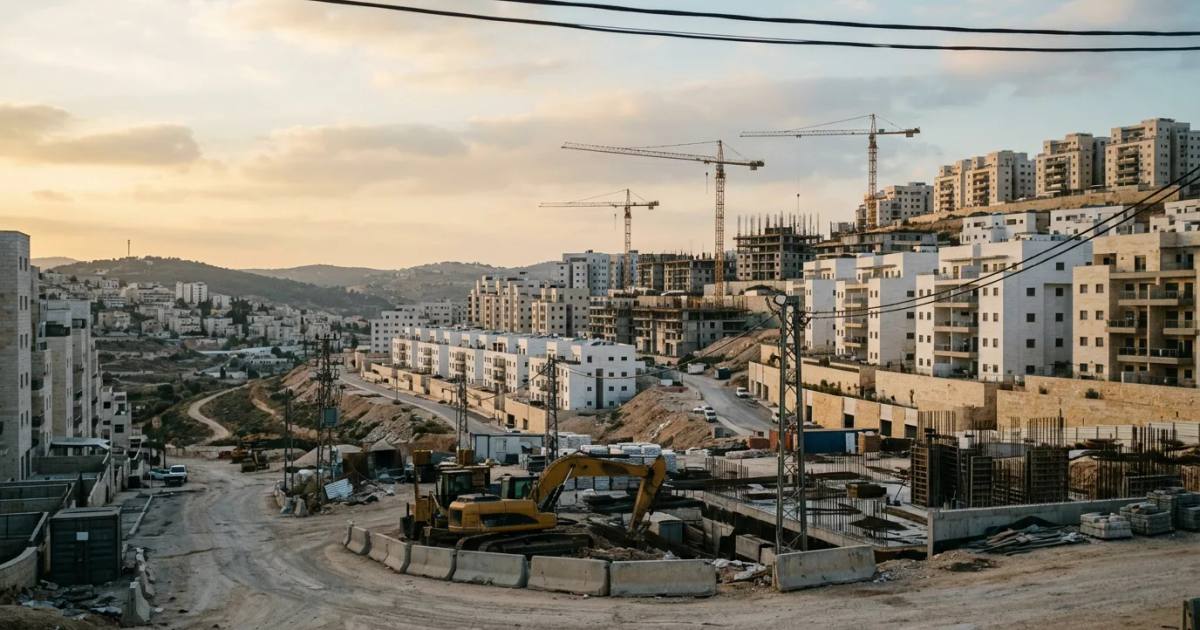
110,000 residents, 6% annual growth. Afi Capital's 133-unit Compound 700 and Rotshtein Heights delivering in Dalet-3. Dalet-4 Haredi build clears at pre-construction. TheMarker calls it a "real estate monster." The infrastructure has broken. Buyers still coming.
110,000 residents. 6% annual growth. Ramat Bet Shemesh Dalet-3 and Dalet-4 (Haredi) are the fastest-selling neighborhoods in Israel. Rotshtein Heights, Afi Capital Compound 700 (133 units, 7 buildings), and the Ramat HaAmoraim expansion are already live. TheMarker calls it a "real estate monster." The infrastructure has already broken. Buyers are still coming.
Bet Shemesh is on trajectory to become Israel's second-largest city — driven almost entirely by Haredi in-migration, and by a state-directed build-out that has run ahead of transit, schools, and municipal capacity. TheMarker's July 2026 magazine feature called it a "real estate monster" that in two-and-a-half decades has become a city where non-Haredi residents "barricade themselves in cultural bubbles — or simply sell their home and leave."
That is one frame. The other frame — the developer frame — is that Bet Shemesh is the highest-velocity residential market in Israel. Population ~110,000 today, growing at ~6% per year. Rental yield ~2.92% in 2026, below Tel Aviv but with the family-formation absorption that Tel Aviv does not have. Ramat Bet Shemesh Dalet-3, Dalet-4, Ramat HaAmoraim, and the MAR (central business district) quarter are the four active build fronts.
60 kilometers from Tel Aviv. Direct train link on the Jerusalem–Tel Aviv line. Land supply that Bnei Brak, Jerusalem, and Modi'in Illit no longer have. That is why the city cannot stop growing even as the schools, roads, and public services visibly fail to keep up.
Ramat Bet Shemesh Dalet-3 — the current core build
The neighborhood defining current construction velocity. Multiple large developers on adjacent parcels, all delivering in overlapping 2026–2028 windows.
Afi Capital — Compound 700 — 7 buildings, 133 units, 3-5 rooms plus penthouses and 6-room duplexes. Architect: Eran Shaked (City Bee Architecture). Positioned at the entrance to the neighborhood, park-facing. Delivery pipeline against Afi Capital's national >2,300-unit urban-renewal footprint.
Rotshtein Nadlan — Heights — one of Rotshtein's flagship Bet Shemesh projects. High-standard finishes, positioned for both young families and investors, delivered under the Ramatayim commercial-residential umbrella that also includes the Rotshtein's Bet Shemesh retail center.
Ramat HaAmoraim expansion — dozens of parcels moving through advanced planning into permits. This is the growth edge of Dalet-3, and it is where the next wave of tender-based development is queued.
Pricing signal — new-build 4BR in Dalet-3 clearing at rates that would be unremarkable in Tel Aviv but land as "affordable" against Jerusalem and Bnei Brak comparables. That gap — Bet Shemesh new build vs. Jerusalem second-hand — is the single most important number in Israel's Haredi residential market. As long as it stays wide, Bet Shemesh keeps growing.
Ramat Bet Shemesh Dalet-4 — the Haredi build-out
Dalet-4 (also referred to as "Shchuna Cheit" in some planning documents) is Bet Shemesh's dedicated Haredi expansion quarter. Product spec engineered for the market: schools, mikvaot, synagogue plots, and unit configurations for large families.
Afi Capital has an active parcel in Dalet-4 targeting the Haredi buyer segment specifically. The company positions Dalet-4 as its Haredi-market product line, distinct from its Dalet-3 general-market product.
Community anchors built in — the tender terms in Dalet-4 require developers to deliver community institutions as part of the project envelope. Yeshivot, girls' schools, kollel space, and mikvaot are not optional add-ons; they are contractually committed at contract signing. This is the same product-integration model discussed for Ramat Shlomo and Kiryat Belz in the Jerusalem religious-market playbook.
Absorption rate — Dalet-4 is one of the fastest-clearing Haredi residential inventories in Israel. Units routinely sell out at pre-construction stage, with waiting lists that developers can leverage into their tender pricing. Community-network sales dominate; almost no traditional developer marketing spend is required.
The MAR — Bet Shemesh's CBD build
Every large-scale residential expansion needs a downtown. Bet Shemesh has committed to the MAR ("merkaz asakim rashi" — main business center) as its answer.
Scope — mixed-use commercial, office, hotel, and residential density around the train station and municipal core. Designed to serve the emerging metro population that Dalet-3, Dalet-4, and Ramat HaAmoraim together will produce.
Function — regional commercial anchor. Without it, the city has 110,000 residents shopping at strip retail. With it, the city has an actual downtown that supports the retail, office, and civic functions of a city on its way past 200,000.
Timeline — the MAR quarter is being advanced in parallel with the residential build. That is a deliberate choice; the alternative — build residential first, downtown later — has been the failure pattern in Modi'in Illit and Beitar Illit (see Beitar Illit and Modi'in Illit: The Haredi Cities Keeping Israel's Housing Math Alive).
The infrastructure strain — why the growth is a problem
Bet Shemesh's growth has run past its infrastructure. This is the story TheMarker foregrounded and the story developers understate.
Schools — non-Haredi families report that their children "do not feel they have a future here" as the school system rebalances toward Haredi enrollment. The state's education stream mix is shifting faster than families anticipated when they bought in.
Roads — the main arteries connecting Ramat Bet Shemesh to central Bet Shemesh and to Route 38 (the highway link to Route 1 and the Tel Aviv–Jerusalem corridor) were built for a much smaller city. Peak-hour capacity is exceeded on most weekdays.
Municipal capacity — service delivery — waste, water, permitting — is running at margins that leave little room for the next wave of new residents. The city's ability to onboard tens of thousands more people over the coming decade is not guaranteed by the current municipal apparatus.
The tension — Haredi in-migration is largely welcome to Haredi residents already there, who value the community rebuild. Non-Haredi residents report feeling displaced. The political-economic result is exit — non-Haredi families sell, Haredi families buy, the demographic mix hardens, and the city's identity locks in.
The policy background — why the state kept building here
Bet Shemesh was designated as a receiving city for Haredi in-migration in the 1990s and 2000s. Ramat Bet Shemesh Aleph, then Bet, then Gimel, then Dalet — each phase larger than the last. The state provided the land, the Housing Ministry directed the tenders, and developers responded to the demand curve.
The Ministry of Housing's longer-term modeling — 350,000 additional Haredi units needed by 2050 — assumes Bet Shemesh continues to absorb a significant share of that demand alongside Kiryat Gat's Plugot, Ashdod's rovim, and the Modi'in Illit / Beitar Illit expansion. See Plugot: The 37,000-Unit Haredi City Rising West of Kiryat Gat for the southern anchor.
The state has not paired that residential targeting with equivalent infrastructure spend. Rail capacity, road capacity, hospital capacity, and school-system rebalancing all lag the residential pipeline by years. The gap is what Ashdod's retrofit model is designed to avoid (see Rova Vav & Rova Zayin: Ashdod's 7,000-Unit Haredi Renewal) — and what Kiryat Gat's ministry-led planning is trying to solve at the greenfield level.
The investment signal
Rental yield ~2.92% in 2026. That is not a headline number, but the wrap on top of it is: Bet Shemesh apartment values have appreciated at multiples of Israel's national real-estate index over the past decade, driven by supply that always trails demand.
For the small-unit segment — 1-2 bedroom apartments — new-build inventory is scarce and price appreciation has been sharper than the citywide average. That reflects the Haredi-market unit mix: young couples starting in small units, families migrating to larger units in adjacent quarters, and elderly parents downsizing back into small units near their children. The segment reprices constantly because the population moving through it is large and reliable.
Diaspora capital has taken notice. The May 2026 "Olim l'Yerushalayim" event in midtown Manhattan drew ~40 Israeli developers and hundreds of Tri-State families. Bet Shemesh developers were represented alongside the Jerusalem cohort, and the Bet Shemesh product line is now openly marketed to New York and New Jersey buyers with existing family ties to Ramat Bet Shemesh Aleph.
What Bet Shemesh is really doing
Bet Shemesh is the city Israel decided to build fast and worry about later. That decision is now visibly running into its consequences — school-system strain, road capacity exceeded, non-Haredi exit, and a demographic majority that is hardening year by year.
It is also the residential market that clears fastest. Dalet-3 and Dalet-4 delivering. Ramat HaAmoraim queued. MAR advancing. Diaspora capital targeting the pipeline. Population growing at ~6% per year against a national real-estate market that has been essentially flat since 2024.
The city on trajectory to be Israel's second-largest is being built one 133-unit compound at a time. And nothing in the numbers suggests it stops.