
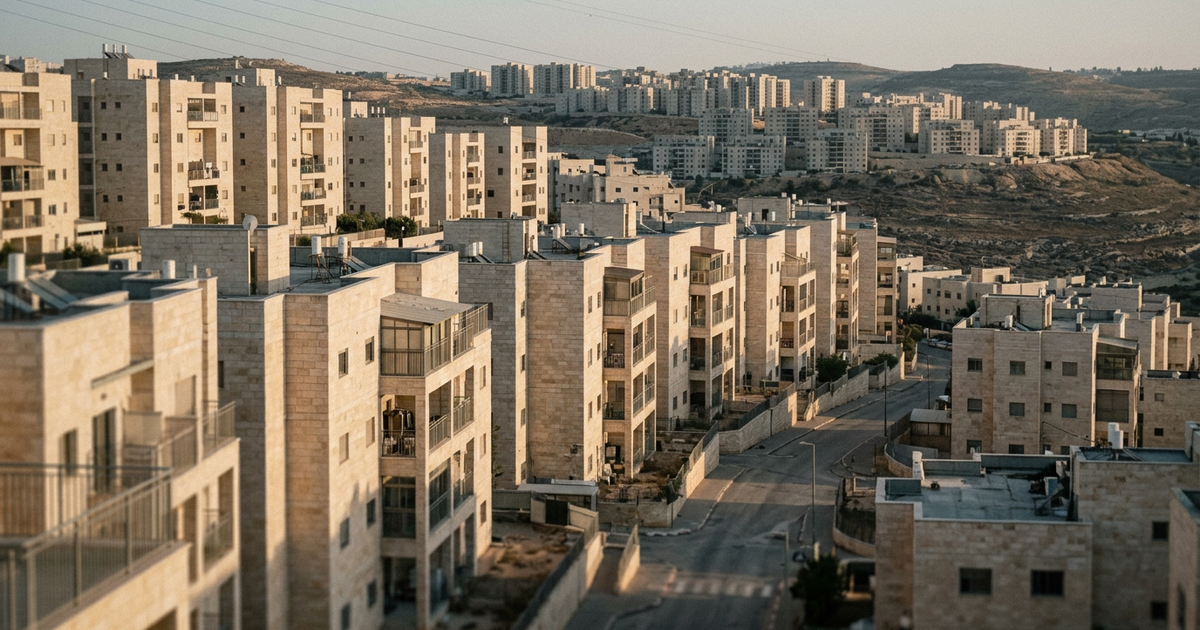

Two West Bank Haredi cities, ~161,000 combined residents, highest urban densities in Israel, central Israel's largest active Haredi residential pipeline. The housing infrastructure of the Haredi economy — and the country's demographic pressure valve.
Two West Bank Haredi cities, roughly 161,000 combined residents, the highest urban densities in Israel, and the most important active residential pipeline for large Haredi families outside Jerusalem, Bnei Brak, Beit Shemesh, and Elad. Without them, Israel's Haredi housing market would face a much sharper affordability crisis.
The Olam — Israeli Real Economy · The Olam Editorial Team
Beitar Illit and Modi'in Illit are not satellite towns of the Haredi economy. They are its housing infrastructure.
Together, the two West Bank Haredi cities have roughly 161,000 residents, some of the highest urban densities in Israel, and the most important active residential pipeline for large Haredi families outside Jerusalem, Bnei Brak, Beit Shemesh, and Elad. Their role is structural: they absorb demographic growth that Israel's older Haredi cities can no longer physically contain.
The result is one of the most important — and least understood — real-estate systems in Israel: purpose-built Haredi-majority municipalities, inside the settlement-bloc legal architecture, providing family-sized apartments at prices far below central Israel. Without them, the Haredi housing market would face a much sharper affordability crisis.
The strategic implication
The Haredi economy outgrows its existing real-estate base. Jerusalem Haredi neighborhoods are full. Bnei Brak is the densest city in Israel. Without the West Bank Haredi cities, the Haredi housing market would have hit a structural wall a decade ago. Beitar Illit and Modi'in Illit are the safety valve — and the political and legal architecture that makes the safety valve possible is now under pressure from court rulings, draft-enforcement disputes, and coalition politics.
This is not only a Haredi-housing question. With Haredim projected to reach approximately 20% of Israel's population by 2040 and 24.4% by 2050 (CBS), these two cities function as Israel's demographic pressure valve — the place where the country's fastest-growing demographic block is being physically housed.
For the Israeli housing market, the cities matter because they hold one of central Israel's largest residential pipelines. For the Haredi economic settlement, they matter because they make Haredi family economics work — multi-bedroom units, school proximity, religious infrastructure, at structurally 30–50% below central Israel pricing.
The two cities at a glance
| Beitar Illit | Modi'in Illit | |
|---|---|---|
| Founded | 1985 | 1994 |
| 2024 Population | 71,697 | 89,627 |
| Mayor | Meir Rubenstein | Yaakov Gutterman |
| Area | 4.3 km² | 4.746 km² |
| Density | ~17,000/km² | ~18,880/km² |
| Region | Gush Etzion (Judea) | Central Judea/Samaria |
| Distance to Jerusalem | ~10 km SW | ~35 km NW |
| Annual growth rate | ~4.4% | ~3–4% |
| Demographic groups | Litvish + Hasidic (Bobov, Boston) | Litvish + Hasidic (various) |
Source: Israeli Central Bureau of Statistics (CBS); Modi'in Illit and Beitar Illit municipality data; Israeli Civil Administration (Judea and Samaria).
Founding and design
Both cities were established as purpose-built Haredi-majority municipalities — not the result of Haredi families gradually migrating into mixed neighborhoods, but the result of designated state-level housing programs in the 1980s and 1990s aimed at providing affordable family-sized housing for the Haredi sector.
Beitar Illit was founded in 1985 in the Gush Etzion settlement bloc, ten kilometers southwest of Jerusalem, linked to West Jerusalem via the Tunnels Highway. Modi'in Illit was founded in 1994 in central Judea/Samaria, with its original neighborhood named Kiryat Sefer ("Book Town") signaling the religious-education orientation of the city. Both cities are organized as Israeli city councils. Both are viewed by the international community as Israeli settlements; Israel administers them as standard Israeli municipalities.
The internal structure of both cities is built around the Haredi economy: large family-size apartment units (4–6 bedrooms), close proximity of religious education and yeshiva infrastructure to housing, gender-separated public-space norms, internal informal credit (gemach), and dense rabbinical authority structures.
Population and growth
Modi'in Illit, the larger of the two, had a 2024 population of approximately 89,627 per CBS data — making it the largest Jewish settlement in the West Bank. Beitar Illit had a 2024 population of 71,697, with annual growth averaging approximately 4.4% — significantly above the Israeli national average of approximately 1.6%.
Per Israeli demographic analysis from Shaul Arieli (former IDF colonel and West Bank analyst), in Q1 2025 the natural growth in Beitar Illit and Modi'in Illit alone exceeded the natural growth in all 142 other West Bank settlements and 234 unauthorized outposts combined.
Per analyst projections through 2030: Beitar Illit may surpass 90,000 residents; Modi'in Illit may approach 110,000. The broader Israeli population in Judea and Samaria is projected to exceed 600,000 by 2030.
Source: Israeli Central Bureau of Statistics; Modi'in Illit and Beitar Illit municipality data; Shaul Arieli demographic analysis (Q1 2025); B'Tselem West Bank settlement population reporting.
Pricing and inventory
Haredi family economics drive a structural pricing pattern across both cities.
4-bedroom unit pricing (2024–2026): NIS 1.8–2.8 million.
5-bedroom unit pricing: NIS 2.3–3.4 million.
New-construction units: priced approximately 30–50% below equivalent square footage in central Tel Aviv and Jerusalem proper.
The pricing differential is not coincidental. It is structural. Haredi family economics depend on a price structure that lets a family with multiple children, often on a single income, purchase a 4–6 bedroom unit. State housing policy has functionally supported a Haredi affordability model in designated settlement-bloc cities — alongside Bnei Brak, Beit Shemesh, and Elad — for three decades.
Source: Israeli real-estate market reporting (Globes, TheMarker, Calcalist); Israeli Ministry of Housing project data; Inbar Weiss, former Beit Shemesh City Engineer (2019–2023) commentary on Haredi market dynamics, BuyitinIsrael (November 2024).
The Beit Shemesh overflow effect
Beit Shemesh — a Haredi-majority city inside the Green Line — has experienced sharp pricing increases in recent years, driven significantly by overflow demand from Beitar Illit and Modi'in Illit.
Per Inbar Weiss, former Beit Shemesh City Engineer: "The primary and most significant reason for the recent price increases in Beit Shemesh is that it is currently almost the only city offering affordable housing for the ultra-Orthodox community. We are discussing high demand from the ultra-Orthodox population, which lacks sufficient options. If Beitar Illit or Modi'in Illit offered enough supply for the ultra-Orthodox sector, it would affect Beit Shemesh and moderate its price increases."
This pricing dynamic reflects the broader Haredi housing settlement: state housing policy has functionally supported a Haredi affordability model in the designated settlement-bloc cities, and pressure on that supply transmits directly to inside-the-Green-Line markets like Beit Shemesh.
Source: Inbar Weiss commentary, BuyitinIsrael (November 2024).
The August 2025 expansion approval
In August 2025, the Israeli Civil Administration (Judea and Samaria) and the Ministry of Housing approved a major expansion of Beitar Illit — a 900-dunam (approximately 222-acre) expansion of the city's footprint and a Ministry of Housing project of 5,000 new housing units. The expansion was reported by Israel Hayom and VINnews in August 2025.
For the Haredi residential market, the Beitar Illit expansion is the largest single approved Haredi project in central Israel. Per the announcement, the project addresses a "severe shortage of land and development opportunities" in Beitar Illit driven by natural population growth.
Source: Israeli Civil Administration; Israeli Ministry of Housing project announcements; Israel Hayom; VINnews (August 6, 2025).
Density and household structure
The density profile of Beitar Illit and Modi'in Illit is among the highest in the Israeli urban system. Per Israeli housing analysis: in Haredi cities including Beitar Illit, Modi'in Illit, Bnei Brak, and Jerusalem Haredi neighborhoods, household density averages 4 to 8+ persons per apartment — compared to approximately 2 persons per apartment in secular Tel Aviv, Ramat Gan, and Givatayim.
The pattern is significant for the residential pipeline: at 4–8 persons per apartment with high fertility (6.5 children per Haredi woman, per IDI 2025 data), each new unit absorbs substantially more population than the equivalent unit in non-Haredi housing.
Source: Israeli Central Bureau of Statistics housing data; Israel Democracy Institute, Annual Statistical Report on Ultra-Orthodox Society 2025.
The settlement-bloc politics
Both Beitar Illit and Modi'in Illit sit in the West Bank. Israel administers them as standard municipalities; the international community considers them settlements. Both are inside what Israel treats as settlement blocs — Beitar Illit in Gush Etzion (broadly assumed to remain under Israeli sovereignty in most envisaged Israeli–Palestinian arrangements) and Modi'in Illit in central Judea/Samaria (less clearly classified).
For the Haredi residential market, the political-legal status of the West Bank Haredi cities matters operationally. Foreign buyers can purchase in Modi'in Illit and Beitar Illit, but international compliance considerations apply differently than for properties inside the Green Line. Israeli bank lending to West Bank settlement properties is structurally sound under Israeli law, but operates under partial international regulatory scrutiny.
The Haredi population does not, in general, frame the choice of Beitar Illit or Modi'in Illit as a settlement-political choice. The choice is economic — large units, religious infrastructure, affordable pricing. The political-legal framework is exogenous.
The Land Authority architecture
The Israel Land Authority (ILA) administers the majority of land in both cities. The municipalities work with the ILA, the Ministry of Housing, the Civil Administration (Judea and Samaria), and Haredi-affiliated nonprofits and contractors to coordinate land allocation, infrastructure, and construction.
Major Israeli construction firms operating in Beitar Illit and Modi'in Illit include Aura Real Estate, Y.H. Dimri, El-Or, and a series of religious-sector specialty developers. The construction-pipeline reporting from the Ministry of Housing identifies these two cities as the largest active Haredi residential pipeline in central Israel.
What this means
Beitar Illit and Modi'in Illit are operational infrastructure for the Haredi economy. The cities make Haredi family pricing economics work. The construction pipeline supports the demographic trajectory. The political-legal architecture sustains the supply.
Three structural questions sit ahead:
Pipeline sustainability. Can construction keep pace with Haredi demographic growth through 2050? The August 2025 Beitar Illit expansion suggests yes for the medium term, but the long-term arithmetic remains tight.
Coalition politics. The Haredi cities exist because state housing policy has, for three decades, functionally supported a Haredi affordability model through ILA land allocation and Ministry of Housing programs. The political-economic settlement that makes that support continuous is now under pressure from Supreme Court rulings, draft-enforcement disputes, and coalition politics.
International compliance. Foreign capital flows into West Bank Haredi cities face partial international regulatory scrutiny. The Israeli regulatory environment is not international consensus. For institutional investors, this is a residual compliance question.
The Haredi cities are not optional. The Haredi economy cannot grow on its current demographic trajectory without them — and the country's broader housing math is increasingly built around the same assumption.
Inside the Olam Map
This article is part of the Haredi economy cluster on The Olam. Forthcoming pieces cover the gemach lending architecture in operational detail, Kamatech and the Haredi tech-employment platform, the mehadrin consumer economy across Strauss, Osem, and Tnuva, and the UTJ–Shas political-economic mechanism.
Related: Inside the Haredi Economy — the cluster hub.