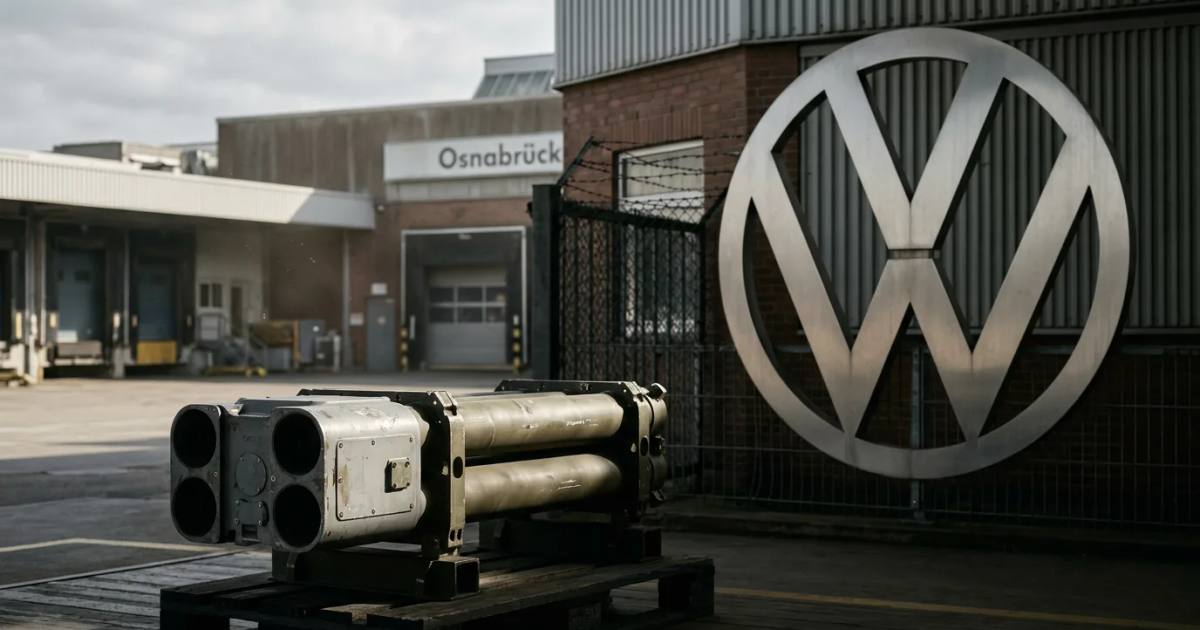

Volkswagen has confirmed the Osnabrück plant conversion for Rafael's Iron Dome components after Qatar's QIA, holding 17% of VW voting rights, tried to intervene. Here is how the standoff resolved.
Two seats on a German supervisory board. Seventeen percent of the voting rights. That is all it took for Doha to slow an Israeli Iron Dome expansion into Europe. The slowdown did not hold.
Update, September 8, 2026:
Volkswagen has confirmed the Osnabrück conversion is proceeding. The company issued an on-record statement that the plans involve the manufacture of systems and components for air defense systems for Germany and Europe, and CEO Oliver Blume said the agreement marks an important step toward opening up a new industrial future for the site. Volkswagen's works council said the deal guarantees at least 1,200 jobs at the plant. The factory will operate as what Volkswagen calls a competence center for security and defense solutions, with Rafael Advanced Defense Systems as its first anchor partner. The company has not disclosed how the QIA objection detailed below was resolved, and neither Volkswagen nor Rafael has said whether Tamir interceptor missiles themselves will be produced at the site; reporting on the confirmed deal indicates the plant will build launch platforms, power units, and heavy-duty transport vehicles for Iron Dome rather than the interceptors.
Rafael Advanced Defense Systems signed a letter of intent in late April 2026 to buy a Volkswagen factory in Osnabrück, Germany. Qatar's sovereign wealth fund said not so fast.
Volkswagen has a plant in Osnabrück, Lower Saxony, that makes convertibles for the T-Roc Cabriolet line and is scheduled to close by end of 2027. The plant employs roughly 2,300 people. The company, in the middle of a painful multi-year restructuring, has been trying to repurpose its idle facilities into something the market actually wants. Defense, it turns out, is in demand across Europe. VW found a buyer: Rafael, Israel's state-owned developer of Iron Dome, David's Sling, Spike, and Trophy.
Rafael signed a letter of intent to acquire the Osnabrück site in late April 2026. The plan was to manufacture non-munitions defense components there, military trucks, power generators, and components for Iron Dome and adjacent systems. It solved two problems at once: kept the plant open and its workers employed, and gave Rafael a European manufacturing footprint at a moment when NATO allies are spending heavily on defense.
Then Qatar intervened.
How is Volkswagen's ownership structured?
Volkswagen AG is one of the most politically structured shareholder registers in European corporate governance. Three parties hold effective control:
- Porsche SE, approximately 32% of shares and about 53% of voting rights. The Porsche-Piëch family holding vehicle.
- State of Lower Saxony, approximately 12% of shares and 20% of voting rights. Statutory blocking minority under the "VW Law" (Volkswagengesetz), which requires 80% supermajority for major corporate decisions.
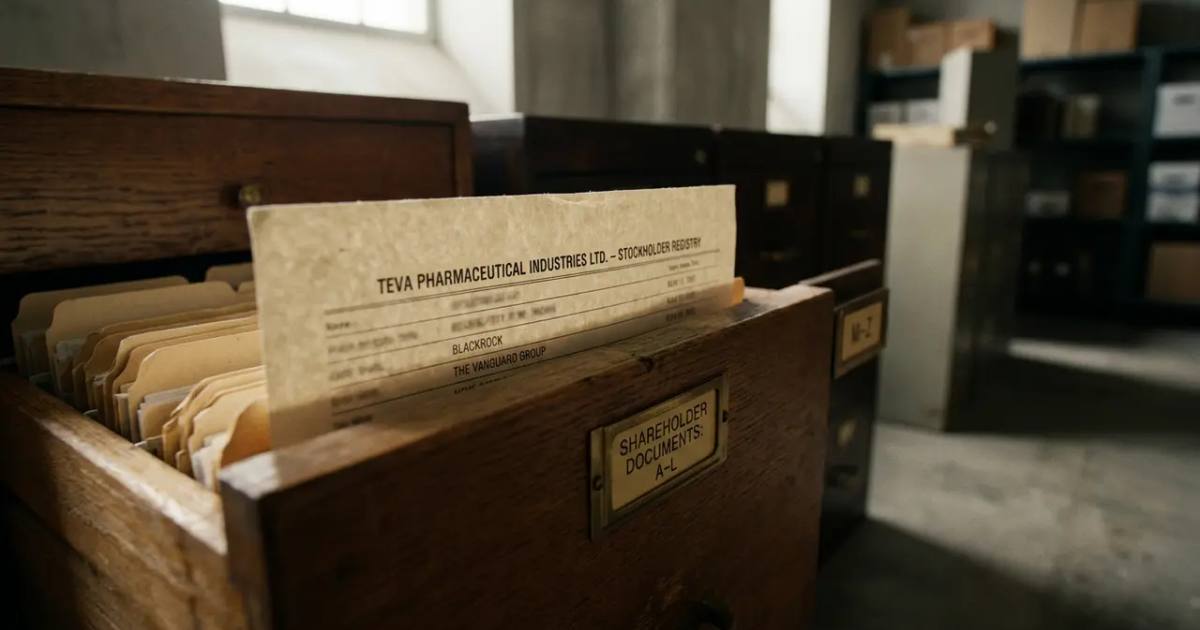
- Qatar Investment Authority (QIA), approximately 17% of voting rights. Two seats on the supervisory board.
The rest is public float. Between Porsche SE, Lower Saxony, and QIA, three shareholders effectively determine every consequential VW governance decision. Rafael's Osnabrück bid needed all three to be neutral or supportive. Two were. One was not, at least until the deal now on record.
Why does Qatar own 17% of Volkswagen?
The Qatar Investment Authority acquired its Volkswagen stake in 2009 during VW's Porsche restructuring saga, when Porsche's failed attempt to take over VW left it deeply in debt. QIA emerged as the rescue capital that stabilized both companies. The fund paid roughly €7 billion for its position and has held it for more than fifteen years, an unusually long-tenured strategic stake for a sovereign wealth fund.
QIA is Qatar's sovereign wealth vehicle, established in 2005 and today running approximately $510 billion in assets. Chair: Prime Minister Sheikh Mohammed bin Abdulrahman Al Thani. CEO: Mohammed Al-Sowaidi. Other anchor holdings include Barclays, Glencore, Harrods, The Shard, Heathrow, Iberdrola, and Paris Saint-Germain via QSI. QIA is one of the ten largest sovereign wealth funds in the world.
What triggered the intervention?
Reuters reported on June 17, 2026 that QIA had raised concerns about the Rafael deal at the VW supervisory board level, citing Qatar's complicated relationship with Israel. It was the first public confirmation of a dispute that had been developing for weeks. VW, QIA, and VW's supervisory board all declined to comment when Reuters approached them. The silence itself was the confirmation.
Qatar and Israel have no formal diplomatic relations. Qatar has historically maintained ties with Hamas leadership, several of whom have lived in Doha, and has positioned itself as a mediator in regional conflicts rather than a party to Abraham Accords-style normalization. The prospect of QIA, a Qatari state fund, facilitating the transfer of a manufacturing facility to an Israeli defense company producing Iron Dome components placed Doha in a position it was not prepared to accept publicly.
What can QIA actually do to block the deal?
Two supervisory board seats and 17% of voting rights gave Qatar enough leverage to slow, complicate, and extract concessions, but not to veto outright, and the outcome now on record bears that out.
VW's supervisory board operates under German co-determination law (Mitbestimmung), which gives labor representatives significant influence alongside shareholders. The Osnabrück deal also had the backing of the Lower Saxony state government, which holds its own VW stake and has strong political interest in keeping the plant operational and the workforce employed. The IG Metall union publicly supported the sale to Rafael as job-preserving, and the works council's confirmation of 1,200 guaranteed jobs suggests that backing held through to the final agreement.
Who is Rafael Advanced Defense Systems?
Rafael is one of Israel's three principal defense primes, alongside Israel Aerospace Industries and Elbit Systems. State-owned. Headquartered in Haifa.
Rafael developed Iron Dome in partnership with the Israel Missile Defense Organization inside the DDR&D (MAFAT). Its product portfolio anchors around:
- Iron Dome, the world's most battle-tested short-range air defense system, having intercepted thousands of rockets during the post-October 7 Gaza and Lebanon operations.
- David's Sling, medium-range air defense, co-developed with Raytheon.
- Spike, an anti-tank missile family with a $2 billion order from Germany alone in the current cycle.
- Trophy, an active protection system standard on the US M1 Abrams and German Leopard 2.
- Litening, targeting pods used across NATO air forces.
Rafael's 2024 revenue was $4.8 billion. FY2025 sales reached $6.8 billion, the first time above $6 billion, with net profit of $423 million and an order backlog of $23.3 billion at year-end 2025, roughly 3.3 years of sales. As of mid-2026, a partial 25 to 30 percent IPO was under Israeli government evaluation, with the listing venue, Tel Aviv Stock Exchange versus a US exchange, still unsettled. See the full Rafael Advanced Defense Systems profile for the complete financial and product picture.
Osnabrück is Rafael's first owned European manufacturing footprint. The strategic logic is straightforward: European NATO defense spending is accelerating, Iron Dome variants and Spike missiles have European buyers including Germany, Poland, the Netherlands, and Finland, and locally manufactured components carry lower tariff and political risk than pure Israeli export.
What does this tell us about Gulf sovereign capital in Europe?
This is not primarily a story about Volkswagen or about Rafael. It is a story about how Gulf sovereign capital, deployed across European corporate governance structures, can function as a geopolitical instrument, and about the limits of that instrument once labor, state, and industrial interests line up on the other side. Qatar did not file a protest with Berlin. It used its board seats. It did not stop the deal.
European defense spending is accelerating post-Ukraine and post-Iran. Israeli defense exports hit $14.8 billion in 2024, with Europe absorbing 54% of the total. Israeli defense companies, Rafael, Elbit, IAI, are well-positioned to benefit from that spending cycle. The Osnabrück deal was a test case for how Israeli defense could embed itself into European manufacturing infrastructure. Qatar's intervention showed the test would not run uncontested. Volkswagen's confirmation shows the contest had a ceiling.
For sovereign wealth strategists, the lesson is that anchor equity positions in European industrials carry decades-long optionality that periodic asset sales cannot replicate, but that optionality has limits when it collides with a state government's jobs mandate and a union's backing. QIA bought VW paper in 2009 as financial rescue capital. In 2026, that same paper became diplomatic leverage, and the leverage reached its ceiling.
Where the deal stands now
Volkswagen has gone on record confirming the Osnabrück conversion, with the works council guaranteeing at least 1,200 jobs and Rafael named as the first anchor partner for the site's new mandate as a competence center for security and defense solutions. This makes Rafael the first Israeli state-owned defense manufacturer to operate a production facility in Germany. The precise mechanics of how the QIA objection was resolved, whether through concessions, a structural change to the transaction, or a change in Doha's position, have not been disclosed by either company.
Three questions now replace the ones this story originally set out to answer:
- What did QIA get, if anything, in exchange for standing down? No public record yet shows whether Qatar's objection was resolved through deal restructuring, a side commitment, or simply being outvoted by Lower Saxony and Porsche SE.
- Will QIA's other European defense-adjacent stakes see similar attempts? QIA holds significant positions in Glencore, Barclays, Iberdrola, and multiple European industrials. Each remains a potential future intervention point for any European industrial acquisition involving an Israeli buyer.
- Does Rafael pursue further owned manufacturing in Europe? Osnabrück was the test case. Whether Rafael expands into Germany's Rheinmetall supplier ecosystem, the Czech Republic, Poland, or Italy within the next twelve months will show whether the strategy was Osnabrück-dependent or Osnabrück-preferred.
FAQ
Has the Rafael-Volkswagen Osnabrück deal been confirmed?
Yes. Volkswagen confirmed in September 2026 that the Osnabrück plant will be converted for defense production, with Rafael Advanced Defense Systems as the first anchor partner. CEO Oliver Blume said the agreement opens a new industrial future for the site, and the works council confirmed at least 1,200 jobs are guaranteed.
Why does Qatar own 17% of Volkswagen?
The Qatar Investment Authority acquired its Volkswagen stake in 2009 during VW's Porsche restructuring saga for roughly €7 billion. QIA holds approximately 17% of voting rights and two supervisory board seats, making it VW's third-largest shareholder after Porsche SE (about 53% voting) and the State of Lower Saxony (20% voting).
What did Rafael want to buy from Volkswagen?
Rafael signed a letter of intent in late April 2026 to acquire Volkswagen's Osnabrück manufacturing plant in Lower Saxony, Germany. The plant made convertibles and was scheduled to close by end of 2027. It employs roughly 2,300 people. Rafael's confirmed plan is to manufacture non-munitions defense components, including launch platforms, power units, and heavy-duty transport vehicles for Iron Dome, at the site.
Did QIA block the Rafael-VW deal?
No, not in the end. QIA's 17% of voting rights and two supervisory board seats gave it leverage to slow and complicate the process, but Volkswagen has since confirmed the deal is proceeding, with Lower Saxony and the IG Metall union's backing intact.
How big is the Qatar Investment Authority?
Approximately $510 billion in assets under management as of 2026, making it one of the ten largest sovereign wealth funds in the world. Established 2005. Chair: Prime Minister Sheikh Mohammed bin Abdulrahman Al Thani. CEO: Mohammed Al-Sowaidi.
What is Rafael Advanced Defense Systems?
Rafael is one of Israel's three principal state-owned defense contractors, alongside IAI and Elbit Systems. It developed Iron Dome (with the Israel Missile Defense Organization inside DDR&D/MAFAT), David's Sling, Spike missiles, Trophy tank protection, and Litening targeting pods. FY2025 sales: $6.8 billion. Order backlog: $23.3 billion at year-end 2025.
Will the Tamir interceptor missile be built at Osnabrück?
No, based on current reporting. The confirmed plan has the plant producing launch platforms, power units, and transport vehicles for Iron Dome, not the Tamir interceptor missile itself.
Where is the Osnabrück plant?
Osnabrück is in Lower Saxony, northwestern Germany. The VW plant there produced the T-Roc Cabriolet convertible and employs roughly 2,300 people.