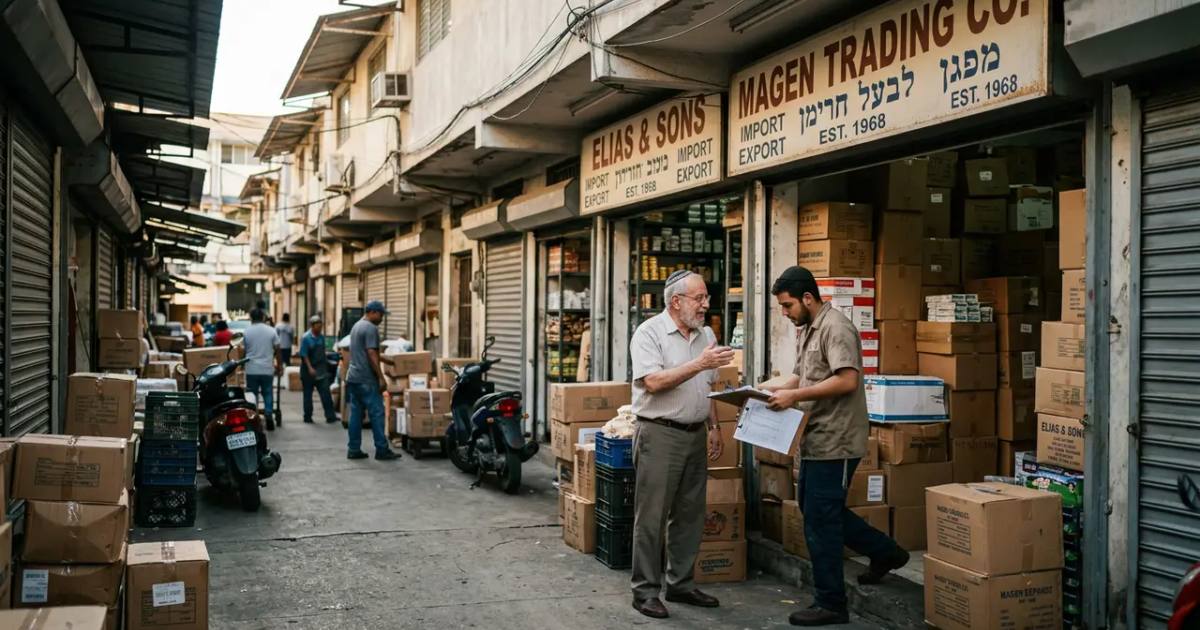

The Colon Free Zone moves $19 billion a year through Panama's Caribbean coast. Jewish merchants, many Syrian-Sephardic, built some of its oldest trading houses across three generations.
The Colon Free Trade Zone, the second-largest free trade zone in the world after Hong Kong, moves roughly $19 billion in imports and exports annually through a Panamanian port city built for tax-free re-export. Jewish merchants, many of Sephardic and Syrian origin, built some of the zone's most established trading houses over three generations, turning a 1948 government-created duty-free district into the commercial backbone of Panama's Jewish community.
What is the Colon Free Trade Zone?
The Colon Free Zone was established under Decree Law No. 18 of June 17, 1948, and operates as a segregated customs territory near the Caribbean entrance to the Panama Canal, about an hour from Panama City. Companies inside the zone can import, store, modify, repackage, and re-export goods without paying Panamanian import duties or export taxes, with the sole exceptions of firearms and petroleum products.
More than 3,000 businesses currently operate inside the zone's roughly 1,065-acre complex. Annual import and export turnover through the zone runs close to $19 billion, a figure that has made Colon the leading free trade zone in the Western Hemisphere, per Middle East Eye's reporting from the zone.
The zone's principal imports are pharmaceuticals, chemicals, textiles, machinery, electrical goods, and footwear, sourced mainly from China, Singapore, the United States, Taiwan, and Mexico. Those goods are re-exported primarily to Venezuela, Colombia, Puerto Rico, and the Dominican Republic, making Colon a regional wholesale hub rather than a retail market serving Panama itself.
How did Jewish merchants come to dominate parts of the zone's trade?
Panama's Jewish population is concentrated heavily in commerce, with individuals active across construction, finance, tourism, textiles, and international trade, and many have found particular success in the Colon Free Zone, according to B'nai B'rith International's profile of the community. Many Jewish families built their wealth specifically inside the Colon Free Zone, selling goods wholesale for tax-free re-export across Latin America — a community whose synagogues, schools, and demographics Olam maps in full in its survey of Jewish institutional life in Panama.
Batia Siebzehner, a researcher at Hebrew University's Harry S. Truman Institute who has studied the Panamanian Jewish community, described a close-knit population to B'nai B'rith International with roots dating to the 1820s that solidified further after two major waves of Syrian Jewish immigration, one in the 1970s and a second in the 1990s. The community's estimated population of 12,000 to 14,000 is the largest in Central America, per Siebzehner's research.
Businesses inside the free zone are often highly specialized and built across multiple generations, with sons expected to enter the family trading company. That generational pattern produced a business class colloquially known within the community by the Yiddish term "shmattes," referring to the textile and apparel trade that many families built by importing clothing from China and other parts of East Asia into the Colon zone for distribution throughout Latin America.
What role did Syrian Jewish migration play in the zone's trade?
The Syrian Jewish wave that reached Panama traces back to the same Aleppo and Damascus merchant communities documented across the broader Sephardic diaspora, a lineage detailed in The Olam's Aleppo and Damascus survey. Panama's Jewish population today is majority Sephardic, with Syrian Jews forming the largest single group within that Sephardic majority — Panama is the only country outside Israel to have had two Jewish heads of state.
The community's commercial rise accelerated after two historical inflection points: the 1914 opening of the Panama Canal and the disintegration of the Ottoman Empire following World War I, both of which pushed Syrian-Sephardic Jewish merchants toward Panama in larger numbers. A second and third wave followed decades later, driven by instability in Syria itself through the 1970s and again in the 1990s.
That migration pattern mirrors the same commercial network structure documented in The Olam's Latin American Jewish institutional survey, which found family-business structures and dense intra-community trading networks to be a defining feature of the Syrian Jewish diaspora across Mexico City, Panama, Lima, and Sao Paulo.
Who trades alongside Panama's Jewish merchants in Colon?
Panama's Jewish and Arab business communities interact extensively within the free zone's commercial life, according to ReVista, the Harvard Review of Latin America published by Harvard's David Rockefeller Center for Latin American Studies. Lebanese Muslim traders, many of whom had previously done business in Colombia, began establishing operations inside the Colon Free Zone during the second half of the 1960s, the publication reported, eventually building a mosque, an Arab country club, a school, and the Islamic Cultural Center of Colon in 1981.
Both the Jewish and Arab merchant communities had earlier been suppliers of goods and services to Arab businessmen operating out of Colombia before those businessmen relocated their own operations directly into the free zone, according to ReVista. The overlap between Panama's Jewish and Muslim trading communities inside Colon has remained a point of peaceful, longstanding commercial coexistence, Middle East Eye separately reported.
What tax structure makes the Colon Free Zone attractive to traders?
Companies operating in the zone pay a maximum 8.5% tax on net income earned from foreign trade, with further reductions available to firms that hire more than 30 Panamanian residents. Companies established after January 1, 1976, that conduct re-export business can qualify for tax discounts of up to 95% during their first five years of operation.
Setup costs for a company operating inside the zone include a roughly $5,560 guarantee deposit and a $2,400 annual operating permit. Companies represented in the zone without maintaining physical presence there pay approximately $2,500 per year, a lower-cost entry point that has drawn smaller trading operations alongside the zone's larger established houses.
The zone's legal framework was later expanded by Law No. 8 of April 4, 2016, which established special economic areas within Colon permitting a broader range of industries beyond traditional import and re-export trade, including manufacturing, technology, and e-commerce.
How does Colon compare to Panama's other major trade zone?
Panama Pacifico, a separate special economic zone created to attract logistics, manufacturing, and service companies, operates under different rules for permits, customs, and taxation than Colon. Panama Pacifico includes residential development and services alongside its commercial districts, allowing companies to concentrate staff and operations in a single location, while Colon functions purely as a designated re-export and wholesale distribution territory administered by the Colon Free Zone Authority, known by its Spanish acronym AZLC.
Colon's legal regime, based on the original 1948 decree law, has remained largely intact despite a 2012 reform attempt under Law 72. That durability has made Colon the default choice for businesses handling physical goods, including wholesale distribution, pharmaceuticals, electronics, and consumer products, while Panama Pacifico has drawn service and technology firms seeking a different regulatory environment.
Why does the free zone matter to Panama's Israel ties?
The free zone predates Panama's 2020 free trade agreement with Israel by more than seven decades, functioning as a parallel, community-driven trade channel that operated independently of formal government-to-government diplomacy documented in The Olam's Panama-Israel canal gateway report. Where the 2020 FTA and 2026 economic MOU opened formal channels for Israeli companies to enter Panama's public and private markets, the Colon Free Zone represents an older, informal architecture built by individual Jewish merchant families rather than state actors.
That distinction matters for understanding Panama's economic relationship with Israel and the broader Jewish world. The free zone shows how a small, tightly connected diaspora community built durable commercial infrastructure using family networks and generational succession, a pattern that operates alongside, but separately from, the formal diplomatic and trade agreements that now govern Israeli corporate entry into Panama.
Panama's Jewish community, concentrated heavily in Panama City with historical roots extending into Colon itself, continues to treat the free zone as a foundational economic institution even as newer opportunities, tourism, direct Israeli investment, and technology partnerships, open up parallel paths for commercial engagement between the two countries.
Related on The Olam
- Panama Is Israel's Canal Gateway in Latin America
- Jewish Life in Panama: Ten Synagogues, Two Presidents
Sources
B'nai B'rith International, "The Jews of Panama: Small Numbers, Great Impact"; ReVista, Harvard Review of Latin America, "Muslims and Jews in Panama"; Middle East Eye, on Colon's Muslim and Jewish trading communities; The Olam's Jewish Life in Panama survey; The Olam's Panama-Israel canal gateway report.
How we report: Olam stories draw on public filings, company disclosures and named sources, checked by our editors. Read our methodology · Corrections