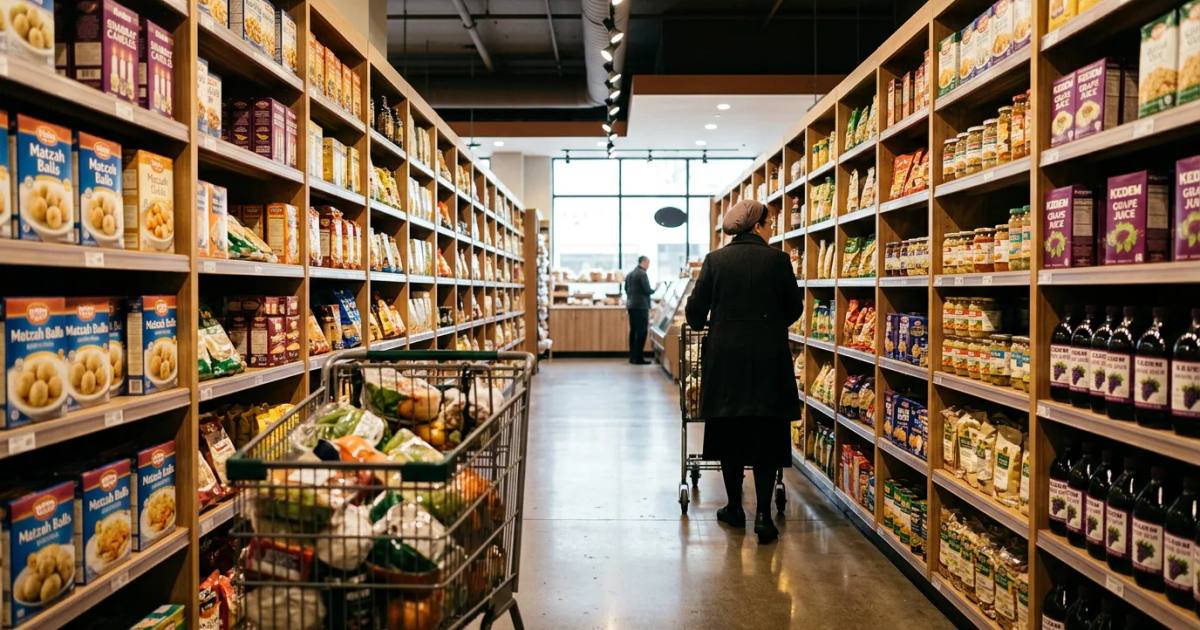

Who owns America's kosher supermarkets: Seasons, Gourmet Glatt, Pomegranate and Evergreen, plus the corridors and Costco pressure shaping them.
America's dedicated kosher supermarkets are mostly family-owned: the Bistritzky family owns Seasons, Yoeli Steinberg and Moshe Ratner co-own Gourmet Glatt, and Abraham Banda founded Pomegranate. The market runs through a handful of corridors (Brooklyn, the Five Towns, Monsey, Lakewood, Pico-Robertson), and it competes less with itself than with Costco, Trader Joe's, and Amazon.
Pomegranate · Evergreen · Seasons · Gourmet Glatt · KolSave · Glatt Mart · Lakewood corridor · Five Towns · Geographic concentration · The Costco and Trader Joe's challenge.
The dedicated kosher supermarket is a retail format unlike anything else in American grocery. It operates under rabbinical supervision. It maintains separate departments, and often separate kitchens, for meat, dairy, and pareve (neutral) products. Its prepared food section functions as a restaurant, catering operation, and deli counter simultaneously. Its customer base is intensely loyal, geographically concentrated, and structurally captive: an observant family in Monsey or Flatbush cannot simply shop at Walmart for their weekly groceries.
That captivity creates unusual economics. Higher margins. Denser foot traffic per square foot. And a competitive landscape defined not by national chains but by neighborhood operators who know their communities with a precision that no corporate grocer can match.
Pomegranate: Brooklyn's "Kosher Whole Foods"
Pomegranate, located on Coney Island Avenue in the Midwood section of Brooklyn, is the flagship of the upscale kosher supermarket format. Founded by Abraham Banda, a Satmar Hasidic businessman who also owns a grocery store on Long Island, Pomegranate opened in August 2008 after two years of construction on the site of a former bakery and auto repair shop.
The store occupies approximately 18,000 to 20,000 square feet, modest by conventional supermarket standards but enormous for a kosher-specific format. It operates three on-site kitchens (meat, dairy, pareve) plus a fourth off-site facility, producing approximately 3,000 prepared food items per week. The product range includes sushi, homemade cheeses, organic produce, artisanal baked goods, and a full-service butcher counter alongside traditional Jewish foods like challah, gefilte fish, and kugel. Valet parking is complimentary.
Pomegranate was immediately dubbed "Kosher Whole Foods" by industry observers, not because of its pricing (which is competitive for the kosher market) but because of its emphasis on quality, presentation, and the shopping experience. It draws both observant and non-observant customers from across Brooklyn and beyond.
Evergreen Kosher Market: The Rockland County Anchor
Evergreen Kosher Market operates 30,000-square-foot locations in Monsey and Pomona, New York, the heart of the Rockland County Orthodox and Hasidic community, one of the fastest-growing Jewish population centers in the United States. Evergreen offers full-service grocery, butcher, bakery, fish department, sushi counter, deli, and prepared foods.
The Monsey and Rockland corridor has exploded in Jewish population over the past two decades, driven primarily by growth in the Hasidic communities (Satmar, Vizhnitz, and others). This demographic surge has created a supermarket market that is growing faster than almost any kosher retail market in the country, and Evergreen is positioned at the center of it.
Who Owns Seasons, America's Largest Kosher Supermarket Chain?
The Bistritzky family owns Seasons through Joseph Bistritzky, CEO of the Maramont Corp, a Brooklyn-based foodservice company. Bistritzky purchased the chain in January 2019 after Seasons filed for Chapter 11 bankruptcy in September 2018 carrying more than $40 million in debt, according to reporting by the Jewish Telegraphic Agency and Supermarket News.
Seasons opened its first store in Queens in 2011 under founding CEO Mayer Gold and expanded into Maryland and planned an Ohio location before the bankruptcy filing forced those stores to close, along with locations on Manhattan's Upper West Side and in Scarsdale, New York. Under Bistritzky ownership, Seasons relaunched with six stores across Scarsdale, Clifton, Lakewood, Lawrence, and Queens, according to the Herald Community Newspapers.
Joseph Bistritzky is the son of the late Rabbi Leibel Bistritzky, who ran Bistritzky's Kosher Gourmet Food on Manhattan's Lower East Side and co-founded Hatzalah of Crown Heights, a volunteer ambulance corps, before his death in 2013. The family has framed its Seasons ownership as an extension of that multi-generational kosher food retail background.
The Five Towns corridor (Lawrence, Cedarhurst, Woodmere, Hewlett, Inwood) is one of the densest concentrations of Modern Orthodox Jews in the United States and a fiercely competitive kosher retail market. Seasons competes with multiple kosher supermarkets in each of its markets, a level of intra-format competition that barely exists outside the New York metro area. In Lakewood, where the population of Orthodox and ultra-Orthodox families has grown to over 150,000, kosher supermarkets compete not just with each other but with the Costco and ShopRite locations that have expanded their kosher sections to capture observant customers who prefer one-stop shopping at lower prices.
Who Owns Gourmet Glatt, Seasons' Five Towns Rival?
Yoeli Steinberg and Moshe Ratner co-own Gourmet Glatt Emporium, according to a 2013 Nassau County business recognition announcement that named both men co-owners. The chain began as a single Cedarhurst grocery store and grew into what Nassau County officials described as the Five Towns' kosher food superstore within less than a decade.
Gourmet Glatt operates locations in Cedarhurst, Borough Park, Woodmere, and Lakewood, New Jersey, expanding through acquisitions of shuttered competitor sites, including a former Key Food location in Woodmere and an attempted purchase of the closed Brach's store in Lawrence. Steinberg serves as vice president and general manager, handling day-to-day operations and community relations, while purchasing manager Howie Klagsbrun oversees vendor relationships.
Gourmet Glatt and Seasons compete directly across overlapping Five Towns and Brooklyn markets, but the two chains have also cooperated during crises. When a 2016 fire closed Gourmet Glatt's Cedarhurst store, Seasons owner Mayer Gold took in Glatt's deliveries and put nearly 20 Gourmet Glatt employees to work in his own store, an arrangement Gourmet Glatt had reciprocated for Seasons after an earlier fire at its Queens location.
How Did Bankruptcy Reshape Ownership of the Kosher Grocery Sector?
Seasons' 2018 bankruptcy filing eliminated a wave of national expansion plans and consolidated the chain under single-family ownership for the first time. Before the filing, Seasons operated eight locations and was expanding toward a national kosher supermarket model; after the Bistritzky family's 2019 purchase, the chain scaled back to a defined regional footprint centered on the New York metro area and northern New Jersey.
The bankruptcy also reshuffled competitive dynamics in the Five Towns specifically. Brach's, a third major kosher supermarket in the area, sold its original Kew Gardens Hills location and eventually closed its Lawrence store, a closure Gourmet Glatt moved to fill by attempting to acquire the vacated space, according to the Jewish Star's local business reporting.
The Lakewood Market: America's Fastest-Growing Kosher Corridor
Lakewood, New Jersey, home to Beth Medrash Govoha, the largest yeshiva in the United States, has become the single most important growth market for kosher retail in America. The township's population has roughly tripled since 2000, driven almost entirely by the expansion of the Orthodox and Hasidic community. The kosher supermarket density in Lakewood rivals Brooklyn.
The Lakewood market includes multiple full-format kosher supermarkets, kosher bakeries, kosher pizza shops, kosher restaurants, and kosher take-out operations. Land use, zoning, and school-district politics in Lakewood are directly shaped by the consumer needs of a population that keeps kosher at rates above 90 percent.
Los Angeles: The West Coast Hub
The Pico-Robertson neighborhood in Los Angeles is the primary kosher retail corridor on the West Coast. The market includes multiple kosher supermarkets, butchers, bakeries, and restaurants serving both the Persian Jewish and Ashkenazi Orthodox communities, two populations with distinct culinary traditions and certification preferences.
The LA kosher market is structurally different from New York. The community is more geographically dispersed, car-dependent, and price-sensitive. Kosher supermarkets in LA compete more directly with mainstream grocers (Ralphs, Vons, Costco) that carry significant kosher selections, and the Persian Jewish population's dietary preferences (heavy on rice, herbs, and grilled meats) create a product mix that looks nothing like the Brooklyn kosher aisle.
Teaneck and Bergen County: The Suburban Modern Orthodox Model
Teaneck, New Jersey, anchors a different kind of kosher retail corridor than Brooklyn, Monsey, or Lakewood. Bergen County's Modern Orthodox population, spread across Teaneck, Englewood, Fair Lawn, and New Milford, is smaller and more suburban than the Hasidic population centers, and it shops differently. Households here are more likely to hold professional jobs outside the community, more likely to be dual-income, and more price- and convenience-sensitive than the Hasidic customer base that anchors Lakewood or Williamsburg.
That has produced a retail format tuned to a commuter lifestyle: mid-sized kosher supermarkets with strong prepared-food and takeout counters aimed at working families who want a full Shabbat meal ready by Thursday evening, rather than the acreage-scale format of Pomegranate or Evergreen. Teaneck's kosher grocers compete directly with a ShopRite that has built out one of the most extensive kosher sections of any mainstream supermarket in the country, a preview of the competitive pressure now spreading to other suburban Orthodox communities nationally.
South Florida: The Snowbird and Retiree Market
North Miami Beach, Surfside, Aventura, and Boca Raton form the primary kosher retail corridor in South Florida, serving a population that swells seasonally as retirees and snowbirds from New York and New Jersey relocate for the winter months. This seasonality creates a demand curve unlike any other kosher market in the country: kosher supermarkets in South Florida staff up and expand prepared-food production ahead of the winter high season, then contract through the humid summer months when much of the snowbird population returns north.
The South Florida kosher market also skews older and more affluent on average than the Brooklyn or Lakewood markets, which supports a heavier emphasis on premium prepared foods, higher-end butcher cuts, and imported Israeli products (dried fruit, wine, olive oil, and specialty snacks) that command a price premium from a customer base less sensitive to per-unit cost than a young Hasidic family feeding six or eight children.
Chicago, Baltimore, Cleveland, and the Secondary Markets
Outside the New York-New Jersey corridor and the Los Angeles and South Florida hubs, a second tier of kosher supermarket markets has developed in cities with large, stable Orthodox populations: Chicago's West Rogers Park and Skokie; Baltimore's Park Heights corridor, home to Ner Israel and a dense Orthodox community; Cleveland's Cedar-Fairmount and Beachwood area; and smaller but durable markets in Cincinnati, Detroit, St. Louis, and Silver Spring, Maryland.
These secondary markets typically support one or two dedicated kosher supermarkets rather than the multiple competing chains found in Brooklyn or Lakewood, which changes the competitive dynamic entirely. A single kosher grocer in a market like Baltimore or Cleveland functions closer to a monopoly than a competitor, with pricing power that a Pomegranate or Evergreen, competing head-to-head with three or four other full-format stores within a few miles, simply does not have. That pricing power is balanced by thinner volume: these stores serve a customer base in the low thousands of households rather than the tens of thousands that support the New York-area giants, and they depend more heavily on the same regional kosher wholesale distributors that supply the larger corridors, since local kosher-specific supply chains are too thin to sustain independent operations at scale.
The Supply Chain Behind the Counter
Every kosher supermarket, regardless of size or region, depends on a supply chain that looks nothing like a conventional grocery's. Fresh kosher meat requires shechita (ritual slaughter) performed by a certified shochet, followed by soaking, salting, and deveining processes, collectively "kashering," that must occur within a defined window after slaughter. A handful of large kosher meat processors and distributors supply the overwhelming majority of America's dedicated kosher supermarkets, which means that a labor dispute, a plant closure, or a certification lapse at a single major processor can ripple through supermarket meat cases from Brooklyn to Los Angeles within days. The kosher meat supply chain is consequently one of the most concentrated and fragile links in the entire kosher retail economy.
Dairy follows a parallel but distinct logic. Chalav Yisrael (milk produced under direct rabbinical supervision from the point of milking) commands a meaningful price premium over chalav stam (milk certified kosher without that supervision level) and is required by a meaningful share of the Hasidic and yeshivish customer base, while much of the Modern Orthodox population accepts chalav stam. Supermarkets in Hasidic-heavy corridors like Lakewood, Monsey, and Williamsburg typically stock chalav Yisrael as their default or exclusive dairy line; stores in more Modern Orthodox markets like Teaneck or the Five Towns typically carry both, doubling shelf space and inventory complexity for the dairy department alone.
Private Label and the Economics of Prepared Food
Prepared food is where the dedicated kosher supermarket makes its real margin. A store like Pomegranate or Evergreen effectively operates as a restaurant chain disguised as a grocery department, and the economics reflect that: prepared foods carry gross margins well above center-store grocery, and a strong prepared-food program can anchor a store's entire profitability even when packaged-goods sales are under pressure from Costco and Amazon.
That has pushed the larger chains toward private-label development (house-brand baked goods, sauces, dips, and frozen prepared meals sold under the store's own name) both to capture more margin and to build a differentiated product a customer cannot buy at a mainstream grocer's kosher aisle. Private label also insulates the largest chains somewhat from the packaged-goods price competition coming from Costco's Kirkland Signature kosher lines and Trader Joe's expanding kosher-certified assortment, since a customer loyal to a particular bakery's rugelach or a particular store's pre-Shabbos soup has no substitute product to switch to.
Real Estate, Zoning, and the Physical Constraints on Growth
Unlike a conventional supermarket chain that can site a new store almost anywhere with adequate rooftops and traffic counts, a dedicated kosher supermarket must locate inside or immediately adjacent to an existing Orthodox community, since its customer base will not, and often religiously cannot, drive far on Shabbat-adjacent shopping days or during the pre-holiday rush. That constraint means kosher supermarket expansion is downstream of Orthodox residential growth rather than a driver of it: a chain like Seasons or Evergreen expands only after a community has already reached a population density that can support 20,000-plus square feet of dedicated kosher retail.
This dynamic has made kosher supermarket real estate some of the most sought-after commercial space in towns like Lakewood, where population growth has consistently outpaced available commercial square footage, driving up lease rates for any parcel large enough to support a full-format kosher grocery. Local zoning fights over new kosher supermarket development in Lakewood and similar fast-growing towns have become, in effect, proxy fights over the pace and scale of Orthodox community growth itself: land use, school-district capacity, and traffic all become entangled with a single commercial permit application.
The Passover Surge
No single period tests a kosher supermarket's operations like the weeks before Passover. Observant households replace or intensively clean their entire kitchen inventory for the holiday, and demand for kosher-for-Passover products, which require separate certification, separate production runs, and in many cases entirely separate manufacturing lines, spikes to a level that can represent a disproportionate share of a kosher grocer's annual prepared-food and packaged-goods revenue within a four-to-six-week window.
Supermarkets in the major corridors typically convert significant floor space to a dedicated Passover section months in advance, and the largest chains (Pomegranate, Evergreen, Seasons) negotiate Passover-specific supply contracts with manufacturers a full year ahead of the holiday to secure adequate inventory of kosher-for-Passover matzah, wine, and packaged goods, since Passover-certified production capacity across the kosher food industry is limited and contested by every major retailer simultaneously. A supply shortfall in the weeks before Passover is one of the few events that can generate genuine consumer anxiety and press coverage inside these communities, comparable to a hurricane run on bottled water in a conventional market.
Wholesale Distribution and the KolSave and Glatt Mart Tier
Below the flagship chains sits a tier of smaller, value-oriented kosher grocers, operations like KolSave and Glatt Mart, that compete less on prepared-food quality or store experience and more on price, serving price-sensitive households in the same communities that also shop at Pomegranate or Evergreen for specific occasions. These smaller-format stores depend heavily on the same regional kosher wholesale distributors that supply the larger chains, since none but the largest operators has the volume to negotiate directly with major kosher food manufacturers or to justify dedicated private-label production runs.
The wholesale distribution layer, a small number of kosher-specific grocery distributors serving the entire Northeast corridor, is arguably as consolidated as the meat supply chain, and it functions as the invisible backbone that lets a value-format store in a secondary market like Baltimore or Cleveland stock the same national kosher brands available in a Pomegranate in Brooklyn, even without the buying power to negotiate comparable terms directly.
Labor and the Rabbinical Supervision Cost Structure
A dedicated kosher supermarket carries a labor and compliance cost structure that a conventional grocer does not. Full-store hashgacha typically requires on-site mashgichim (kosher supervisors) during all hours of food preparation, plus a supervising rabbi or kashrus organization that certifies the store's overall compliance, costs that are layered on top of ordinary butcher, baker, and deli staff wages. For a store running three or four separate kitchens, as Pomegranate does, that supervision cost multiplies across each kitchen and department rather than applying once at the store level.
These costs are ultimately passed through to consumers in the form of the well-documented kosher price premium on prepared foods and fresh meat, even as packaged dry goods increasingly reach price parity with mainstream retail through OU-certified products sold at Costco, Trader Joe's, and conventional supermarket chains. The gap between packaged-goods price parity and fresh-and-prepared-food premium is, in effect, the dividing line marking where mainstream grocers can compete with dedicated kosher supermarkets and where they structurally cannot.
The Mainstream Grocery Threat
The existential competitive question for dedicated kosher supermarkets is not each other. It is Costco, Trader Joe's, Amazon, and the mainstream chains that have expanded their kosher offerings. An increasing share of year-round kosher products are available at mainstream retailers. The OU symbol appears on Kirkland Signature products at Costco. Trader Joe's carries dozens of kosher-certified items without marketing them as kosher.
Dedicated kosher supermarkets survive, and in many cases thrive, because of three structural advantages mainstream grocers cannot replicate: fresh kosher meat and poultry (which requires on-site butchering under rabbinical supervision), prepared foods from supervised kitchens, and the trust that comes from a full-store hashgacha. A family that needs chalav Yisrael dairy, glatt kosher meat, and kosher-for-Passover products in one trip has no alternative to the dedicated kosher store.
Consolidation, Succession, and the Next Decade
Nearly every major dedicated kosher supermarket chain in America remains a privately held, often family-run business, frequently still controlled by its founder or the founder's children. Both Seasons and Gourmet Glatt remain privately held by the founding or acquiring families rather than by outside investors, and neither has taken on institutional capital or expanded through franchising. That structure distinguishes the sector sharply from conventional grocery, where regional chains have consolidated under a small number of public and private-equity-backed parent companies over the past two decades. It has so far insulated the kosher supermarket sector from private-equity roll-ups, but it also raises an open succession question: as founding operators like Pomegranate's Abraham Banda age, it remains unclear whether the next generation will run these businesses directly, sell to another family operator, or open the door to outside capital for the first time.
The sector's growth has tracked the geographic concentration of Orthodox Jewish communities rather than broad national retail strategy, a pattern consistent with the 2013 Pew Research study on New York-area Jewish communities. Population growth in Lakewood, Monsey, and similar corridors shows no sign of slowing, which points toward continued organic expansion of the dedicated kosher supermarket footprint over the next decade even without consolidation. But the packaged-goods price pressure from Costco, Trader Joe's, and Amazon is real and likely to intensify, pushing the sector's center of gravity further toward prepared foods, private label, and the supervised-kitchen advantages that mainstream retailers cannot replicate, a bet that the format's next decade of growth will look less like a grocery story and more like a foodservice one.
Frequently Asked Questions
Who owns Seasons kosher supermarket?
The Bistritzky family owns Seasons through Joseph Bistritzky, CEO of the Maramont Corp. He bought the chain in January 2019 after its September 2018 Chapter 11 filing.
Who owns Gourmet Glatt?
Yoeli Steinberg and Moshe Ratner co-own Gourmet Glatt Emporium, which began as a single Cedarhurst grocery store.
What is the largest kosher supermarket in the United States?
By square footage, several stores in the Monsey, Lakewood, and Brooklyn corridors exceed 20,000 to 30,000 square feet. Pomegranate in Brooklyn and Evergreen in Monsey are among the most prominent, and Seasons is described as the largest chain.
Where are America's kosher supermarket corridors?
Brooklyn (Flatbush, Williamsburg, Borough Park), the Five Towns (Long Island), Monsey and Rockland County (NY), Lakewood (NJ), Teaneck (NJ), Pico-Robertson (LA), and pockets of North Miami Beach, Chicago, Baltimore, and Cleveland.
Can you buy kosher food at regular supermarkets?
Most packaged kosher food (OU-certified) is available at mainstream grocery chains. But fresh kosher meat, chalav Yisrael dairy, and rabbinically supervised prepared foods typically require a dedicated kosher supermarket.
Why do kosher supermarkets cost more than regular supermarkets?
Fresh kosher meat and poultry require on-site rabbinical supervision (mashgichim) during slaughter, kashering, and preparation, and full-service prepared-food kitchens require ongoing supervision across each separate meat, dairy, and pareve kitchen. Those labor and compliance costs are layered on top of ordinary grocery operating costs and are passed through primarily on fresh and prepared items, while packaged dry goods have moved much closer to mainstream price parity.
The Kosher Economy on Olam
This article is part of Olam's Kosher Economy series, anchored by The Kosher Economy: The Olam Guide:
Kosher Certification Economy · Who Owns the Brands · Meat Supply Chain · Price Premium · America's Kosher Supermarkets
How we report: Olam stories draw on public filings, company disclosures and named sources, checked by our editors. Read our methodology · Corrections