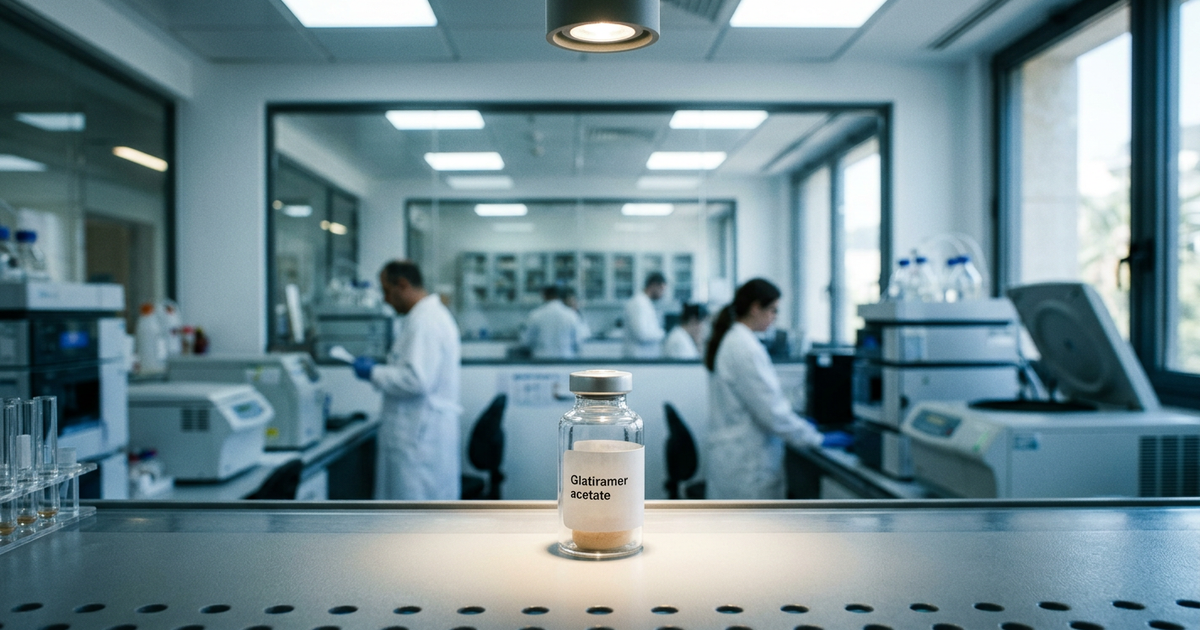

The Weizmann Institute's tech transfer arm earned more than $1.5 billion in royalties on a single multiple sclerosis drug. Over its commercial life, Copaxone generated more than $40 billion in cumulative revenue for Teva. The structure of that deal is the template Israeli TTOs have spent thirty years trying to replicate. None has succeeded.
The Weizmann Institute's technology transfer arm earned more than $1.5 billion in royalties on a single multiple sclerosis drug. Over its commercial life, that drug — Copaxone — generated more than $40 billion in cumulative revenue for Teva Pharmaceutical Industries, the Israeli generics giant that licensed it. The structure of that deal is the template Israeli tech transfer offices have spent thirty years trying to replicate. None has succeeded.
The Science: A Serendipitous Discovery in Rehovot
In the late 1960s, three immunologists at the Weizmann Institute of Science — Michael Sela, Ruth Arnon, and Dvora Teitelbaum — set out to do something unrelated to treating multiple sclerosis. They were trying to create a synthetic antigen that could induce experimental autoimmune encephalomyelitis (EAE) in laboratory animals — the standard animal model for studying autoimmune inflammation of the central nervous system.
The team synthesized a random copolymer — a mixture of four amino acids (glutamic acid, alanine, tyrosine, and lysine) in roughly the same proportions they occurred in myelin basic protein, the molecule believed to trigger the autoimmune attack in MS. They expected this synthetic molecule to cause disease in their animal models. It did the opposite. Instead of inducing EAE, the copolymer suppressed it. The molecule that was supposed to make animals sick was protecting them.
That accidental finding — one of the most productive failures in the history of pharmaceutical research — launched a three-decade journey from Rehovot to the FDA.
The Scientists
Michael Sela (1924–2022) was born Mieczysław Salomonowicz in Tomaszów Mazowiecki, Poland. His family fled rising antisemitism — first to Romania, then to Mandate Palestine, where he arrived at age 17. After studying chemistry at the Hebrew University of Jerusalem, he joined the Weizmann Institute in 1950 as a doctoral student of Ephraim Katzir, who would later become President of Israel. Sela founded Weizmann's Department of Chemical Immunology in 1963 and served as the Institute's sixth president from 1975 to 1985. He co-invented and held patents on two blockbuster drugs — Copaxone for MS and Erbitux for cancer — and his collaborative work contributed to two additional cancer drugs, Vectibix and Portrazza. He received the Israel Prize in Life Sciences in 1959 and shared the Wolf Prize in Medicine with Arnon in 1998. He was a member of the Israel, US, Russian, French, and Pontifical academies of sciences. Sela died in Rehovot in May 2022 at the age of 98. In 2025, the Weizmann Institute inaugurated the Michael Sela Prize in Biomedical Sciences in his honor.
Ruth Arnon (born 1933 in Tel Aviv) was Sela's first graduate student and became a leading immunologist in her own right. She served as Head of Weizmann's Department of Chemical Immunology, Dean of the Faculty of Biology, and Vice President of the Institute. Like Sela, she was a visiting professor at leading institutions worldwide — the Rockefeller Institute, the Pasteur Institute, the Curie Institute. She shared the Wolf Prize in Medicine with Sela. Arnon documented the Copaxone development saga in Immunology Letters in 1996, the year the drug received FDA approval.
Dvora Teitelbaum was the third co-inventor — a Weizmann researcher whose role in the initial synthesis and animal experiments was foundational. All three are named on the original patents.
The Licensing Deal
Yeda Research and Development Company — the Weizmann Institute's tech transfer arm, established in 1959 — licensed glatiramer acetate (initially called Copolymer 1, or Cop 1) to Teva Pharmaceutical Industries under an exclusive license in the 1980s. The deal structure was simple in outline: Teva took on the full cost and risk of clinical development and regulatory approval, and Yeda received a royalty stream on net sales.
The royalty percentage is not publicly disclosed. What is known: Yeda's cumulative royalty take from Copaxone and its other major licenses (including Rebif, marketed by Serono, and an NDS satellite encryption system) exceeded $2 billion over a recent six-year period. Roughly 80–90 percent of Yeda's total royalty income has historically come from three inventions: Copaxone, Rebif, and the NDS encryption system. Of those, Copaxone was the largest by a wide margin.
Under Yeda's standard distribution model, approximately 40 percent of royalties go to the inventors (in this case Sela, Arnon, and Teitelbaum). The remainder is reinvested into the Weizmann Institute to fund further research. As a public academic institution, the Weizmann Institute is generally exempt from taxes on these royalties — a structural advantage that amplified the compounding effect of the Copaxone income stream over decades.
The Clinical Journey: Twenty-Eight Years from Lab to FDA
The path from Sela and Arnon's 1960s bench discovery to FDA approval in December 1996 was a twenty-eight-year saga — long even by pharmaceutical standards.
The problem was simple: nobody outside Rehovot believed the drug would work. Arnon later described the 1970s as her "peddling period" — she attended every MS conference she could find, presented the experimental data, and talked to anyone willing to listen. Two physicians responded: Dr. Helmut Bauer of the University of Göttingen in Germany, and Dr. Murray Bornstein of the Albert Einstein College of Medicine in New York.
Bornstein (1917–1995) was an American neuroscientist known for developing tissue culture techniques for studying demyelinating disease. He ran a small open-label dose-finding study in 1982 that established 20 mg subcutaneous daily as the safe, tolerable dose. He then conducted the landmark Phase II trial — a randomized, double-blind, placebo-controlled study of 50 relapsing-remitting MS patients — published in the New England Journal of Medicine in 1987. It showed a remarkable reduction in relapse frequency. The suspense during the three-year trial was intense; Arnon recalled calling Bornstein at least once a month for updates.
The pivotal Phase III trial, led by Kenneth Johnson and published in Neurology in 1995, confirmed the Phase II findings in a larger multicenter cohort. In December 1996, glatiramer acetate — now branded as Copaxone — received FDA approval for relapsing-remitting MS. It was one of the first Israeli-invented medications to clear the FDA, and the first non-interferon agent demonstrated to reduce relapse frequency in MS patients.
The Financial Arc: From Launch to Patent Cliff
Copaxone's commercial trajectory is one of the great arc-shaped revenue stories in pharmaceutical history.
Growth phase (1997–2013). Revenue climbed steadily from its 1997 launch. By Q3 2004, global in-market sales hit $242 million for the quarter alone — a 34 percent year-over-year increase — making Copaxone the fastest-growing MS therapy worldwide. By 2007, quarterly US sales alone reached $441 million. Copaxone captured 30.5 percent of total US MS prescriptions by late 2004 and continued gaining share. Annual revenue crossed $4 billion for the first time in 2013, hitting a record $4.3 billion.
Peak (2013–2015). In the $4 billion-plus years, Copaxone represented roughly 20–30 percent of Teva's total revenue and an even larger share of its profits. The MS franchise's profitability ran at 73–77 percent of Copaxone revenues. In 2015, US Copaxone revenues alone were $3.2 billion — roughly 29 percent of Teva's total US revenues — with an additional $783 million outside the US.
Patent cliff and generic erosion (2014–present). Patents on the original 20 mg/mL formulation expired in May 2014. Sandoz (Novartis) launched Glatopa, the first generic version, in June 2015. Teva's defensive strategy — launching a 40 mg/mL three-times-weekly formulation in January 2014, protected by patents expiring in 2030 — initially worked. By late 2015, 78 percent of US Copaxone scripts had been switched to the new dosing. But those patents were challenged. In 2016, two of five US patents were struck down. Mylan launched a generic 40 mg version in late 2017. Global revenue fell to $3.8 billion in 2017, then accelerated downward: roughly $1 billion by 2021, $359 million in 2022, $297 million in 2023, $242 million in 2024.
Cumulative revenue estimate. Aggregating publicly reported annual figures from Teva's SEC filings across the full commercial period (1997–2025), Copaxone's cumulative global revenue exceeds $40 billion. At even a conservative assumed royalty rate, Yeda's take comfortably exceeds $1.5 billion — a figure widely cited in the tech transfer literature.
The EU Antitrust Case
Copaxone's patent defense strategy drew regulatory scrutiny that culminated in a landmark European Commission enforcement action.
On October 31, 2024, the European Commission fined Teva €462.6 million (approximately $503 million) for abusing its dominant position to delay competition to Copaxone. It was the Commission's first decision condemning the misuse of so-called "divisional patents" — a strategy in which Teva allegedly filed and withdrew patent applications in a sequence designed to force generic challengers to restart their legal proceedings each time. The Commission also found Teva engaged in disparaging therapeutically equivalent generic products to healthcare professionals.
The case — one of the Commission's most significant pharmaceutical antitrust actions — is currently subject to potential appeal. But it underscores a structural irony: the very longevity of Copaxone's market dominance that made the Yeda license so valuable also attracted the kind of aggressive patent defense that eventually triggered regulatory intervention.
Where Copaxone Ranks: The Global Academic License Leaderboard
Only a handful of academic licenses in history have generated royalties in the billion-dollar range. The comparison illuminates what made Copaxone exceptional.
Cohen-Boyer recombinant DNA patents (Stanford/UCSF). Licensed non-exclusively to over 450 companies starting in the early 1980s. Generated approximately $255 million in cumulative royalties before the patents expired. The deal seeded an entire industry — but the non-exclusive structure, while catalytic for biotechnology's growth, limited per-deal royalty concentration. Stanford's OTL also received $336 million in equity proceeds from Google's IPO in 2005 — a separate license, not recombinant DNA.
Northwestern University / Lyrica (pregabalin). A traditional pharmaceutical exclusive license to Pfizer. Northwestern sold its royalty rights for $700 million and earned an estimated $1.4 billion in total. The closest comparable to Copaxone in structure (exclusive license, single pharmaceutical partner, long-running royalty).
Columbia University Axel patents (co-transformation). The method for inserting foreign DNA into mammalian cells was broadly licensed and generated hundreds of millions for Columbia. Congress declined to extend the patents when they expired, ending the royalty flow.
What distinguishes the Copaxone deal from all of these is the combination of three factors: exclusive license to a single industrial partner, an exceptionally long commercial monopoly enabled by complex generic substitution challenges, and a royalty rate applied to a product that reached $4+ billion in annual peak revenue. No other academic license checked all three boxes simultaneously. The Cohen-Boyer patents had the breadth but not the exclusivity. Lyrica had the structure but not the peak revenue. The Copaxone deal had everything.
Why It Cannot Be Replicated
The window. The Copaxone license was negotiated before the global university tech transfer system matured. The Bayh-Dole Act of 1980 in the US — which gave federally funded researchers the right to patent and license their inventions — normalized a different set of deal structures. Universities globally now keep more equity and less pure royalty exposure. The pre-Bayh-Dole vintage of the Yeda-Teva deal meant it was negotiated under terms that would be unusual today.
The partner. Teva was the natural Israeli industrial home for an Israeli academic invention in the 1980s. It was already the world's largest generic pharmaceutical company and had the clinical-development and regulatory infrastructure to take a complex molecule through trials and FDA approval. The Israeli pharma landscape today is structurally different. There is no current-generation Teva equivalent — no Israeli company with both the commercial scale and the branded-drug development capability to serve as the industrial anchor for an early-stage academic license at this level. Most Israeli academic biotech IP now licenses to US or European acquirers, structurally limiting Israeli royalty capture.
The molecule. Copaxone is not a small molecule. It is a complex mixture of synthetic polypeptides with a broad molecular-weight distribution. That complexity delayed generic substitution far longer than a typical small-molecule drug would have experienced. It took almost twenty years after FDA approval for meaningful generic competition to arrive. New molecules — particularly biologics and gene therapies — face a different competitive landscape. Biosimilar pathways are more established. Regulatory agencies are more experienced at evaluating complex generics. The structural protection that Copaxone enjoyed for two decades is simply unavailable to new entrants.
The disease market. MS is a chronic condition requiring long-term management. Copaxone entered a market with limited treatment options and became the standard of care for a large patient population over a sustained period. First-mover advantage in a chronic-disease market creates compounding revenue dynamics that are difficult to replicate even with a superior drug, because switching costs — both clinical and administrative — are high.
What the Israeli TTOs Actually Do Today
Yeda, Yissum (Hebrew University), Ramot (Tel Aviv University), T3 (Technion), and BGN Technologies (Ben-Gurion University) have all evolved toward an equity-and-royalty hybrid model, with more emphasis on early spinout equity and proof-of-concept funding. The new business model is structurally different from the Copaxone template.
Deal sizes are smaller. The TTOs take equity positions in spinout companies rather than — or in addition to — pure royalty streams. More deals are done per year, spreading risk across a broader portfolio. Government co-investment through the Israel Innovation Authority and institutional venture funds provides additional risk-sharing. The model produces more companies but fewer blockbuster royalty streams.
Yeda itself has adapted. It currently manages approximately 500 unique patent families and has generated the highest income per researcher of any academic technology transfer operation worldwide. Its post-Copaxone portfolio spans biotechnology, oncology therapeutics, AI-applied life sciences, and materials science. In 2020, Yeda and Deerfield Management launched Orchard Innovations with up to $130 million in initial funding — Deerfield's first research collaboration outside the US — to advance translational research from the Weizmann campus toward clinical validation.
The Sela legacy also extends institutionally. Michael Sela established the Yeda-Sela Fund, which supports basic research projects that may not otherwise receive backing from traditional funding agencies — precisely the kind of curiosity-driven work that produced Copaxone in the first place. It is a structural acknowledgment that the most valuable commercial outcomes in academic science often emerge from research that looks commercially unpromising at the time.
The Template and Its Limits
Every Israeli TTO implicitly operates with Copaxone as the benchmark. The deal proved that a basic-science discovery at an Israeli university, licensed to an Israeli industrial partner, could generate a royalty stream that sustained an entire research institution for decades. It demonstrated that the Israeli academic system could produce not just papers and patents but world-scale commercial outcomes.
But the template also created a structural expectation problem. The conditions that produced Copaxone — a pre-Bayh-Dole licensing regime, a national-champion pharmaceutical partner with branded-drug capability, a complex molecule with natural generic-substitution barriers, a chronic disease market with limited treatment options — were historically specific. They are not features of the current landscape.
The more replicable, more diversified model the Israeli TTOs now operate will probably not produce another Copaxone. It will more reliably produce a stream of mid-sized spinouts that anchor the next generation of Israeli scientific founders — and that is a more sustainable architecture for a national innovation system than waiting for the next serendipitous copolymer to arrive in a Rehovot laboratory.
Related on Olam — Israeli Universities & Tech Transfer
• Reichman and the Private University Question
• The IIA Budget as Industrial Policy
How we report: Olam stories draw on public filings, company disclosures and named sources, checked by our editors. Read our methodology · Corrections