Reichman and the Private University Question
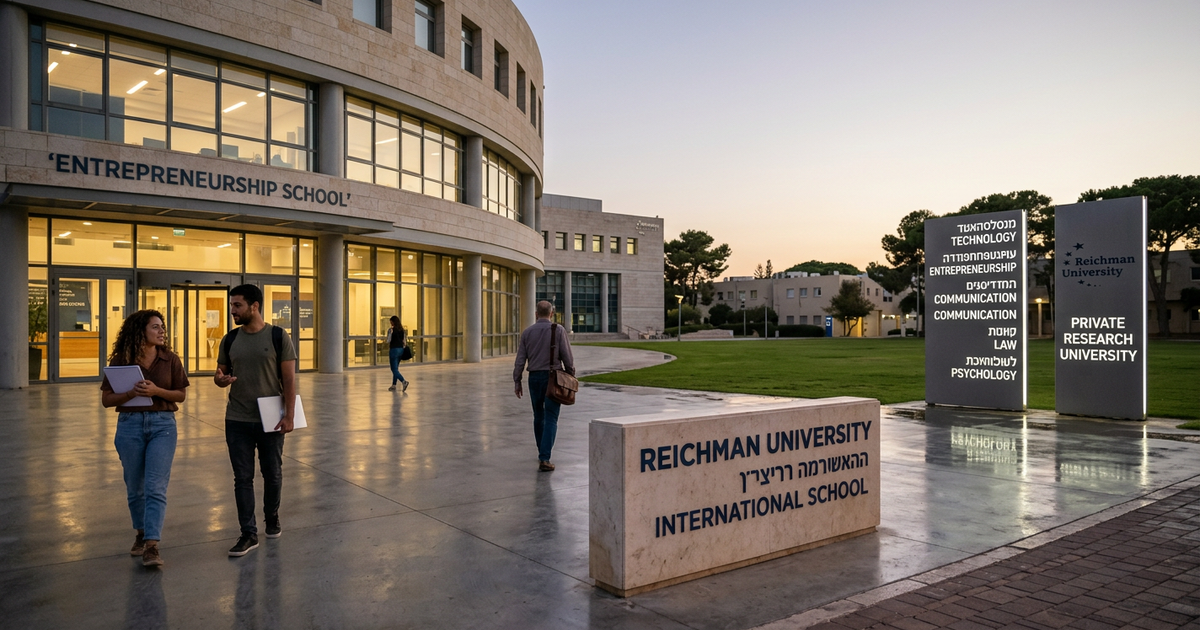
Reichman University is Israel's only private research university and the closest analog to a Stanford-style entrepreneurship-tilted institution. Why no second has emerged.
Reichman University (formerly IDC Herzliya), founded by Uriel Reichman in 1994, became Israel's first private research university. It is structurally distinct from the public university system: tuition-funded, board-governed, and free to set faculty compensation and research priorities outside the Council for Higher Education's public-university framework.
Reichman has produced an outsized share of recent Israeli founders, particularly through its Adelson School of Entrepreneurship and the Zvi Meitar Institute. The school's computer science, business, government, and entrepreneurship programs explicitly emulate Stanford and INSEAD models.
Why no second private research university has emerged
-
Regulatory friction. The CHE has been institutionally reluctant to grant new private-university status. Reichman's upgrade from college to university took years of regulatory engagement.
-
Capital intensity. A research-grade STEM faculty requires sustained donor flow, lab capex, and faculty compensation that approaches US private-university scales. Few Israeli donors have written checks at that scale outside the public-university Friends-of-X channels.
-
The public university subsidy. Israeli public universities are heavily subsidized through CHE allocations. Charging full-cost tuition for the same product is competitively difficult.
-
The Reichman model itself is not easily replicable. Reichman's success rested on a specific founder's 30-year institution-building project. Few comparable institutional founders are visible today.
What might change the equation
-
The Adani-style donor. A single multi-billion-shekel donor could plausibly capitalize a new private research university with the right entrepreneurial culture. There is no announced such donor, but the donor pool exists.
-
The Saudi/Gulf model. KAUST and similar Gulf research universities have shown that very large, single-source capital can stand up a research institution in a decade. The Israeli regulatory environment is more constrained than the Saudi one, but the financial model is informative.
-
AI-era retraining demand. A more practical pathway: private vocational/professional institutions focused on AI, semiconductors, and applied science could grow under existing regulatory regimes without needing full university status. Watch the Israeli vocational-tech space for this dynamic.
For now: Reichman remains a unique institution. Its alumni share in Israeli founder cohorts is the single best argument for the model's replicability.