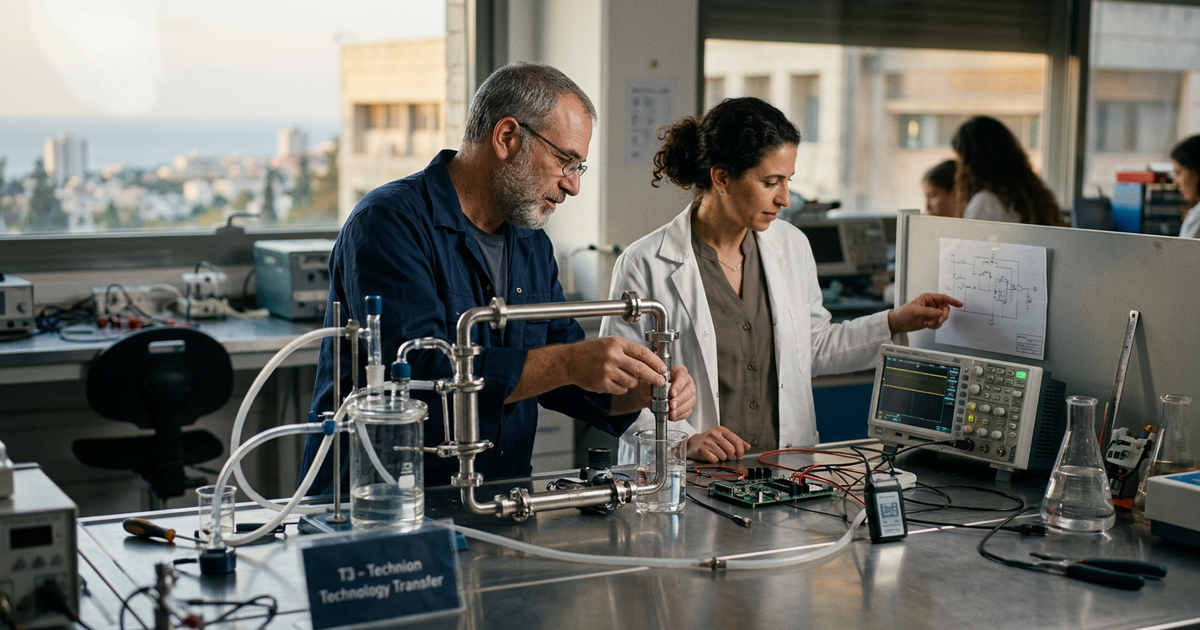

The Technion, founded 1912, opened 1924, has produced four Nobel laureates in Chemistry and trained the engineers behind Check Point, Wiz, and Waze. Its founding fight was over whether Hebrew could carry a science curriculum.
The Technion, Israel Institute of Technology, is Haifa's founding engineering university and the largest single source of Israeli tech founders. Founded in 1912 and opened for instruction in 1924, it has produced four Nobel laureates in chemistry and anchors Haifa's technology cluster.
The Technion, Israel Institute of Technology, is Haifa's founding engineering university and the single largest source of Israeli tech founders, credited with training the people behind Check Point, Wiz, and Waze. Founded in 1912 and opened for instruction in 1924, it has produced four Nobel laureates in chemistry and anchors Haifa's technology cluster alongside Intel, Microsoft, and Apple's Israeli R&D centers.
Institution Snapshot
| Founded | Cornerstone laid 1912 in Haifa; opened for instruction 1924, delayed by World War I |
| Main campus | Neve Sha'anan, Haifa, on the slopes above Haifa Bay |
| Enrollment | Approximately 14,000 students across undergraduate, master's, and doctoral programs |
| Faculties | Computer Science, Electrical and Computer Engineering, Industrial Engineering and Management, Mechanical Engineering, Aerospace Engineering, Biomedical Engineering, Civil and Environmental Engineering, Materials Science, Mathematics, Physics, Chemistry, Biology, Rappaport Faculty of Medicine |
| Nobel laureates on faculty | Four, all in Chemistry: Avram Hershko and Aaron Ciechanover (2004), Dan Shechtman (2011), Arieh Warshel (2013) |
| Technology transfer | Technion Research and Development Foundation (TRDF) and T3 (Technion Technology Transfer) |
| International partnership | Jacobs Technion-Cornell Institute at Cornell Tech, New York, established 2011 |
| Diaspora funding vehicle | American Technion Society, one of the principal channels for U.S. Jewish philanthropy into Israeli engineering research |
The War of the Languages Made Hebrew the Language of Israeli Science
The Technion's founding fight was not about engineering. In October 1913, the German-Jewish philanthropic organization Hilfsverein der deutschen Juden, which was funding the new institution, chose German as its language of instruction, arguing Hebrew lacked the scientific vocabulary for university-level study. The decision triggered the War of the Languages, a Yishuv-wide campaign of protests, teacher strikes, and boycotts led by figures including Eliezer Ben-Yehuda and Menachem Ussishkin. The Hilfsverein's board reversed itself in February 1914 and adopted Hebrew. The dispute delayed the Technion's opening by a decade, but it also settled, before the university had taught a single class, that science in the future Jewish state would be taught in Hebrew.
A Nobel Record Concentrated in One Discipline
All four of the Technion's Nobel laureates won in Chemistry, and three of the four prizes trace to a single research relationship. Aaron Ciechanover joined Avram Hershko's biochemistry lab at the Rappaport Faculty of Medicine as a graduate student in 1976; the two, working with Irwin Rose of the University of California, Irvine, discovered ubiquitin-mediated protein degradation, the mechanism by which cells break down unneeded proteins, and shared the 2004 Nobel Prize in Chemistry for it. Dan Shechtman, a Technion materials science graduate who returned to its faculty, won the 2011 Nobel Prize in Chemistry for discovering quasicrystals. Arieh Warshel, who completed his undergraduate work at the Technion, won the 2013 Nobel Prize in Chemistry for developing multiscale models of complex chemical systems.
The Founder Pipeline Behind Check Point, Wiz, and Waze
Check Point, one of Israel's first and largest cybersecurity companies, was founded by Gil Shwed, Marius Nacht, and Shlomo Kramer, with Shwed's path running through the Talpiot military-technology program before Technion-adjacent engineering training. Wiz, the cloud-security company Google agreed to acquire for roughly $32 billion in 2024, traces to the same founding team's earlier company, Adallom, which sold to Microsoft, and to a Technion engineering pipeline behind both. Waze was founded by Ehud Shabtai, Uri Levine, and Amir Shinar, with Shabtai and Shinar drawing on Technion-ecosystem engineering backgrounds. Mobileye, by contrast, was founded by Amnon Shashua, a Hebrew University faculty member, illustrating that the Technion's influence on Israeli tech runs through engineering talent and research infrastructure as much as through founder pedigree alone.
Why the Technion Feeds Israel's Military-Technology Units
The Technion's graduate programs sit downstream of Israel's elite military intelligence and technology units, including Unit 8200 and Talpiot. Graduates of those units frequently complete Technion graduate degrees before founding companies, often alongside academic supervisors who become technical co-founders or advisors. That two-directional flow, from military unit into the university and from the university into industry, is one of the most consistently cited structural explanations for Israel's unusually high concentration of PhD-holding startup founders.
Cornell Tech Gave the Technion a Permanent New York Foothold
The Jacobs Technion-Cornell Institute at Cornell Tech, on Roosevelt Island in New York City, was established in 2011 after Cornell and the Technion jointly won the Bloomberg administration's applied-sciences competition. It remains the most consequential international academic partnership any Israeli university has built, giving the Technion a permanent institutional presence inside the largest technology employment market in the United States.
The Haifa Cluster the Technion Anchors
Haifa's technology cluster, including Intel Haifa, Microsoft Israel R&D, Apple's Israeli development center, IBM Israel, and Rafael Advanced Defense Systems' research operations, sits in proximity to the Technion campus and draws heavily on its engineering graduates. The cluster functions as Israel's second major technology center after the greater Tel Aviv area, and the Technion is its structural anchor.
Frequently Asked Questions
When was the Technion founded?
The Technion's cornerstone was laid in Haifa in 1912. Instruction began in 1924 after the War of the Languages and World War I delayed the opening by a decade.
How many Nobel Prizes has the Technion produced?
Four, all in Chemistry: Avram Hershko and Aaron Ciechanover in 2004, Dan Shechtman in 2011, and Arieh Warshel in 2013.
Which Israeli companies did Technion alumni found?
Check Point (Gil Shwed, Marius Nacht, Shlomo Kramer), Wiz (via the Adallom founder pipeline), and Waze (Ehud Shabtai, Amir Shinar), among others. Mobileye was founded by Amnon Shashua of Hebrew University but drew heavily on Technion-trained engineering talent.
What is Cornell Tech's connection to the Technion?
The Jacobs Technion-Cornell Institute at Cornell Tech is a joint graduate school on Roosevelt Island in New York, established in 2011 through the Bloomberg administration's applied-sciences competition.
Sources
Technion, Israel Institute of Technology public disclosures and institutional history. American Technion Society public reporting. Zionist Archives and University of Haifa historical records on the War of the Languages. Nobel Prize official records.
Related Olam Coverage
Israeli Academic Anchors — Profiles
Weizmann Institute · Hebrew University · Ben-Gurion University · Bar-Ilan University · Tel Aviv University · Reichman University · University of Haifa · Technion
See also: Amnon Shashua · Unit 8200 · The Builders · 5W AI Higher Education Index 2026 (for a ranking-based comparison against global peers)