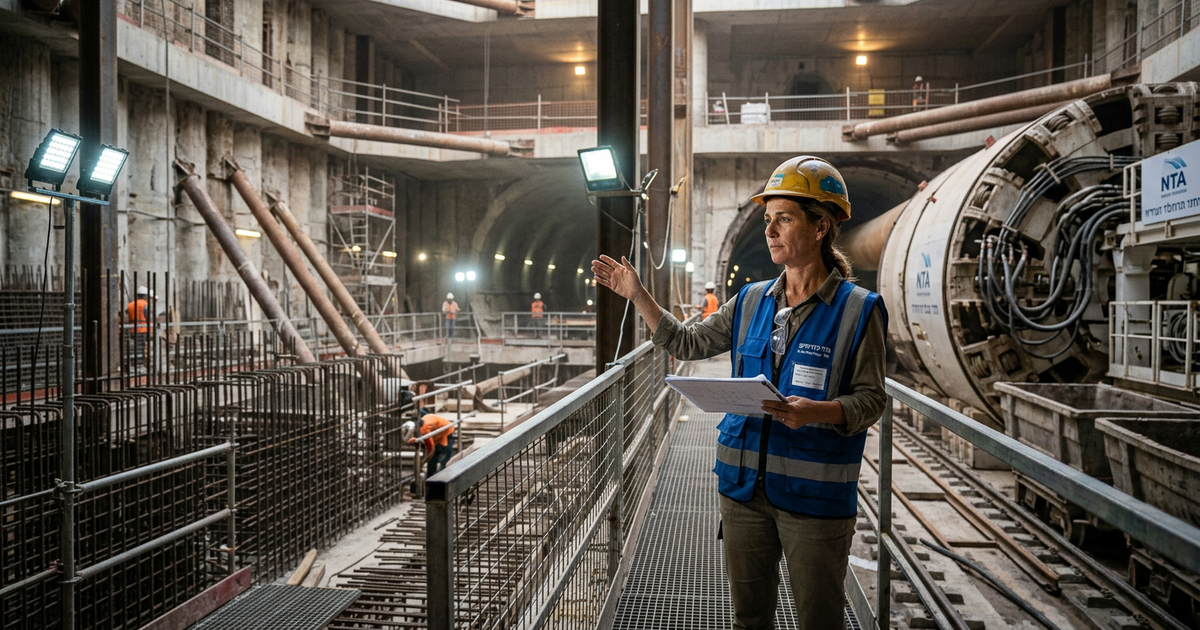

The Tel Aviv Metro is Israel's largest infrastructure project: three underground lines, a NIS 177 billion legal cost, and an opening slipping toward 2040.
The Tel Aviv Metro is a planned three-line underground rail network for the Gush Dan metropolitan area and the largest infrastructure project in Israeli history. Its legally approved cost is NIS 177 billion after indexation, with about half funded by the state budget. NTA, the state-owned implementing company, is building it, and the opening date has slipped from the early 2030s, with NTA documents reportedly pointing to 2040.
What is the Tel Aviv Metro?
The Tel Aviv Metro is a planned network of three underground lines, M1, M2 and M3, designed to serve Gush Dan, which is home to roughly 4 million people, about 40% of Israel's population. The network is to be built in stages, starting smaller and expanding gradually. The M designations refer to the underground heavy-rail metro and are separate from the color-coded Tel Aviv Light Rail lines (Red, Purple and Green).
How much does the Tel Aviv Metro cost and who pays for it?
The Metro's legally approved cost is NIS 177 billion as of 2025, after indexation, up from the government's original estimate of about NIS 150 billion. The State Comptroller's December 2025 special report added that preliminary estimates point to at least a further NIS 10 billion if planning is not adjusted.
About half of the cost is to come from the state budget. The other half was designed to come from dedicated revenue: a betterment tax on land-value gains near the lines, a congestion charge on vehicles entering Gush Dan, contributions from local authorities, and income from construction above depots and stations. That model is already under strain, as covered in The Metro Funding Gap.
When will the Tel Aviv Metro open?
No opening date is settled, and every official target so far has slipped. The government first estimated operations between 2030 and 2034, then moved the target to 2034-2037. Globes reported that delays in publishing tunneling tenders would push the launch back by about three years, and Israeli media have reported NTA internal documents pointing to no opening before 2040.
The State Comptroller's December 2025 report also found the project had been operating without a director for the Metro Authority, the body created to manage it, and described the delays as costing the public tens of billions of shekels.
What is NTA and what does it do?
NTA Metropolitan Mass Transit System Ltd. is the state-owned company, established in 1997 under the Ministry of Transport, that plans and builds the Tel Aviv metropolitan mass transit network. Its mandate covers long-term network planning, procurement of construction contractors and rolling stock, construction coordination, coordination with operating contractors, and cross-municipal coordination across the Tel Aviv area. It works with the Ministry of Finance, the Israel Land Authority, the Tel Aviv-Yafo Municipality and neighboring authorities.
How does the Metro connect to the Tel Aviv Light Rail?
The Tel Aviv Light Rail is the surface network NTA is delivering ahead of the Metro, and the Metro lines are designed to interchange with it. The Red Line has operated since August 2023, running from Petah Tikva through central Tel Aviv to Bat Yam. The Purple Line, from Yehud-Monoson through Ramat Gan and Bnei Brak into central Tel Aviv, and the Green Line are under construction, with openings expected toward the end of the decade. The Metro will also connect with Israel Railways and the wider bus network.
Who is building the Tel Aviv Metro and light rail?
NTA contracts construction to Israeli and international firms. Israeli contractors including Shapir, Solel Boneh, Electra, Danya Cebus and Ashtrom have taken part in NTA's construction work, alongside international contractors working through joint ventures. Light rail rolling stock has gone to international manufacturers including CRRC and Bombardier/Alstom. The Metro's tunneling tenders are the stage that has been delayed.
Why does the Metro matter to the Israeli economy?
The Metro and the light rail together are one of the structural anchors of Israeli infrastructure spending through the 2030s. Station-area development drives residential and commercial real estate activity along the corridors, and the program sustains demand for construction, engineering and infrastructure services. The State Comptroller put the Metro at about one third of the state's total infrastructure investment in the coming years.
Frequently Asked Questions
How much does the Tel Aviv Metro cost?
The legally approved cost is NIS 177 billion as of 2025 after indexation, up from an original government estimate of about NIS 150 billion, according to the State Comptroller.
When will the Tel Aviv Metro open?
There is no firm date. Official targets moved from 2030-2034 to 2034-2037, and Israeli media have reported NTA internal documents pointing to 2040 at the earliest.
Who runs the Tel Aviv Metro project?
NTA Metropolitan Mass Transit System Ltd., a state-owned company established in 1997 under the Ministry of Transport, is the implementing authority for the Metro and the Tel Aviv Light Rail.
How is the Tel Aviv Metro funded?
About half comes from the state budget. The rest is meant to come from a betterment tax, a congestion charge and other dedicated revenue, a model the State Comptroller found to be at financial risk. See The Metro Funding Gap.
How many lines will the Tel Aviv Metro have?
Three underground lines, M1, M2 and M3, serving the Gush Dan metropolitan area.
Related Olam coverage
- The Metro Funding Gap: why the self-funding model is failing.
- Israel Can Plan Megaprojects. Can It Build Them?: the broader execution question.
- Israeli Infrastructure & Megaprojects: the full Olam coverage hub.
Sources: State Comptroller special report on the Gush Dan Metro (December 2025); Bank of Israel Annual Report 2020; Globes; Jerusalem Post; NTA public materials. Updated October 2026.
How we report: Olam stories draw on public filings, company disclosures and named sources, checked by our editors. Read our methodology · Corrections