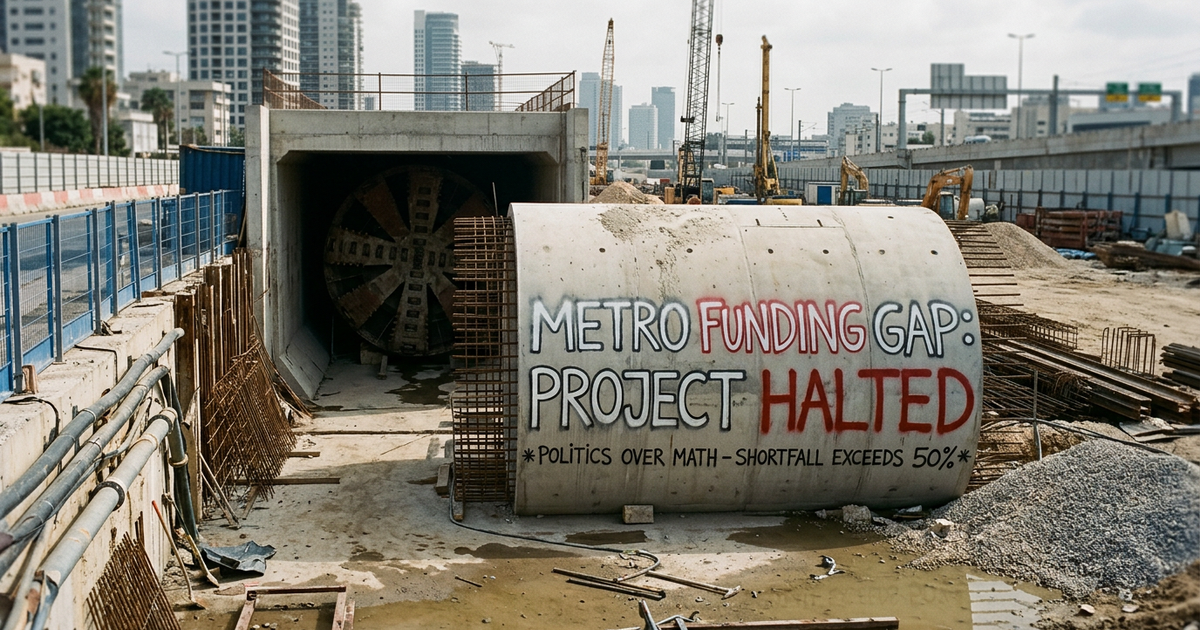

Half the Tel Aviv Metro is supposed to pay for itself through dedicated taxes. Those taxes are coming in short, the bridge financing doesn't exist, and the politics are fighting the math.
The Tel Aviv Metro has a number set in law, 177 billion shekels, and a funding model that was supposed to make half of it pay for itself. That half is already short. The dedicated betterment tax meant to fund the project has seen its projected revenue fall from 38–43 billion shekels to 25–30 billion, the bridge financing to cover the timing gap does not yet exist, and the congestion charge that completes the model is politically stranded. The Metro's deepest risk is not engineering. It is the financing model itself, and it is already failing in three places at once.
What is the Tel Aviv Metro's self-funding promise?
The logic of the funding model is sound in theory. A metro line raises the value of nearby land; a betterment tax captures part of that uplift to help pay for the line that created it. A congestion charge discourages driving while generating revenue earmarked for transit. Together they were projected to cover about half of the project, the politically attractive idea that the Metro would substantially fund itself rather than draining the general budget. NTA, the state implementation authority, administers the program against this funding model.
Why is the betterment-tax revenue coming in short?
In practice, the betterment-tax stream has already shrunk. The State Comptroller's December 2025 report found that projected revenues fell from an initial 38–43 billion shekels to 25–30 billion, a shortfall of roughly 13 billion driven largely by reductions in the applicable tax rates. That is not a rounding error; it is a meaningful share of the project's self-funding half evaporating before major construction has even begun. When the mechanism designed to cover half the cost delivers materially less, the difference has to come from somewhere, and the only somewhere is the state.
Why doesn't the bridge financing exist yet?
Here the report identified the sharpest problem. Even if the dedicated revenues eventually materialize, they arrive over decades, long after the bills for tunneling and stations come due. That timing mismatch requires tens of billions of shekels in interim financing to bridge the years between spending and collection. As of the audit, the Finance Ministry had not presented the government with any approved mechanism to provide that bridge. A project a third the size of all state infrastructure spending is being built without a settled answer to how its near-term cash flow will be covered.
Why is the congestion charge politically stranded?
The congestion charge, the second pillar of the self-funding model, is legally designated as a key Metro revenue source, with a contractor already selected and a launch planned for 2027. It is also being actively opposed by the Transportation Minister. A funding stream written into the project's economics is now hostage to a political fight over whether it will be implemented at all. If it is not, another load-bearing piece of the financing model gives way, and the gap the state must fill grows again.
The argument, stated plainly
The Metro's funding model was designed to make a 177-billion-shekel project palatable by promising it would largely pay for itself. That promise is unraveling in three places at once: the betterment tax is yielding less than planned, the bridge financing has not been designed, and the congestion charge is politically stranded. None of this means the Metro will not be built; the broader execution question is its own piece (see Israel Can Plan Megaprojects. Can It Build Them?). It means the comfortable story about how it gets paid for was always more fragile than the headline budget suggested. It also means the true cost to the public purse is likely to be higher, and to arrive sooner, than the model promised. The engineering risk gets the attention. The financing risk is the one that has already started to materialize.
Frequently Asked Questions
How much does the Tel Aviv Metro cost, and how much of that is self-funded?
The project's cost is set in law at 177 billion shekels. The funding model was designed so that dedicated taxes, a betterment tax on nearby land value and a planned congestion charge, would cover roughly half of that total, with the state budget covering the rest.
Why did the betterment-tax revenue projection fall?
Israel's State Comptroller reported in December 2025 that projected betterment-tax revenue fell from an initial 38–43 billion shekels to 25–30 billion, a roughly 13-billion-shekel shortfall driven largely by reductions in the applicable tax rates.
What is the Tel Aviv Metro's bridge-financing problem?
The dedicated tax revenues arrive over decades, well after construction costs come due. As of the Comptroller's audit, the Finance Ministry had not presented the government with an approved mechanism to cover that multi-decade timing gap with interim financing.
What is the status of the Tel Aviv congestion charge?
A congestion charge is legally designated as a Metro revenue source, with a contractor already selected and a 2027 launch planned, but Israel's Transportation Minister has actively opposed it, leaving that funding pillar politically unresolved.
Who runs the Tel Aviv Metro project?
NTA (Metropolitan Mass Transit System Ltd.) is the Israeli government implementation authority responsible for the Tel Aviv metropolitan light rail and metro network, including the Metro program described here. Tel Aviv Metro: Cost, Timeline and the NTA Behind It covers its role in full.
Related Olam coverage
- Tel Aviv Metro: Cost, Timeline and the NTA Behind It: the three planned lines, the cost, the timeline and the authority building it.
- Israel Can Plan Megaprojects. Can It Build Them?: the broader execution question.
- The Jerusalem Light Rail Expansion: the comparable transit megaproject in Jerusalem.
- Israeli Infrastructure & Megaprojects: the full Olam coverage hub.
How we report: Olam stories draw on public filings, company disclosures and named sources, checked by our editors. Read our methodology · Corrections