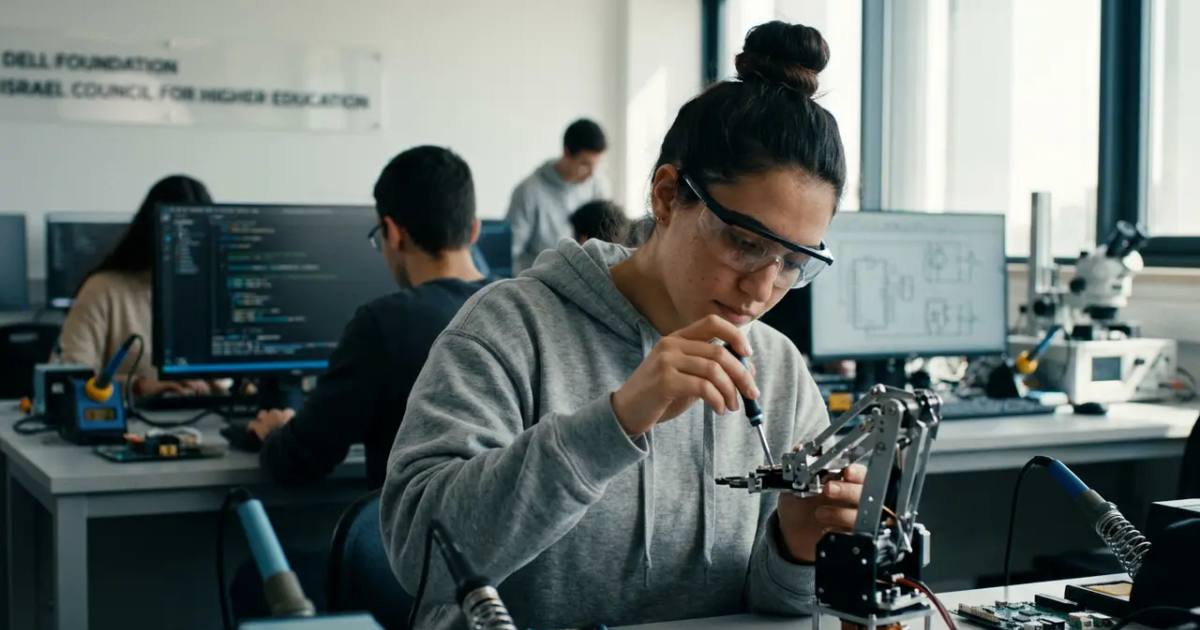

Tech Leaders, a 170M NIS Dell Foundation and CHE-PBC program, funds up to 1,500 underrepresented Israeli students in STEM degrees over five years.
The Michael & Susan Dell Foundation and Israel's Council for Higher Education Planning and Budgeting Committee (CHE-PBC) have launched the Dell IL CHE-PBC Tech Leaders program, known as Tech Leaders: an estimated 170 million NIS investment split evenly between the two organizations. The program will fund up to 1,500 students from underrepresented communities through STEM degrees over five years. A student who misses this pipeline has few comparable entry points into Israeli high-tech.
Who Does Tech Leaders Serve?
Tech Leaders targets four groups: Israel's ultra-Orthodox and Arab communities, Ethiopian-Israelis, and young people from the country's social periphery. Arab Israelis make up roughly a fifth of Israel's population but a much smaller share of its hi-tech workforce, according to Jewish Telegraphic Agency reporting on similar workforce-integration efforts.
Selection happens before candidates enter university, not after. Candidates are identified for potential rather than existing academic record, then given the preparatory support needed to qualify for STEM programs.
What Does Tech Leaders Funding Cover?
Each accepted Tech Leaders student receives a package that spans the full length of their academic path:
- Financial assistance from preparatory coursework through degree completion
- Living stipend
- A laptop
- Mentorship
- Career preparation and employer connections
The program's own site, Dell IL CHE-PBC Tech Leaders, confirms this structure: tuition coverage, a living stipend, and a laptop, plus academic advising, mentorship, and employer connections that continue from the pre-Mechina preparatory stage through a bachelor's degree and into a first job, according to the Tech Leaders official site. The Dell Foundation's own grants database lists the partnership as an active grant under its Israel portfolio.
The model mirrors what the Dell Foundation runs elsewhere. In South Africa, its Dell Young Leaders program has produced an 86% graduation rate among participants, with 98% placed in jobs or graduate programs within three months, according to the Dell Foundation's global scholarships page.
How Do Students Apply to Tech Leaders and Who Qualifies?
Applicants must first register for or be enrolled in a pre-Mechina or Mechina preparatory program at one of four partner institutions: Ben-Gurion University of the Negev, Hebrew University of Jerusalem, Technion, or Bar-Ilan University, according to the program's official FAQ. Students who complete the preparatory stage keep their place through a bachelor's degree at one of eight partner institutions, adding University of Haifa, Ariel University, Azrieli College of Engineering Jerusalem, and Sami Shamoon College of Engineering.
Eligible fields cover science, technology, engineering, mathematics, and agriculture, but exclude biology, per the same source. Candidates must also meet income and residency criteria as of age 18. The current application window closes October 18, and the program's FAQ notes that applying early increases the odds of acceptance.
Why Does Israel Need a Program Like Tech Leaders?
Tech Leaders lands against a backdrop of documented strain in Israel's STEM pipeline. Only 11.3% of Israeli high school graduates complete a full "hi-tech matriculation" combining advanced math, physics, and computer science, according to Israel's National Council for Civilian Research and Development, as reported by The Jerusalem Post. Hi-tech employment has stagnated at roughly 11.5% of the national workforce for three consecutive years, per the same reporting.
That gap is not evenly distributed. Socioeconomic background explains 20% of the variance in Israeli math achievement, compared with 15% across the OECD average, according to The Jerusalem Post's analysis of PISA data. Tech Leaders targets the ultra-Orthodox, Arab, and Ethiopian-Israeli communities and the social periphery precisely because that gap is widest there.
How Does Tech Leaders Differ From Earlier Israeli Tech-Inclusion Efforts?
Tech Leaders is not the first attempt to widen who gets into Israeli high-tech. In 2018, Start-Up Nation Central launched EXCELLENTEAM, a pilot to train Arab and ultra-Orthodox computer science graduates for industry jobs, citing a shortage of 12,000 to 15,000 skilled tech workers, according to The Times of Israel. That program started with 20 participants in each community and targeted graduates who already held a degree.
| Program | Entry point | Target population | Launch |
|---|---|---|---|
| Tech Leaders | Pre-Mechina / Mechina, before a STEM degree | Ultra-Orthodox, Arab, Ethiopian-Israeli, social periphery | 2026 |
| EXCELLENTEAM | Post-degree, already holding a CS degree | Arab and ultra-Orthodox graduates | 2018 |
Tech Leaders differs by intervening earlier and by tying its funding directly to the Council for Higher Education's own budgeting arm rather than a coalition of outside NGOs and companies.
Who Leads Tech Leaders?
Tali Barash-Bouskila, who heads the Dell Foundation's Israel office, said the initiative is designed to address the obstacles that keep talented candidates from reaching engineering and science programs. Barash-Bouskila previously led the Moshal Program, which expanded higher education access in Israel and South Africa, and has held senior roles at McGraw-Hill Education and Lehman Brothers. She holds a master's degree in education from Kibbutzim College and an MBA from Harvard Business School.
What Happens Next for Tech Leaders?
Tech Leaders is structured as a five-year commitment, with the Council for Higher Education's Planning and Budgeting Committee matching the Dell Foundation's contribution dollar for dollar. The program joins a wider field of Israeli initiatives, including JDC-Tevet and Start-Up Nation Central's EXCELLENTEAM pilot, aimed at closing the same representation gap through direct funding and preparation rather than after-the-fact hiring incentives. For related coverage of how philanthropic capital moves into Israeli institutions, see Olam's Global Jewish Philanthropy and Israeli Health and Biotech coverage.
Frequently Asked Questions
Who does Tech Leaders serve?
Tech Leaders targets Israel's ultra-Orthodox and Arab communities, Ethiopian-Israelis, and young people from the country's social periphery, groups underrepresented in Israeli STEM programs relative to their share of the population.
What does Tech Leaders funding cover?
Each accepted student receives financial assistance from preparatory coursework through degree completion, a living stipend, a laptop, mentorship, and career preparation with employer connections, according to the official Dell IL CHE-PBC Tech Leaders site.
How do students apply to Tech Leaders and who qualifies?
Applicants first register for a pre-Mechina or Mechina preparatory program at Ben-Gurion University of the Negev, Hebrew University of Jerusalem, Technion, or Bar-Ilan University, then keep their place through a bachelor's degree at one of eight partner institutions. Eligible fields cover science, technology, engineering, mathematics, and agriculture, excluding biology, and the current application window closes October 18, according to the program's official FAQ.
Why does Israel need a program like Tech Leaders?
Only 11.3% of Israeli high school graduates complete a full hi-tech matriculation combining advanced math, physics, and computer science, and hi-tech employment has stagnated at roughly 11.5% of the national workforce for three straight years, according to Israel's National Council for Civilian Research and Development as reported by The Jerusalem Post.
How does Tech Leaders differ from earlier Israeli tech-inclusion efforts?
Tech Leaders intervenes earlier, at the pre-Mechina and Mechina stage before a student has committed to a STEM degree, and ties its funding directly to the Council for Higher Education's budgeting arm, unlike Start-Up Nation Central's 2018 EXCELLENTEAM pilot, which trained graduates who already held a degree.
Who leads Tech Leaders?
Tali Barash-Bouskila, who heads the Dell Foundation's Israel office, leads Tech Leaders. She previously led the Moshal Program and has held senior roles at McGraw-Hill Education and Lehman Brothers.
What happens next for Tech Leaders?
Tech Leaders is structured as a five-year commitment, with the Council for Higher Education's Planning and Budgeting Committee matching the Dell Foundation's contribution dollar for dollar.
How we report: Olam stories draw on public filings, company disclosures and named sources, checked by our editors. Read our methodology · Corrections