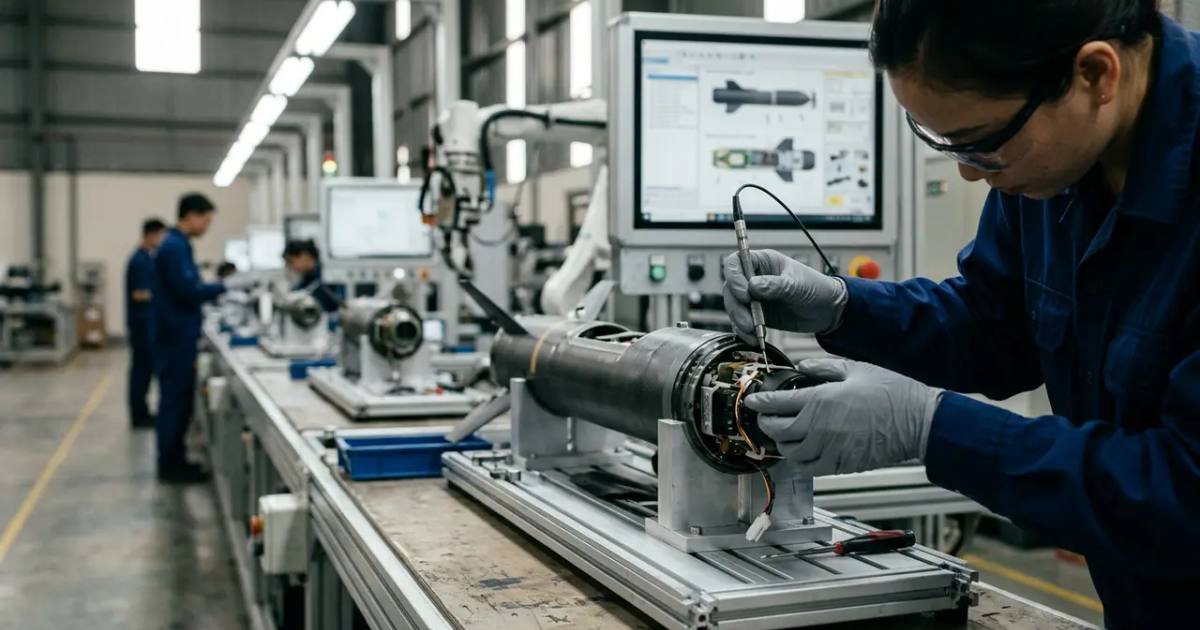

Israel is Vietnam's second-largest arms supplier after Russia. A new $250 million deal gives Vietnam its own factory to build Rafael's newest loitering munition — part of a relationship spanning a decade-old rifle plant, an active free-trade deal, and new direct flights.
Israel is Vietnam's second-largest arms supplier after Russia, and the relationship just crossed a new threshold: a $250 million deal signed in February 2026 gives Vietnam its own factory to build one of Rafael's newest loitering munitions on Vietnamese soil. The partnership runs alongside a free-trade agreement, a rifle plant that has operated since 2011, and direct flights that only started this year — all despite Vietnam's long public history of solidarity with the Palestinian cause.
The $250 Million Spike Factory
Vietnam's Ministry of Defense signed an agreement with Rafael Advanced Defense Systems in early February 2026 for a domestic production facility to manufacture the L-Spike 1X (formerly known as Firefly), a tactical loitering munition with a strike range up to 40 kilometers designed for company-level ground forces, particularly in urban environments. The roughly $250 million deal includes full technology transfer from Israel, with a Vietnamese company receiving a Rafael production license to build the missile domestically rather than simply importing finished units. Rafael has not officially confirmed the reporting, which originated with the French defense-and-intelligence outlet Intelligence Online, but multiple Israeli and Asian defense outlets have since corroborated the deal terms. Vietnam becomes at least the sixth country outside Israel with a Spike-family licensed production or resale arrangement, alongside recent deals with Thailand and a long-standing reseller relationship in Australia — with three of those six arrangements landing in just the past three years.
A Decade of Buildup Before the Big Deal
The 2026 factory deal did not appear from nowhere. Israel Weapon Industries built a $100 million production facility in Vietnam in 2011 to manufacture Galil ACE assault rifles for the Vietnam People's Army, and Vietnam signed a formal defense memorandum of understanding with Israel in 2015, appointing an Israeli defense attaché to Hanoi. Since then, per Stockholm International Peace Research Institute tracking, Vietnam has acquired Rafael's SPYDER air defense system (roughly $600 million about a decade ago) and IAI Heron surveillance drones, while the Vietnamese Air Force has separately shown interest in IAI's Barak MX air defense system. Israeli arms sales appeal to Hanoi specifically because they typically arrive without the political end-use conditions that Western and especially American suppliers often attach — a genuine advantage for a government trying to diversify away from historical dependence on Russian and Chinese equipment without taking on new strings.
Why Now: The South China Sea, Not Gaza
Vietnam's accelerating defense relationship with Israel is driven almost entirely by regional geography rather than Middle East politics. China has expanded its presence across disputed areas of the South China Sea also claimed by Vietnam, the Philippines, and Thailand, and Hanoi is trying to build independent strike and surveillance capability without over-relying on any single foreign patron. Overall Israeli defense exports to the Asia-Pacific region nearly doubled between 2024 and 2025, from about $3.4 billion to $6.1 billion, out of a record $19.2 billion in total Israeli arms exports in 2025 — and industry analysts say the model increasingly sought by Asian governments is co-production and technology transfer, not simple purchase orders, which is exactly the template the 2026 Vietnam deal follows.
The Trade and Travel Layer
Since October 7, 2023, Vietnam has moved to deepen ties on the civilian side too: a free-trade agreement between the two countries took effect, with bilateral trade reaching $3.75 billion in 2025 and $1.6 billion in the first five months of 2026 alone, including $462 million in Vietnamese exports to Israel. In January 2026, Israeli carrier Arkia launched direct flights between Tel Aviv and Hanoi, the first direct air link between the two countries. None of this has been uncontroversial inside Vietnam, a one-party state whose founding leader Ho Chi Minh was an outspoken supporter of the Palestinian cause; the growing defense and trade relationship with Israel sits in open tension with that history, even as the government continues to expand it.
The Map, at a Glance
- 2026 Spike factory deal — ~$250 million, Rafael L-Spike 1X (Firefly) loitering munition, full technology transfer, domestic production license.
- Rank — Israel is Vietnam's second-largest arms supplier after Russia.
- Prior deals — Galil ACE rifle factory (2011, $100M), SPYDER air defense (~$600M), Heron drones, interest in Barak MX.
- Civilian layer — active free-trade agreement, $3.75B trade in 2025, direct Tel Aviv-Hanoi flights since January 2026.
Frequently Asked Questions
Is Israel Vietnam's largest arms supplier?
No. Israel is Vietnam's second-largest arms supplier after Russia, though the relationship has deepened significantly since 2011.
What is the L-Spike 1X?
Also known as Firefly, it is one of the newest variants of Rafael's Spike missile family — a tactical loitering munition with a strike range of up to 40 kilometers, designed for ground forces in urban combat environments.
Does Vietnam manufacture any Israeli weapons domestically?
Yes. Israel Weapon Industries has operated a Galil ACE rifle factory in Vietnam since 2011, and a new $250 million deal signed in February 2026 will add domestic production of Rafael's L-Spike 1X loitering munition.
Sources
AsiaNews, Israeli military exports to Asia-Pacific (2026); Middle East Eye, Vietnam-Israel defense ties and Palestinian solidarity tension; Left Voice, Vietnam-Israel trade and defense figures (2026); DIMSE, Vietnam-Israel defense relationship database; Calcalist, Vietnam Spike factory deal reporting; Jerusalem Post, Israeli defense demand across Asia.