
The Green Party voted 1,022 to 813 to brand Zionism racist, splitting its own Jewish members and drawing condemnation from Israel's government and Jewish communal leaders.
The Green Party of England and Wales voted 1,022 to 813 on October 4, 2026 to adopt a conference motion declaring Zionism racist, according to the Jerusalem Post's conference report. An amendment protecting Jewish members who belong to Zionist-identifying synagogues failed 684 to 1,026. The vote lands as British Jewish support for the Green Party has been rising for more than a year, and it split the party's own Jewish members as much as it drew outside condemnation.
What Did the Green Party's 'Zionism Is Racism' Motion Say?
The motion recognizes Zionism as Israel's foundational ideology and states that it has created and maintained an apartheid regime between the Jordan River and the Mediterranean Sea, according to the Jerusalem Post. It supports a single democratic Palestinian state across all of historic Palestine with Jerusalem as its capital, with no mention of Israel continuing to exist alongside it, according to ITV News' report on the vote. Delegates rejected the protective amendment for Zionist-identifying synagogue members by a wider margin than the one by which the core motion passed.
Why Did the Green Party's Own Jewish Members Split on the Vote?
Jewish Greens, the party's internal Jewish group, declined to take an official position on the motion after a pre-conference survey of its own members returned an almost even split, according to the Jerusalem Post. Asked on a 0 to 10 scale whether the group should collectively oppose the motion, members averaged 5.1.
Most Jewish Greens, 81%, identify as anti-Zionist or non-Zionist, and 80% of the group's Zionist respondents opposed the motion. The anti-Zionist majority was itself divided: 70% strongly support de-proscribing Palestine Action, 64% strongly support Palestinians resisting occupation through means permitted under international law, and support split exactly in half on whether UK citizens who fight alongside the Israeli military should face prosecution.
What Happened at the Conference's Jewish 'Safe Room'?
Jewish members of the Green Party said organizers set aside a designated safe room during the Brighton conference for Jewish attendees who felt unsafe, according to the Mail on Sunday as reported by the Jerusalem Post. One member told the paper the room was used on the conference's first day to host a meeting between a rabbi and Jewish attendees.
How Have UK Rabbis Responded to the Vote?
Rabbi Charley Baginsky and Rabbi Josh Levy, co-leads of the Movement for Progressive Judaism, said the motion is hostile to Jews in both its wording and its intent, according to the Jerusalem Post. They said adopting it makes antisemitism party policy, that Jewish self-determination is a right, and that branding it racist makes equal participation in the party conditional on Jewish members renouncing that belief. Support for the motion from some Jewish members, they added, does not excuse discrimination against others.
How Have Israel's Government and British Jewish Groups Responded?
Israel's Ministry of Foreign Affairs said the vote gives legitimacy to terrorism and "goes far beyond the boundaries of legitimate political debate," according to the Jewish Telegraphic Agency. The Board of Deputies of British Jewry, the Jewish Leadership Council and the Community Security Trust had separately written to Green Party leaders ahead of the conference, warning the motion would make the party the first electorally significant UK party in living memory to adopt what the groups called an overtly antisemitic platform, and that it risked fueling hatred of Jews rather than criticism of Israeli policy.
Who Is Zack Polanski, the Green Party's Jewish Leader?
Zack Polanski, elected Green Party leader in September 2025 with 20,411 votes against 3,705 combined for his rivals, skipped the conference vote to campaign in the Holborn and St Pancras by-election, according to ITV News. He addressed delegates before leaving, telling the conference, "Drop the charges. End the genocide. Deproscribe Palestine Action."
At a Jewish community hustings in September, Polanski declared himself an antizionist for the first time, replacing the softer term "non-Zionist" he had previously used, according to the Jewish Chronicle's hustings report. He has described himself as "proud to be Jewish" but not a Zionist, and declined to affirm Israel's right to exist, arguing that countries are ideas that change over time, according to the Times of Israel.
Where Is the Green Party's Jewish Vote Surge Coming From?
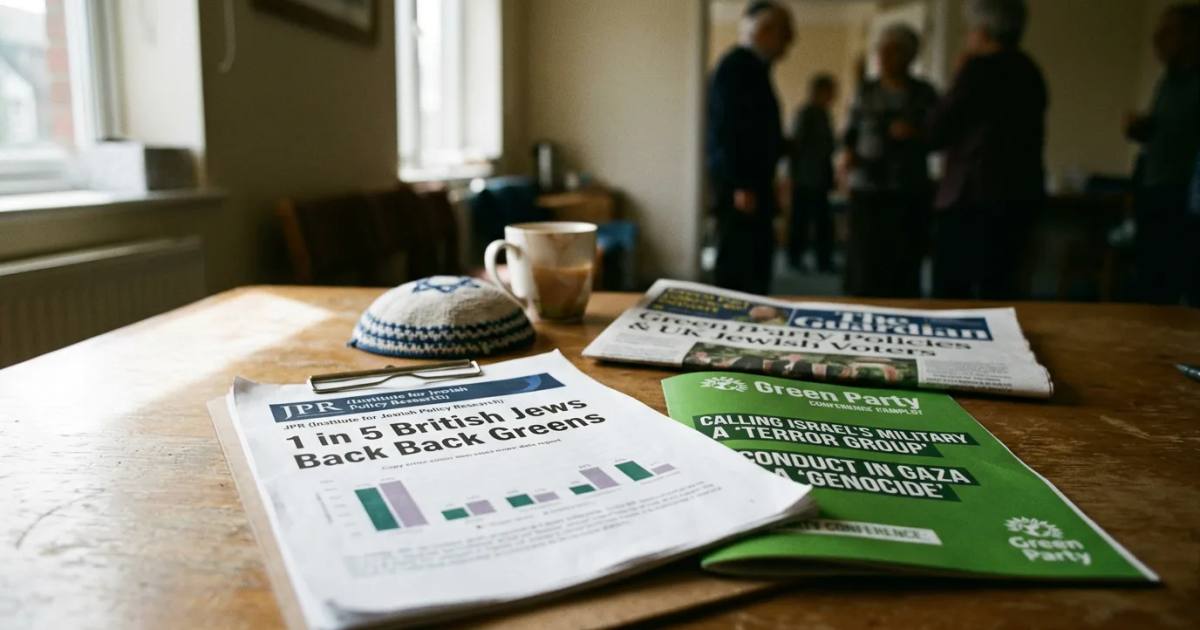
Jewish support for the Green Party reached 18% in June 2025, more than double the 7% recorded among the general population, according to JPR's November 2025 report by Executive Director Dr. Jonathan Boyd. JPR's cross tabulation traces the surge to British Jews who self-identify as anti-Zionist, a group it sizes at roughly 12% of the community: 62% of that group say they would vote Green, against 0% who favor Reform UK.
Combined Labour and Conservative support among British Jews fell from 80% in 2023 to 58% by June 2025, the lowest level JPR has recorded. Unlike the national electorate, where the collapsing center has flowed mainly to Reform UK, Jewish voters moved the other way, toward the Greens. This month's vote builds on prior motions: in September 2024 delegates called Israel's conduct in Gaza "genocide," and in October 2025 they voted to designate the Israeli military a "terror group," according to the Green Party's own published statement.
Has the Green Party Had Other Antisemitism Controversies?
Joe Belcher, a Green candidate for Rushall-Shelfield in Walsall, was suspended by the party in 2024 after suggesting without evidence that Israeli and Gaza leaders colluded in the October 7 attack for financial gain, according to the Jewish Chronicle. The party nonetheless allowed Belcher to stand again in the May 2026 local elections. A separate King's College London statement calling Israel's conduct in Gaza a genocide claim and boycott call drew similar scrutiny in August 2026.
What Does the 'Zionism Is Racism' Vote Mean for British Jews?
A party that had already voted twice in thirteen months to call Israel's conduct genocide and apartheid has now gone further, voting to brand the country's founding ideology itself racist. Yet the Jewish members most directly affected could not agree among themselves whether to oppose it, and the clause meant to shield Zionist-identifying synagogue members from internal discipline failed by a wider margin than the one by which the main motion passed.
That split mirrors a wider one JPR has tracked: the share of British Jews identifying as Zionist fell from 72% in 2013 to 65% in 2024, an eleven-point decline that predates and likely feeds the Green surge. The 18% figure does not mean British Jews broadly have turned against Israel; the surge is concentrated in the 12% of the community that already identifies as anti-Zionist. What the October 2026 vote adds is a harder test of that arrangement: a party now built partly on calling Zionism racism, led by a Jewish leader who will not condemn the policy, is still the fastest-growing political home for a measurable slice of British Jewry.
How we report: Olam stories draw on public filings, company disclosures and named sources, checked by our editors. Read our methodology · Corrections