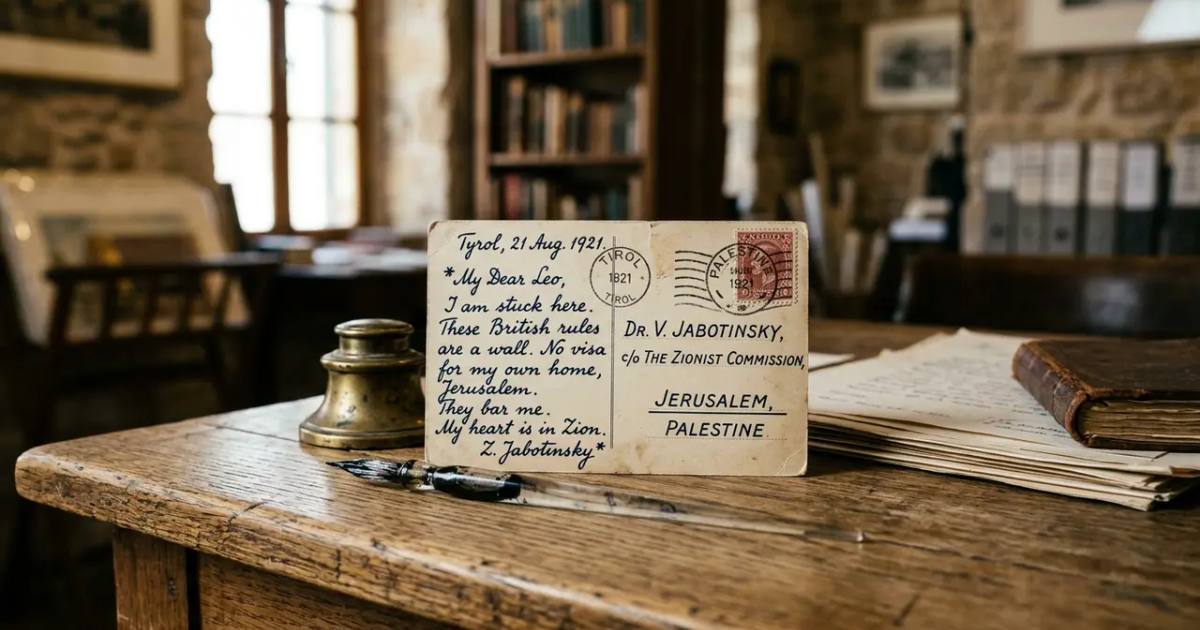

A newly offered 1921 postcard handwritten by Ze'ev Jabotinsky from Tyrol, Austria shows the Zionist leader fighting British Mandate visa rules to get home to Jerusalem. Now offered through Farkash Gallery in Tel Aviv.
A postcard Ze'ev Jabotinsky mailed from Tyrol, Austria on September 21, 1921, to his wife in Jerusalem shows the newly reelected Zionist Executive member stuck chasing a British Mandate entry visa to Palestine. Offered now through Farkash Gallery in Tel Aviv for $2,800, the handwritten Russian note captures the gap between Jabotinsky's political stature at the 12th Zionist Congress and his personal struggle to get home.
What Does Jabotinsky's 1921 Postcard Say?
The postcard is dated 21/9/21 in Jabotinsky's own hand and carries two Austrian postage stamps worth three kronen each. The address side reads simply: Mme E. Jabotinsky, Jerusalem, Palestine, care of a faded institutional address that modern cataloguers have not been able to fully recover.
The message side, written in Russian and signed with the single letter "V." (for Vladimir, his given name before he became known by the Hebrew Ze'ev), reads in translation: "I am wandering around Tyrol, waiting for all the visas, but in vain. Today I am traveling to somehow arrange my residency around October 1st, and then I will find out exactly when I will be in Jerusalem. Kisses to you."
"I am wandering around Tyrol, waiting for all the visas, but in vain."
It is four sentences. It is addressed to his wife, Anna, known in the family as Anya. It does not read like the private correspondence of a man who had, days earlier, just won a seat on the governing body of the Zionist movement. It reads like a man stuck in a bureaucratic holding pattern, unsure when he will see his own family again.
Why Was Jabotinsky Stuck in Tyrol, Austria?
Jabotinsky was in Tyrol in September 1921 because he was making his way home from the 12th Zionist Congress, held in Carlsbad (now Karlovy Vary, Czechoslovakia) from September 1 to 14 of that year. Vienna and the surrounding Austrian territory had become one of the main transit corridors for Zionist leaders and Jewish refugees moving between Central Europe and the Mediterranean after the collapse of the Austro-Hungarian Empire.
After the Congress closed, Jabotinsky continued working the German- and Russian-speaking Jewish communities of Central Europe, raising money for Keren Hayesod, the Zionist movement's fundraising arm, and pressing the case for unrestricted Jewish immigration to Palestine. The postcard was written somewhere in that stretch of travel, before he had secured the paperwork to go home.
What Happened at the 12th Zionist Congress?
The 12th Zionist Congress was the first full gathering of the movement since the 11th Congress in 1913, delayed eight years by the First World War. Delegates met in Carlsbad to work out what the 1917 Balfour Declaration and the new British Mandate for Palestine actually meant in practice, and to elect the leadership that would run the Zionist Organization through the next phase.
Jabotinsky, who had joined the Zionist Executive at Chaim Weizmann's urging after the war, had to defend his seat against opposition led by the American delegation grouped around Louis Brandeis. He won. He left Carlsbad still a member of the Zionist Executive, the small governing committee of the World Zionist Organization, and still without a confirmed way back into the country whose future he had just helped vote on.
Why Did Jabotinsky Need a Visa to Enter His Own Homeland?
Jewish immigration into Palestine in 1921 ran through a permit system the British Mandatory administration had built the year before. High Commissioner Herbert Samuel's government issued an Immigration Ordinance in September 1920 that capped Jewish entry at a quota tied to the country's so-called economic absorptive capacity, a standard that would later be written into formal British policy in the 1922 Churchill White Paper.
That permit system did not make exceptions for rank. Jabotinsky had just been reelected to the committee nominally responsible for building the Jewish national home, and he still had to clear the same visa apparatus as any other Jewish traveler trying to reach Jerusalem. The postcard does not record whether the October 1 residency arrangement he mentions worked out, only that he was still waiting when he wrote it.
Who Was Ze'ev Jabotinsky?
Ze'ev Jabotinsky, born Vladimir Jabotinsky in Odessa in 1880, was a Russian-Jewish writer, orator, and soldier who became one of the central figures of the Zionist movement. He founded the Jewish Legion alongside Joseph Trumpeldor during the First World War and later founded the Revisionist Zionist movement, the Betar youth organization, and the Irgun.
A year before writing this postcard, in the spring of 1920, Jabotinsky organized Jewish self-defense units in Jerusalem during the Nebi Musa riots. British authorities arrested him for it and imprisoned him in Acre, a sentence that turned into a public cause and, after his release, into a stepping stone toward the national standing he carried into the 1921 Congress.
Who Is Selling the Postcard, and Where Is It Available?
The postcard is offered through Farkash Gallery in Tel Aviv, listed at $2,800. The gallery, run by the Farkash family out of Old Jaffa since 1948, holds one of the largest private collections of vintage Israeli posters, Zionist documents, and signed correspondence from the founding generation of the state.
Full disclosure: Farkash is a longtime collaborator with this publication. The gallery has previously brought other Jabotinsky items to market, including an autograph letter the Zionist leader wrote from a New York hotel room three months before his death in 1940, a piece covered separately on The Olam. The 1921 postcard and the 1940 letter sit at opposite ends of the same life: one written by a man at the height of his political momentum, still fighting Mandate paperwork to get home, the other written by a dying man who had already seen, with uncomfortable precision, the war and the state that would follow.
The Takeaway
The postcard is a small object carrying a large contradiction. Jabotinsky had just been reelected to help govern the Zionist movement's future in Palestine, and he still could not get a straight answer on when he would be allowed back into the country. The gap between political authority on paper and the lived reality of British Mandate bureaucracy is the whole story the postcard tells in four handwritten lines.
More From The Olam on Jabotinsky
Full details and images of the postcard are available through Farkash Gallery. The item is offered for sale through the gallery's online shop listing.