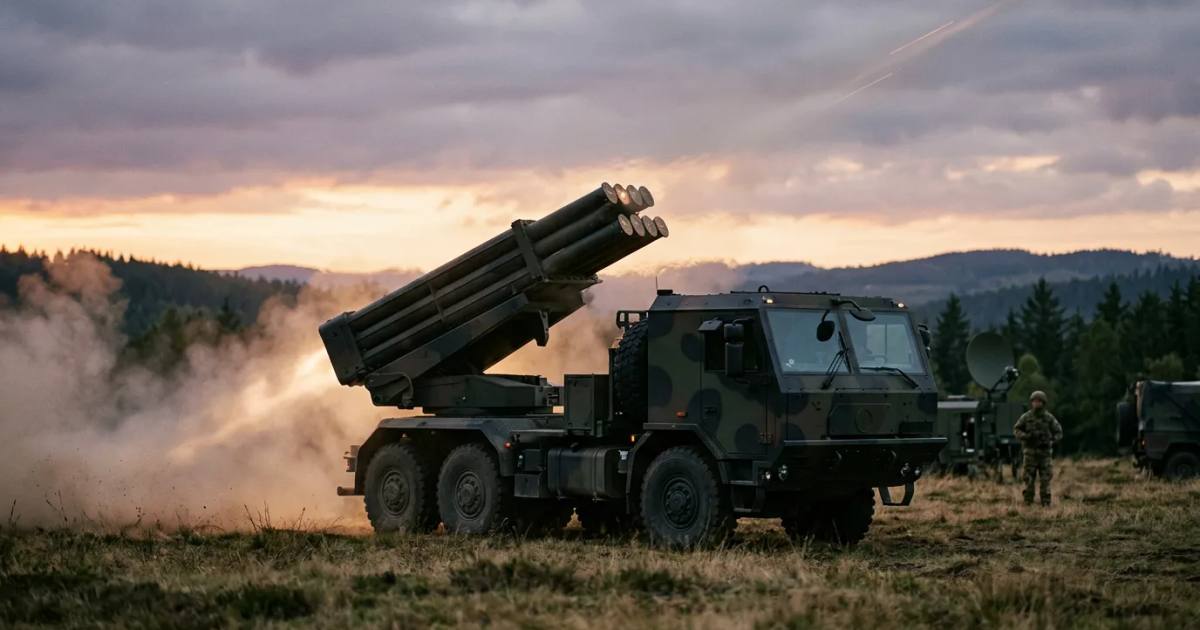

PULS is Elbit's precision rocket artillery system, now in service or on order with Denmark, the Netherlands, Germany, and Greece. Its real competitor is Rheinmetall/Lockheed's GMARS — corrected from an earlier draft.
PULS is Elbit Systems' multi-caliber precision rocket artillery system — a genuine, fast-growing NATO export success story. It doesn't need an invented rivalry to make that case: PULS is in service or on order with Denmark, the Netherlands, Germany, and Greece, and Elbit's European sales have grown sharply since 2021. Its real competitor is Rheinmetall and Lockheed Martin's GMARS, not a system called "Giuntella," which does not exist.
What PULS Is
PULS — Precise & Universal Launching System — was developed by Elbit Systems from the earlier Lynx MRL platform originally built by Israel Military Industries, which Elbit acquired in 2018. It entered Israeli Defense Forces service in 2020 under the designation Lahav, mounted on a HEMTT truck chassis. The system uses two sealed, interchangeable pods that can each be loaded with different munition types in the field: Accular 122mm rockets (18 per pod, roughly 35 km range), Accular 160mm rockets (10 per pod, roughly 40 km range), EXTRA rockets (4 per pod, roughly 150 km range), and longer-range Predator Hawk munitions. Elbit's own product literature states the system can strike out to 300 km depending on munition selected.
Real NATO and Export Wins
PULS has been adopted by a genuine and growing list of buyers:
- Denmark — announced acquisition of two PULS batteries in March 2023.
- Netherlands — a $305 million agreement for 20 PULS systems, integrated onto the Dutch COMMIT truck platform, announced in 2023.
- An undisclosed European NATO member — a $133 million contract for two batteries, awarded March 2023.
- Germany — a contract reported at approximately $57 million to supply PULS to the German Armed Forces.
- Greece — a contract worth approximately $750 million for 36 launchers, announced in 2026, following the Hellenic Ministry of National Defense's cooperation agreement with Elbit.
- India — NIBE Limited signed a technology-transfer agreement with Elbit in July 2025 to manufacture a licensed variant domestically.
- Thailand — a localized D-11A variant developed with Thailand's Defense Technology Institute.
Elbit is also co-developing EuroPULS with German industry partners (KNDS) as an open-architecture European variant designed to integrate European-made munitions — directly addressing the vendor lock-in criticism often leveled at proprietary rocket-artillery systems. A Spanish procurement effort under the SILAM program began in 2023 and was cancelled in 2025.
The Real Competitor: GMARS, Not "Giuntella"
Elbit's most significant Western competitor in this category is GMARS — the Global Mobile Artillery Rocket System — a joint program between Rheinmetall and Lockheed Martin announced in 2023. GMARS is built on Rheinmetall's HX-series 8x8 truck chassis and carries a two-pod launcher compatible with the existing MLRS Family of Munitions, including GMLRS, ATACMS, and the newer Precision Strike Missile. Lockheed Martin and Rheinmetall have marketed GMARS as offering roughly double the firepower of HIMARS in a wheeled, European-manufactured package, aimed primarily at Germany's requirement to replace its aging MARS II rocket systems. No system called "Giuntella" appears in public defense-industry reporting; it does not exist.
Where PULS Sits Against HIMARS
The American M142 HIMARS remains the NATO incumbent, in service since the mid-2000s and fielded across dozens of allied militaries. PULS and GMARS both compete for the segment of NATO procurement now underway as European militaries look to expand or replace aging rocket-artillery fleets, driven in large part by lessons from the war in Ukraine. Specific reload times, unit costs, and comparative performance claims between PULS, HIMARS, and GMARS vary by source and are not independently verified here; Olam presents Elbit's stated specifications as Elbit's claims, not as confirmed head-to-head test results.
What This Article Does Not Claim
Earlier drafting of this piece included invented market-share projections, an unsupported combat-deployment claim, and a fabricated competitor name. None of that appears here. Future NATO procurement volumes, Elbit's eventual market share, and any figures beyond the contracts named above are not established in public reporting and are not asserted as fact.
Part of Olam's Israeli Defense Industry coverage. Related: Elbit Systems · Israeli Defense Prime Index: Rafael, IAI, Elbit Compared.
How we report: Olam stories draw on public filings, company disclosures and named sources, checked by our editors. Read our methodology · Corrections