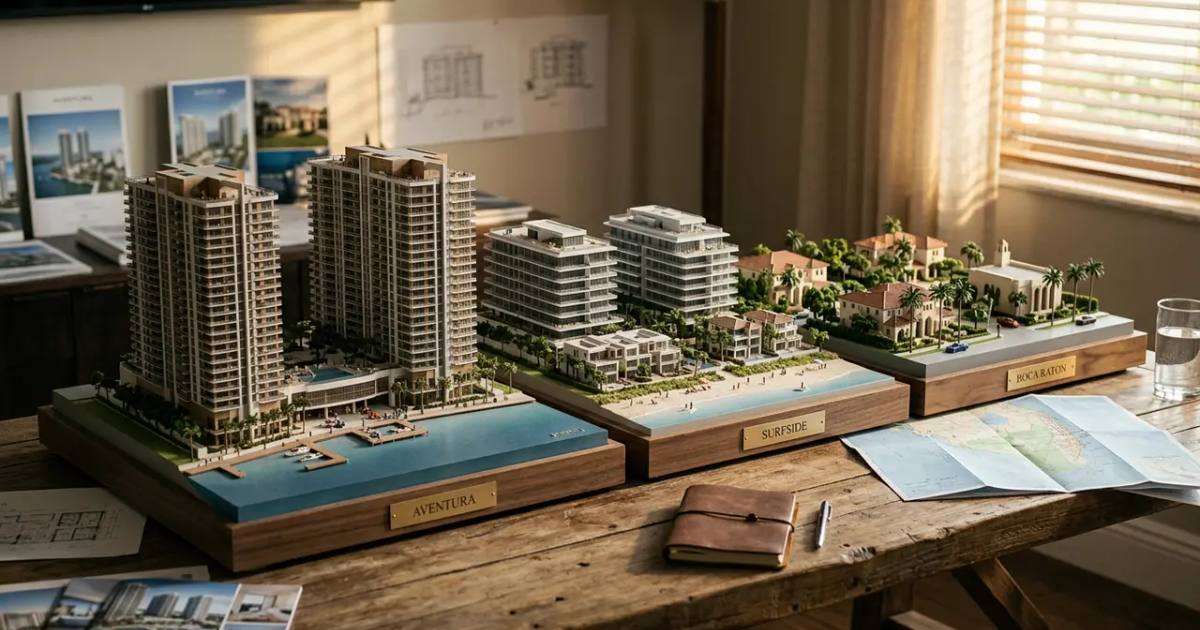

Surfside runs $1M-$20M for the Sephardic community. Aventura runs $600K-$4M, mixed Israeli/Ashkenazi. Boca runs $800K-$3M, Modern Orthodox professionals. Why these South Florida markets aren't interchangeable, and why prices are spiking.
Surfside and North Beach condos run 1 million to 20 million dollars and serve the largest Sephardic Orthodox community outside New York. Aventura runs 600,000 to 4 million dollars for a mixed Israeli and Ashkenazi community. Boca Raton runs 800,000 to 3 million dollars for a Modern Orthodox professional class. These are not interchangeable Miami suburbs. Each neighborhood serves a distinct segment of South Florida's Jewish and Israeli population, and the price bands reflect that segmentation directly.
What Makes Surfside and North Beach Different From Aventura?
The area of Miami Beach north of 71st Street, covering Surfside, Bal Harbour, and North Beach, hosts the largest year-round Sephardic luxury Jewish community in the southeastern United States, according to real estate specialist Own Luxury Homes. Sephardic buyers require Sephardic-specific synagogues using a different prayer nusach, Sephardic day schools, and community social networks, and a nearby Ashkenazi Orthodox shul does not substitute for a Sephardic minyan, per the same source. Properties in this corridor run 1 million to 20 million dollars.
The Shul of Bal Harbour, actually located in Surfside at 9540 Collins Avenue, anchors this community. Founded as a congregation in 1969 and completed in its current 125,000-square-foot building in 1994, the Chabad-Lubavitch synagogue was named one of America's 25 most vibrant congregations by Newsweek in 2009, according to Wikipedia's documented history, and has hosted dignitaries including Florida Governor Ron DeSantis. The neighborhood's history is not frictionless: in the early 1980s, Surfside real estate agents refused to deal with Jewish clients, and the nearby Bal Harbour Club dropped its policy banning Jewish and Black members only in 1982, after a discrimination lawsuit.
How Is Aventura Different From Both?
Aventura hosts a mixed Ashkenazi Orthodox and Israeli community, with properties running 600,000 to 4 million dollars, according to Own Luxury Homes' South Florida market breakdown. Unlike the more denominationally specific Sephardic corridor to the south, Aventura's community draws a broader mix of Israeli and Ashkenazi Orthodox families, which shows up directly in Census data: Hebrew is spoken in 3.66 percent of Aventura households, documented separately in Olam's profile of Aventura as the densest Israeli-American community in the country, the highest concentration of any city in the United States.
Young Israel of Aventura, led by Rabbi Aviv Mizrachi, and Young Israel of Bal Harbour, actually located in neighboring Surfside and led by Rabbi Moshe Gruenstein, are both part of the national Young Israel synagogue network, according to Wikipedia's list of Young Israel congregations, giving the corridor an institutional anchor distinct from the Chabad-Lubavitch model that defines the Shul of Bal Harbour a few miles south.
What Does Boca Raton Offer That Miami-Dade Doesn't?
Boca Raton hosts a well-established Modern Orthodox community with properties running 800,000 to 3 million dollars, according to Own Luxury Homes, drawing specifically the Modern Orthodox professional relocating from New York or New Jersey who wants to shed state income tax while buying a larger home for the same money. Boca Raton Synagogue, the largest Modern Orthodox synagogue in Palm Beach and Broward counties, serves more than 750 families across multiple minyanim from its main campus on Montoya Circle, with a satellite congregation, BRS West, serving the western Boca Raton area, according to real estate specialist listings tied to the synagogue.
Boca's positioning relative to Aventura and Surfside is professional rather than denominational. Both markets are strong and both have genuine community infrastructure, per Own Luxury Homes' assessment, but Boca draws a career-track Modern Orthodox family prioritizing synagogue and school access alongside proximity to Palm Beach County's professional employment base, while Aventura and Surfside skew toward families already embedded in Miami-Dade's Israeli and Sephardic business networks. The tax mechanics behind that relocation decision, zero state income tax and the Homestead Exemption specifically, are covered in full in Olam's coverage of Florida's tax case for relocating families.
Why Are Prices Rising Faster Than Anywhere Else in South Florida?
Housing supply in the Orthodox corridor has not kept pace with demand, and the resulting price spike is now a documented affordability crisis rather than a normal market adjustment. A large number of Orthodox Jewish families relocating to Miami have driven up home values specifically in Surfside, Bal Harbour, and North Miami Beach while straining an already limited housing inventory, according to a 2025 analysis published by the YU Observer.
The mechanism is structural, not incidental. Proximity to synagogues, kosher markets, and Jewish institutions makes these specific neighborhoods convenient and accessible for Orthodox families in a way a demographically similar but institutionally distant neighborhood cannot replicate, per the YU Observer's analysis, which means demand concentrates geographically rather than spreading across comparably priced South Florida markets. That concentration has pushed prices to record highs, creating affordability challenges even for upper-middle-class families who would not be considered priced out of a conventional Miami suburb.
How Do These Neighborhoods Fit the Broader Florida-Israel Corridor?
The neighborhood-level segmentation documented here sits directly underneath the county-level economic data covered in Olam's reporting on the Florida-Israel corridor by county, where Miami-Dade's overall Israeli-linked economic output and Palm Beach County's wage premiums are tracked at the county level rather than the neighborhood level. Aventura's density is covered in full in Olam's dedicated profile of the city, and the broader wealth migration into all three corridors is documented in South Florida: The Jewish Wealth Corridor. What the county and city-level pieces do not capture is the denominational sorting, Sephardic versus Ashkenazi versus Modern Orthodox, that actually determines which of these three markets a specific relocating family chooses.
Frequently Asked Questions About South Florida's Jewish Neighborhoods
What is the price range for homes in Surfside and Bal Harbour? Roughly 1 million to 20 million dollars, serving the largest year-round Sephardic Orthodox luxury community in the southeastern United States.
How is Aventura different from Surfside? Aventura serves a mixed Ashkenazi Orthodox and Israeli community with properties from 600,000 to 4 million dollars, while Surfside and Bal Harbour serve a specifically Sephardic community at a higher price point.
Why do Modern Orthodox families choose Boca Raton over Miami-Dade? Boca Raton draws a career-track Modern Orthodox professional from New York or New Jersey seeking Florida's tax advantages alongside strong synagogue and school infrastructure, anchored by Boca Raton Synagogue's 750-plus families.
Why are home prices rising so fast in the Orthodox Jewish corridor specifically? Demand from relocating Orthodox families is concentrating in a small number of neighborhoods with existing synagogue, kosher, and school infrastructure, and housing supply has not kept pace, according to a 2025 YU Observer analysis.
Was Surfside always welcoming to Jewish residents? No. In the early 1980s, local real estate agents refused to deal with Jewish clients, and the nearby Bal Harbour Club dropped its policy banning Jewish and Black members only after a 1982 discrimination lawsuit.
What This Means for Families Choosing Where to Live in South Florida
Surfside, Bal Harbour, Aventura, and Boca Raton are not substitutable options inside a single "South Florida Jewish community" category. Each serves a distinct denominational and professional segment, at a distinct price point, anchored by distinct synagogues with distinct institutional histories, from the Shul of Bal Harbour's Chabad-Lubavitch model to Boca Raton Synagogue's Modern Orthodox network. The resulting price pressure, now documented as a genuine affordability crisis in the most institutionally dense corridors, is the direct consequence of that segmentation rather than a general South Florida housing trend.
How we report: Olam stories draw on public filings, company disclosures and named sources, checked by our editors. Read our methodology · Corrections