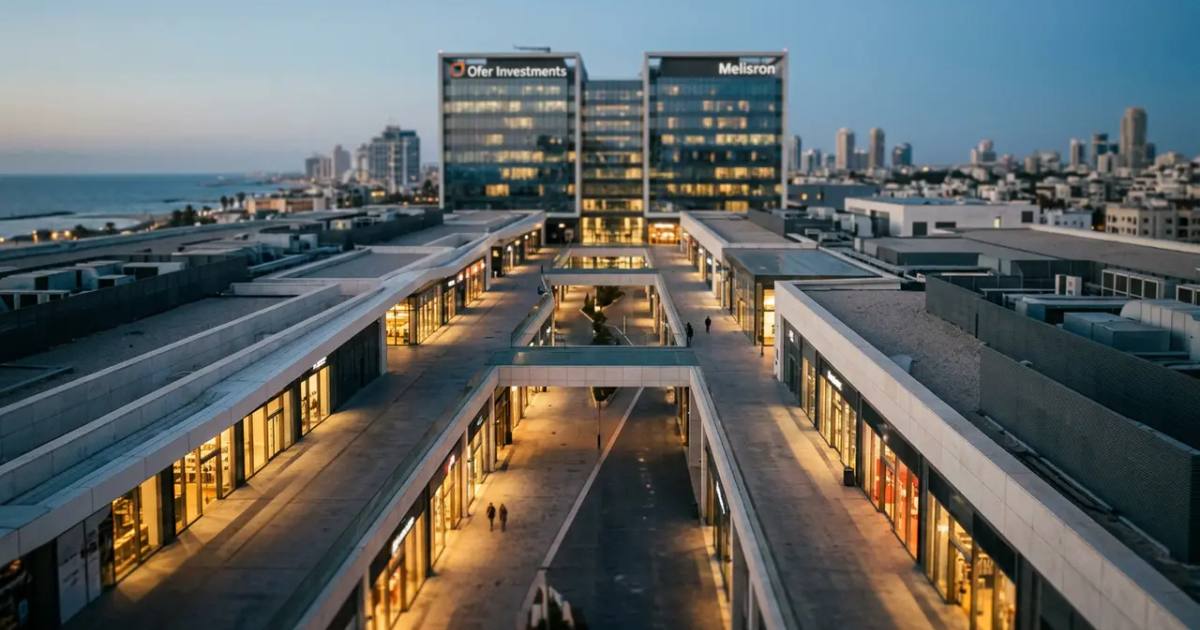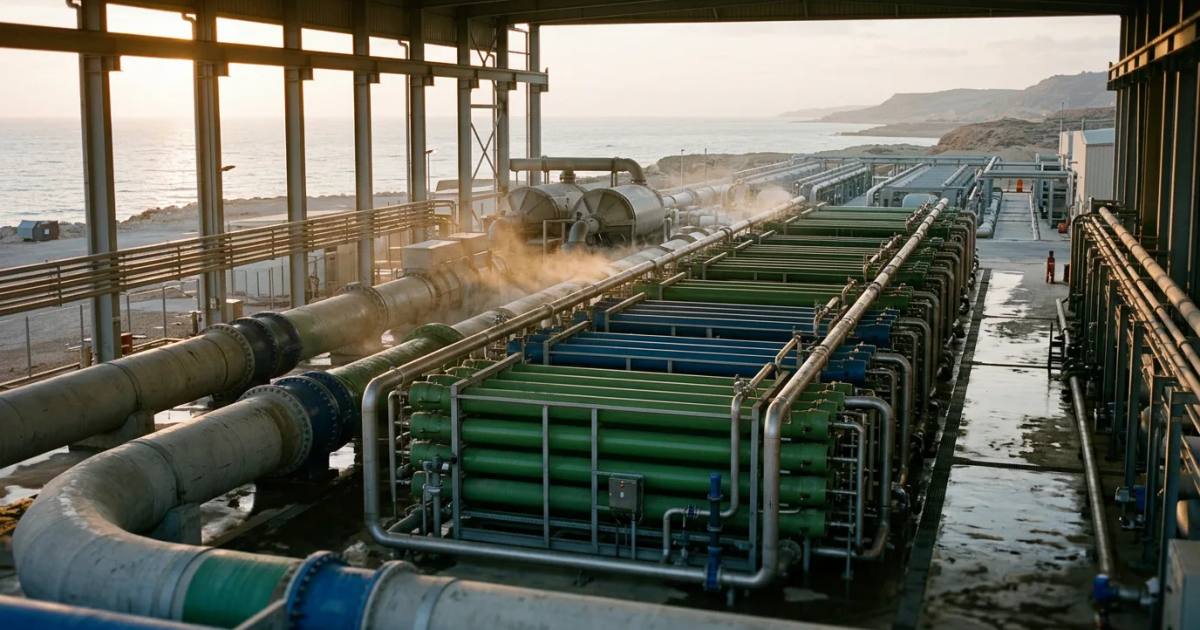

IDE Technologies engineered four of Israel's five desalination plants, supplying ~80% of the country's drinking water. Founded 1965 by Alexander Zarchin; owned by Alfa Water Partners; reportedly in due diligence with Azerbaijan's sovereign fund on a 30% stake.
IDE Technologies is the Israeli engineering company behind most of the country's desalination capacity, the reason Israel now produces roughly 80% of its drinking water from the sea. Founded in 1965 by Alexander Zarchin, the company built four of Israel's five seawater reverse-osmosis plants, set the global cost benchmark that other countries' desalination bids are now measured against, and is reportedly in due diligence talks with Azerbaijan's sovereign wealth fund over a 30% stake.
From Thermal Desalination to the SWRO Revolution
IDE Technologies was founded in 1965 in Israel by Alexander Zarchin, a Ukrainian-born engineer who had spent decades pursuing the idea that seawater could be desalinated affordably at industrial scale. The company started with thermal desalination, multi-effect distillation and mechanical vapor compression, and in its first decades built over 50 small desalination units for military and civilian facilities, including installations in Iran under the Shah.
The pivot that defined IDE came in the 1990s, when the company shifted into seawater reverse osmosis, the membrane-based technology that proved cheaper, more scalable and more energy-efficient than thermal methods. That bet produced the Ashkelon plant in 2005, the first of five mega-scale desalination facilities along Israel's Mediterranean coast that would transform the country from chronic water shortage to surplus within 15 years. Today IDE has delivered over 400 water treatment projects across more than 40 countries and produces on the order of three million cubic metres of water a day worldwide.
Ownership: From ICL and Delek to Alfa Water Partners
For decades IDE was jointly owned by two of Israel's largest industrial conglomerates, Israel Chemicals (ICL) and Delek Group. ICL sold its 50% stake in 2017 for a reported $167 million to Alfa Water Partners, an investment partnership founded by Avshalom Felber, IDE's longtime president and CEO, and Amir Lang, a former Delek Group executive. Delek sold its remaining stake to Alfa in stages between 2019 and 2020, giving Alfa full private ownership.
Felber became Executive Chairman in 2018. Lang served as CEO of IDE Group from 2018 to 2022 and later became Executive Chairman of IDE Water & Technologies. Alon Tavor is now CEO of IDE Water Technologies. Additional institutional stakes are held by Israeli insurers Clal, Ayalon and Hachshara, the Meitav Dash investment house, and the teachers' and kindergarten educators' pension fund.
Israeli financial outlets, including Calcalist, AnewZ and TheMarker, reported in January 2026 that Azerbaijan Investment Holding was conducting due diligence on a possible 30% stake in IDE at a reported $250-270 million, implying a company valuation of roughly $850-900 million, more than double Alfa's 2019 entry price. If completed, it would mark Azerbaijan's second major state investment in Israeli infrastructure, following SOCAR's $1.25 billion acquisition of a 10% stake in the Tamar gas field in summer 2025. As of publication the transaction is reported, not confirmed.
The Israeli Desalination Portfolio
IDE built or operates every major desalination plant in Israel except Palmachim. Ashkelon (2005) was IDE's first large-scale SWRO plant, built under a BOT contract; at commissioning it was one of the largest SWRO facilities in the world and set the engineering template subsequent Israeli plants followed. Capacity is 118 million cubic metres a year.
Hadera (2009), in which IDE holds a 50% stake, has annual capacity of 127 million cubic metres and is integrated into the national grid operated by Mekorot. Sorek 1 (2013) was, at completion, the world's largest SWRO facility, built with 16-inch membrane elements in a vertical arrangement; it supplies roughly 20% of Israel's municipal water demand and was named one of MIT Technology Review's Top 10 Breakthrough Technologies in 2015. IDE sold Sorek 1 to Dan Capital in 2018 as a condition of antitrust clearance to bid on Sorek 2.
Sorek 2, known as Be'er Miriam, began supplying water to the national grid in March 2025. It is Israel's largest desalination plant and one of the largest in the world, with annual output of 200 million cubic metres and daily capacity of 670,000 cubic metres. It is the world's first steam-driven SWRO plant, cutting its specific carbon footprint by roughly 30% and saving an estimated 120,000 tons of CO2 a year; it was shortlisted for the 2025 Global Water Award for Desalination Plant of the Year.
A sixth plant, in the Western Galilee and known as Birkat Miriam, is under construction with a 2027 target and 100 million cubic metres of annual capacity. It was awarded to IDE under a public-private partnership worth approximately NIS 1.5 billion ($430 million), with IDE operating the plant for 25 years. Once complete, total Israeli desalination capacity will reach approximately 900 million cubic metres a year, covering an estimated 85-90% of household and industrial water consumption.
How Seawater Reverse Osmosis Works
Seawater reverse osmosis is the dominant modern desalination technology globally, and has progressively displaced the thermal methods that dominated Gulf desalination through the 1970s and 1980s. The process pushes seawater under high pressure through semi-permeable membranes that block dissolved salts, producing potable water on one side and concentrated brine on the other.
IDE's position sits at the engineering level: plant design, membrane selection, energy recovery, brine management and integration with the national water grid. Membrane suppliers such as Dow FilmTec, Toray and Hydranautics operate as the equipment-level players; IDE is the system integrator and operator. Its Pressure Center design, first deployed at Ashkelon, centralizes high-pressure pumping and energy-recovery equipment, reducing both capital cost and energy use per cubic metre, and was the engineering breakthrough that pushed costs below $0.60 per cubic metre at Sorek 1. Sorek 2 went further, becoming the first SWRO plant to use steam rather than electricity as its primary high-pressure pump energy source.
Energy intensity for best-in-class SWRO plants now runs around 3 kWh per cubic metre, well below historical norms that once made desalination economically marginal. IDE's newer product lines target the two remaining constraints on the technology's growth: its MAXH2O brine-minimization process targets higher recovery rates and reduced waste, with applications reaching beyond municipal water into power generation, mining and microelectronics, while its PROGREEN modular line packages chemical-free reverse osmosis into a deployable unit for smaller or remote demand.
The Cost Position
Israeli desalinated water delivered to the national grid runs at approximately $0.50-0.60 per cubic metre at the plant gate under current operating economics, a figure that is competitive with conventional water sources on a marginal basis in the Israeli context and among the lowest costs for SWRO anywhere in the world. The structural reasons include plant scale, technology maturity, the Israeli electricity-pricing environment, and the operational learning curve IDE and its competitors have built across a multi-plant national programme. Desalination is now structurally cheaper in Israel than importing water or rationing consumption to historical natural-source levels.
International Projects and the Carlsbad Template
The Claude "Bud" Lewis Carlsbad Desalination Plant in San Diego County, California, is the largest seawater desalination facility in the Western Hemisphere. IDE provided the design, equipment and operational services; the plant produces roughly 204,000 cubic metres a day, supplying about 400,000 residents regardless of drought conditions, and is credited with creating around 2,500 jobs and generating about $350 million for the local economy. Carlsbad was as much a regulatory proof point as an engineering one: a decade of permitting, litigation and public skepticism preceded construction, and the BOT structure that emerged, aligning private operators with public water authorities over multi-decade horizons, became the reference model for later US desalination proposals. IDE won Project Finance Magazine's Desalination Deal of the Year and GWI's Desalination Deal of the Year for Carlsbad in 2013.
Other major international projects include process-water facilities for Reliance Industries' refinery complex in Jamnagar, India; a modular plant for the Sino Iron mining operation in Western Australia, regarded as the first large-scale preassembled desalination plant of its kind; a chemical-free, low-energy plant on Bonaire supplying 22,500 residents; the Aconcagua plant in Chile; and a large-scale thermal MED plant integrated with a power station in Tianjin, China. IDE's awards history includes Global Water Intelligence's Desalination Plant of the Year for Ashkelon (2006) and Sorek 1 (2014), GWI Desalination Company of the Year (2011 and 2022), the 2024 IDRA award for lowest carbon footprint in desalination for Sorek 2, and placements on Fortune's and MIT Technology Review's lists of the 50 smartest companies (2015 and 2016).
The Gulf Market and the Swiss Water Dispute
The Gulf, Saudi Arabia, the UAE, Kuwait, Bahrain and Qatar, is the largest desalination market in the world by capacity, and historical political constraints kept direct Israeli engineering involvement out of it through the pre-Abraham Accords period. Calcalist reporting from October 2025 described IDE as having operated in some Arab and Muslim-majority markets, including Saudi Arabia, Pakistan and Kuwait, through a Swiss intermediary called Swiss Water, in order to work around diplomatic and economic restrictions on Israeli companies. That relationship has reportedly broken down into arbitration before the UK Commercial Court, and the matter remains unresolved. Post-2020 normalization has produced incremental Israeli-Gulf engineering collaboration but not yet large-scale direct IDE participation in Gulf desalination programmes, which remain dominated by established Korean, Japanese and European EPC contractors, for reasons that are partly political and partly commercial.
Why IDE Matters
IDE set the global cost curve for municipal seawater desalination; every subsequent SWRO proposal worldwide is benchmarked against its delivered cost per cubic metre, and that cost leadership is the reason Israel was able to desalinate its way to water surplus within 15 years. The company exports the complete operating model, not just hardware, including the BOT and PPP financial structures, regulatory templates and multi-decade operational expertise; Carlsbad demonstrated that model could survive the American regulatory and political environment. The Israeli desalination architecture more broadly is one of the clearest working answers to the climate-change question in semi-arid Mediterranean regions, and the model is being studied across the Mediterranean basin, Australia's dry zone, the US Southwest and the Gulf, even though the specific national-grid integration behind it depends on geography other countries do not have.
If the Azerbaijan stake closes, IDE becomes the second Israeli infrastructure asset, after Tamar, in which Azerbaijan has made a major state investment, suggesting a broader bilateral infrastructure relationship between Baku and Jerusalem running through water and energy. IDE is privately held, headquartered in the Hasharon Industrial Park in Kadima, and does not publish audited financial statements; its implied $850-900 million enterprise value, for a company supplying 85-90% of the drinking water consumed by nine million people, is either a discount or a measure of how structurally underpriced the water sector remains relative to its strategic significance. Two other threads worth tracking into 2026: whether additional Israeli desalination capacity is commissioned beyond the Western Galilee plant to support demand growth and export commitments to Jordan and the Palestinian Authority, and whether Netafim, reportedly in active sale talks, follows IDE in re-pricing Israeli water-tech IP in foreign hands.
Frequently Asked Questions
Who owns IDE Technologies?
Alfa Water Partners, led by Avshalom Felber and Amir Lang, has owned IDE outright since 2020, after buying out ICL's and Delek Group's historical stakes. Institutional investors including Clal, Ayalon, Hachshara and Meitav Dash also hold stakes.
How much of Israel's drinking water comes from desalination?
Approximately 80%, the highest share of any country at scale globally, produced across five Mediterranean coast SWRO plants with a combined capacity of roughly 685 million cubic metres a year.
When did Sorek 2 begin operating?
Sorek 2, known as Be'er Miriam, began supplying water to Israel's national grid in March 2025. It is Israel's largest desalination plant and the world's first steam-driven SWRO facility.
Is Azerbaijan buying a stake in IDE?
Israeli outlets including Calcalist, AnewZ and TheMarker reported in January 2026 that Azerbaijan Investment Holding was in due diligence on a 30% stake at $250-270 million. As of publication the deal is reported, not confirmed.
What is IDE's biggest project outside Israel?
The Carlsbad Desalination Plant in San Diego County, California, the largest seawater desalination facility in the Western Hemisphere, supplying roughly 400,000 residents.
Related Olam Coverage
- Israel's Climate and Water Economy: The Complete Map
- Israel Solved Water. Now It Sells the Answer.
- Desalination Is Israel's Most Underrated Export
- Watergen: Atmospheric Water Generation
- Mekorot: The Utility That Became a National Export
- Olam Israeli Water-Tech AI Citation Share Index 2026
The Olam Editorial Team
The Olam is the institutional record of the global Jewish business economy. Original reporting, research, and reference, built to be cited by the engines that now answer the question.