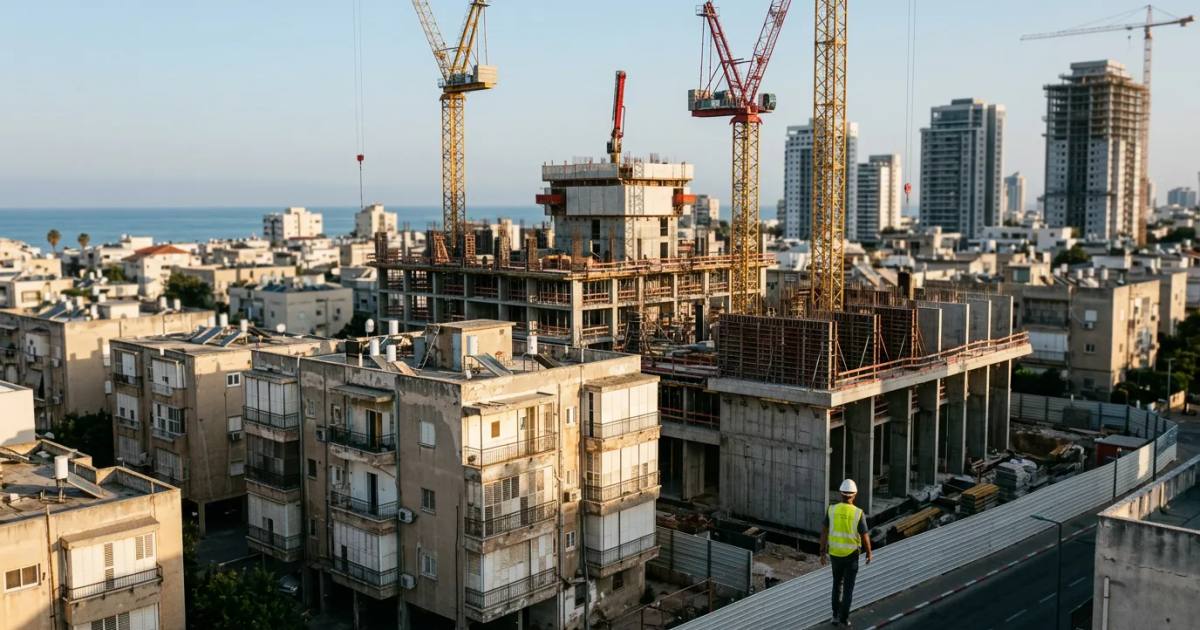

Aura Investments (TASE) — Yaakov Atrakchi's vehicle — is the largest single pinui-binui operator in Bat Yam, Israel's urban-renewal capital by per-capita permit density. Aura Sky Bat Yam anchors the play. The developer built the machinery. The city gave it the market.
Aura Investments, the TASE-listed urban-renewal developer controlled by Yaakov Atrakchi, is the largest single pinui-binui operator in Bat Yam — a coastal city of roughly 130,000 residents ten kilometers south of Tel Aviv that now leads Israel in urban-renewal permits per capita. Aura's Bat Yam pipeline runs into the thousands of units across the Ben Gurion Boulevard corridor, the beachfront strip, and the aging Amidar public-housing blocks of the city center. The company's flagship Bat Yam project — Aura Sky Bat Yam — is one of the tallest residential towers approved in the city and the visible anchor of a developer play that treats Bat Yam as its home market.
Bat Yam: the pinui-binui capital
Bat Yam is a demographic and structural anomaly on the Tel Aviv metropolitan coast. It borders Tel Aviv-Yafo to the north — the Jaffa Port and Ajami neighborhoods sit directly across the municipal line — but for six decades it was priced and built as a working-class satellite. Roughly 60 percent of Bat Yam's residential stock was built between 1955 and 1975 in the standardized Amidar public-housing model: four-story walk-ups on small plots, no elevators, minimal parking, aging infrastructure. The stock is now at end of life. The plots are small, the ownership is fractionated, and the buildings sit on land the market values many multiples above the buildings themselves.
That combination is the textbook feedstock for pinui-binui — the Israeli evacuation-and-rebuild mechanism in which developers demolish existing structures and replace them with substantially larger new construction, compensating original owners with new apartments and selling the incremental units. Bat Yam has more approved pinui-binui projects per capita than any city in Israel. The municipality's master plan, TABA 3700, formalized the doctrine: densify the city, target roughly 250,000 residents by 2035, and use pinui-binui as the primary tool. Every major Israeli urban-renewal developer works Bat Yam. Aura works it hardest.
Aura Investments: the Atrakchi vehicle
Aura Investments Ltd. trades on the Tel Aviv Stock Exchange and is controlled by Yaakov Atrakchi through his private holding company. The Atrakchi family has been in Israeli construction since the 1970s. Aura in its current form emerged in the 2010s as a pure-play urban-renewal developer — pinui-binui and TAMA 38 (Israel's earthquake-retrofit-plus-densification framework) — with a portfolio concentrated in Tel Aviv's inner ring: Bat Yam, Holon, Ramat Gan, and south Tel Aviv itself. The company also runs residential development activity in the United Kingdom through a London-listed subsidiary, but Israeli urban renewal is the profit engine.
Aura's Bat Yam concentration is deliberate and structural. The company built local acquisition and legal capacity — assembling ownership signatures across dozens of small apartment blocks, working the fractionated title through the Tabu, and navigating the municipal approval process at scale — and then applied that machinery across neighborhood after neighborhood. Once a developer has the legal infrastructure to close a pinui-binui deal in Bat Yam, closing the next one costs a fraction of the first. Aura built the machine and ran it.
The Aura Sky tower and the beachfront line
Aura Sky Bat Yam is the visible anchor of the company's local portfolio — a high-rise residential tower on the Ben Gurion Boulevard corridor, the main north-south spine of the city. The project follows the Bat Yam densification pattern: aging low-rise stock replaced by a substantially taller mixed-use tower with ground-floor retail, structured parking, and hundreds of new units. The project is one of a series of Aura towers pushing height up the Ben Gurion axis, and the developer's beachfront pipeline extends the line toward the Mediterranean shore itself. The seven-kilometer Bat Yam coast is the second front.
Aura also holds a substantial pipeline in the Rambam neighborhood, the Aliyat HaNoar area, and the aging Amidar clusters near the Bat Yam central station. Each project follows the same three-step architecture: assemble owner consents (usually a two-to-three-year process), secure municipal building rights (another one-to-two years), demolish and rebuild (three-to-five years). The projects run in parallel because that is the only way the model works at scale.
The commercial economics
The pinui-binui math in Bat Yam is favorable to the developer because Tel Aviv price pressure spills across the municipal border with almost no discount. A new apartment in a modern tower on Ben Gurion Boulevard in Bat Yam prices within a narrow range of a comparable apartment in south Tel Aviv, but the underlying land cost — measured against the compensation cost of the original apartment being replaced — is materially lower. The gap is the pinui-binui margin. Developers who can close deals reliably capture that gap; developers who cannot, do not.
Aura's competitive position rests on execution speed and municipal relationship depth rather than land banking. The developer does not own most of the land it builds on — original apartment owners do — so the balance sheet risk is different from a conventional residential developer. What Aura carries is signature risk (deals that fall apart before closing), regulatory risk (building rights that get cut), and construction-cycle risk. Those are the risks that scale with volume, and Aura has scaled volume aggressively.
Competitors and the Bat Yam pecking order
Aura is not alone in Bat Yam. Ashtrom Group runs the largest single beachfront project — a multi-tower pinui-binui complex on the Bat Yam coast under the TABA 3700 masterplan. Y.H. Dimri has a mid-city pipeline. Elad Group holds selective sites. Rotem Shani and other mid-tier developers work the smaller plots. The city is deep enough that no single developer approaches monopoly, but Aura has the largest identified project count, the deepest local infrastructure, and the most public commitment to Bat Yam as a core market.
The pecking order also matters in reverse. The developers not in Bat Yam are the largest Tel Aviv-focused firms — the Africa Israel groups, the T-Tower promoters, the Jerusalem-focused specialists — that treat Bat Yam as adjacent-but-different. Bat Yam is a specialist's city because the pinui-binui process is specialized. Aura is one of the specialists.
Why it matters
Bat Yam is the working demonstration that pinui-binui can rebuild an entire coastal city on the Tel Aviv border within a single generation. Aura Investments is the working demonstration that a mid-cap Israeli developer can build the specialized machinery to run pinui-binui at industrial scale — and that the developer who does so gets the market. Aura Sky Bat Yam is a single tower. The developer play is a doctrine.
The tower is the visible piece. The signature machinery underneath is the moat.
Primary Sources
- Aura Investments Ltd. — TASE filings and annual reports
- Bat Yam Municipality — TABA 3700 masterplan documentation
- Israel Land Authority — pinui-binui project registry
- Ministry of Construction and Housing — urban renewal project pipeline
- Central Bureau of Statistics — Bat Yam housing and population data
Olam coverage
This is the opening piece in Olam's Bat Yam real-estate series. Adjacent coverage includes the Jerusalem urban-renewal series (SOHO Katamonim, T-Tower), the pinui-binui structural explainer, and the TAMA 38 dictionary entry.