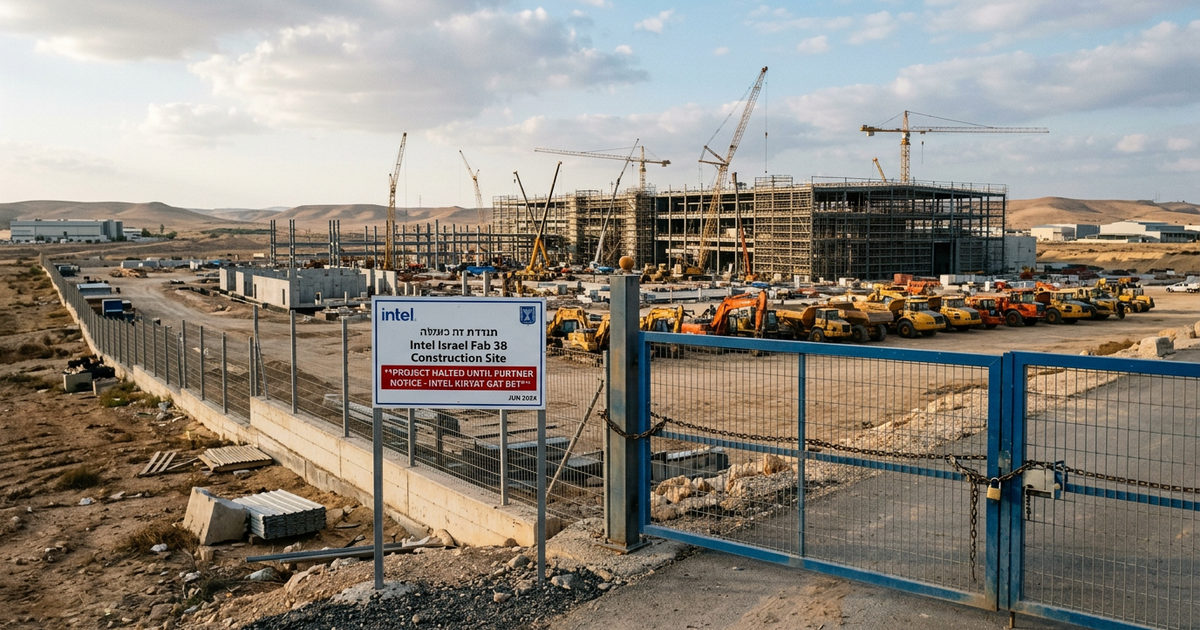

Intel's largest-ever industrial commitment to Israel is no longer on the timetable originally announced. The $25 billion Fab 38 has been frozen since June 2024.
Intel's largest-ever industrial commitment to Israel is no longer moving on the timetable originally announced.
Kiryat Gat, six kilometers from the Gaza border, was meant to anchor Israel's place in the global semiconductor map for the next decade. Fab 28, Intel's existing 10-nanometer wafer plant, is operational and produces processors, 5G silicon, and AI parts. Fab 38, the $25 billion expansion announced alongside the largest single subsidy ever awarded to a private company in Israel — $3.25 billion from the state in December 2023 — was supposed to bring leading-edge manufacturing online by 2028. It is not on track to do so.
The pause was unannounced. In June 2024, six months after the grant was awarded, Intel told its Israeli contractors to stop work. Construction has continued on one of the two planned clean rooms; the second is frozen. Contractor headcount on site has fallen from a 2024 peak of 5,500 to roughly 2,000. The schedule has slipped from 2028 to "2028 or later," with full capacity now projected for 2035 in optimistic readings and unstated in pessimistic ones.
The repricing matters for three reasons that extend well beyond a single facility.
Semiconductors as strategic infrastructure
Semiconductors are no longer an industrial sector; they are strategic infrastructure. The U.S. CHIPS and Science Act committed $52 billion in direct subsidies and tax credits to bring chip manufacturing back onto U.S. soil. The European Union followed with a €43 billion Chips Act. Japan has committed roughly $25 billion. South Korea and Taiwan, the existing leaders, have responded with their own subsidies and export controls. The map of where advanced silicon is fabricated is being redrawn through public policy, not commercial choice. Israel sits inside that map only because of Intel — and only at the production nodes Intel chooses to operate here.
The U.S.–Israel industrial alignment
The $3.25 billion grant was an unusually direct statement of U.S.-Israel industrial alignment. Intel is a U.S. company; the Israeli subsidy effectively co-funded a piece of U.S.-aligned manufacturing capacity at a site outside North America. The bilateral framing has been consistent across administrations: Israel's chip cluster — Intel in Kiryat Gat, Tower Semiconductor in Migdal HaEmek, NVIDIA's design center in Yokneam, Apple's R&D in Herzliya — operates as an extension of the U.S. semiconductor base, not as a competitor to it. A frozen Fab 38 is a frozen U.S. capacity project that happens to sit in Israel.
Why Kiryat Gat matters globally
Kiryat Gat is one of fewer than a dozen sites in the world capable of leading-edge logic production. The list — TSMC's Fab 18 in Hsinchu and Arizona, Samsung's Pyeongtaek and Taylor, Intel's Hillsboro, Chandler, Magdeburg, and Kiryat Gat, plus a small number of others — does not lengthen easily. Building one such site from scratch takes five years and twenty billion dollars. Losing one, or downgrading its node, is a structural event for the country that hosts it.
The Israeli base
Intel arrived in Israel in 1974 and has been the country's most important industrial investor ever since. The Kiryat Gat campus employs roughly 9,350 people, the largest Intel workforce outside the United States. Intel pledged, alongside the 2023 grant, to purchase NIS 60 billion ($16.5 billion) in goods and services from Israeli suppliers over the following decade — a commitment designed to anchor an industrial cluster of equipment vendors, chemical suppliers, and specialized logistics around Fab 38 as the demand center.
That cluster is now operating at a fraction of the scale it was contracted for. The roughly 3,000 foreign work visas granted by the state specifically for Fab 38 — for workers from India, Sri Lanka, and Thailand — are being returned. At Fab 28, the operating plant, Intel announced a new round of layoffs in July 2025 as part of a global program targeting 15 to 20 percent of its manufacturing workforce. Several hundred Israeli employees lost their jobs. Internal discussions, reported in Israeli media, included the possibility of shutting Fab 28 entirely on the grounds that the Intel 7 process node is no longer competitive at the leading edge — and that the site, without extreme ultraviolet lithography equipment, cannot easily be upgraded to Intel's 18A process or beyond.
Intel has not confirmed any shutdown. Public statements continue to describe Israel as one of the company's key global manufacturing and R&D sites. The Ministry of Finance has not asked Intel to return any portion of the grant. Disbursement is tied to milestones, and Intel has met enough of them to retain partial funding while the project sits idle.
The strategic question is no longer whether Fab 38 will be completed on the original timetable. It will not. The question is whether Intel still views Israel as a leading-edge manufacturing site, or as a legacy-node site that produces older silicon for as long as the demand profile justifies it. The two interpretations carry materially different consequences for Israeli industrial policy, for tax receipts in the south, and for the long-running argument that the country can sustain a sovereign semiconductor base alongside its design economy.
Fab 38's first clean room will likely come online. The second may not. Intel's path back to leading-edge production runs through Arizona, Ohio, and New Mexico, where the CHIPS Act has placed roughly $20 billion of subsidies per project. Israel does not have a CHIPS Act. It has Intel, and it has the original 2023 grant, and it has, at present, half of a plant.
The most consequential industrial investment ever made in Israel is now, mechanically, a waiting game.
How we report: Olam stories draw on public filings, company disclosures and named sources, checked by our editors. Read our methodology · Corrections