
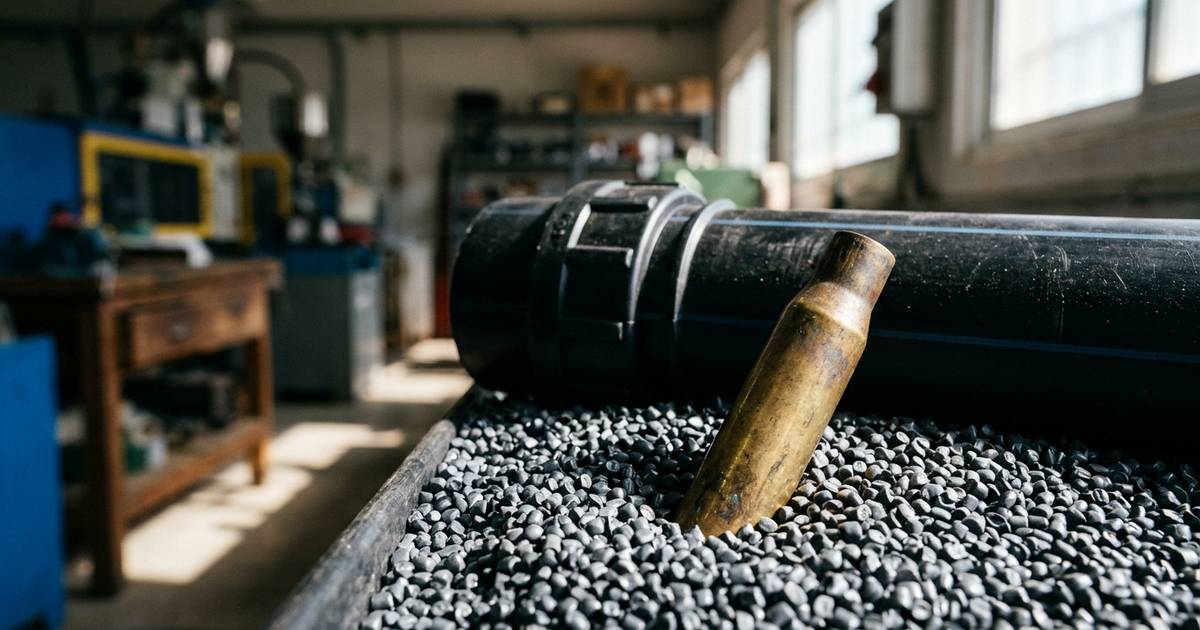

Plasson manufactures plastic pipe fittings and livestock equipment globally — 2,600 employees, operations in 100+ countries. The kibbutz that built it ran a clandestine bullet factory in the 1940s. The industrial DNA never left.
Plasson is one of the oldest and most quietly successful of the kibbutz industrials. The company manufactures plastic fittings for polyethylene pipe systems — water, gas, sewage, mining, telecommunications, irrigation — alongside a separate division producing poultry and livestock equipment. It has operated for more than six decades, listed on the Tel Aviv Stock Exchange in 1997 (ticker PLSN), runs more than 160 injection-molding and extrusion machines, produces over 8,000 distinct products, employs approximately 2,600 people across its global operations, and exports to over 100 countries. Headquarters and main production remain at Kibbutz Maagan Michael, on the Mediterranean coast 30 kilometers south of Haifa. The reason this kibbutz produced this company is one of the more remarkable origin stories in Israeli industrial history.
The Ayalon Institute legacy
Maagan Michael was founded in 1949, but the kibbutz that planted it had operated under a different name and at a different location during the British Mandate period. In the early 1940s, a group of Hashomer Hatzair members on Kibbutz Hill near Rehovot ran one of the most consequential clandestine industrial operations in pre-state Israeli history: the Ayalon Institute, a hidden underground bullet factory built beneath a working kibbutz laundry and bakery. The factory produced an estimated 2.5 million 9mm bullets for the Sten submachine guns of the Haganah between 1945 and 1948. The British Mandate authorities never discovered it.
After independence and the merger of several Hashomer Hatzair groups, the membership relocated to a coastal site and founded Kibbutz Maagan Michael in 1949. The clandestine ammunition factory was eventually folded into Israel Military Industries, the state-owned defense manufacturer. But the industrial culture — precision metalwork, injection molding, machine-shop discipline, the institutional knowledge of how to run a sophisticated manufacturing operation inside a kibbutz — relocated with the members. Maagan Michael was, from day one, a kibbutz with an unusually deep technical bench.
From plastic buckets to global pipe fittings
Plasson was founded in 1964 by a group of Maagan Michael members led by Itzik Kantor, who brought injection-molding machines onto the kibbutz to produce plastic household goods — buckets, waste bins, basic consumer plastics. The first technical innovation came in 1965: a plastic dual-flush toilet tank that allowed the user to select between two water volumes. This was a novel feature at the time and an early indicator that the company would pursue functional engineering rather than commodity production.
The pivot into agriculture came quickly. By 1967, Plasson was producing automatic bell drinkers for poultry. Transportation cages for poultry followed. The kibbutz was already farming livestock at scale, and the in-house manufacturing operation could produce the equipment that the kibbutz farm needed. That dual-customer dynamic — build it for ourselves, then sell it externally — defined Plasson's early growth.
The lineage from clandestine arms work to precision plastics is not coincidental. It is the same workforce, the same machine-shop discipline, redirected.
The 1971 inflection: pipe fittings
In 1971, Plasson introduced its Line 7 compression fittings — mechanical couplings for polyethylene pipe systems. This was the product line that turned the company from a kibbutz industrial into a global manufacturer. Polyethylene pipe was replacing metal pipe across municipal water systems, gas distribution networks, agricultural irrigation, mining operations, and telecommunications conduit. Every PE pipe network needs reliable joint fittings. Plasson developed a deep catalog of mechanical fittings, electrofusion couplings, and pushfit systems, supported by an in-house research and development unit that refined the products over the next five decades.
By the late 1980s, Plasson had introduced ElectroFusion technology — an electrically heated coupling that fuses polyethylene pipe ends into a single continuous joint under controlled current. ElectroFusion became the industry standard for large-diameter and high-pressure PE pipe networks. By the 1990s, Plasson was selling into more than 100 countries. The company listed on the Tel Aviv Stock Exchange in 1997.
The current structure
Plasson today operates two parallel businesses. The pipe-fittings business serves municipal water utilities, gas distributors, industrial fluid-transfer systems, mining operations, and irrigation infrastructure across more than 100 export markets. The livestock division — Plasson Poultry — is one of the world's leading manufacturers of poultry-house water, feed, and climate systems, with major subsidiaries in Brazil, China, Germany, France, and the United States. The corporate parent is listed on the TASE in the TA-100 Index. Kibbutz Maagan Michael remains the controlling shareholder.
The company runs subsidiaries or joint ventures in Brazil, China, Germany, France, Italy, Spain, the United Kingdom, Australia, South Africa, Poland, the United States, Mexico, and Romania. A second domestic plant operates at Kabri in northern Israel under the Plasson Group subsidiary Rion, specializing in complex precision-injection components.
| Founded | 1964, Kibbutz Maagan Michael |
|---|---|
| Headquarters | Kibbutz Maagan Michael, Mediterranean coast |
| Ownership | Kibbutz Maagan Michael (controlling), TASE-listed minority |
| Ticker | TASE: PLSN (TA-100 Index) |
| Employees | ~2,600 globally |
| Manufacturing | 160+ molding/extrusion machines, 8,000+ products |
| Export markets | 100+ countries |
| Divisions | Plasson Pipe Fittings; Plasson Poultry/Livestock |
The structural lesson
Maagan Michael answers the Hatzerim and Yizrael questions from yet another angle. Hatzerim built its company because the desert demanded it. Yizrael built its company because the farm produced the engineering culture that made it possible. Maagan Michael built its company because the kibbutz had been running a sophisticated clandestine manufacturing operation since the 1940s, and when the war was over the workforce simply redirected. The same hands that pressed bullets into casings for the Sten gun were pressing plastic into molds for poultry drinkers twenty years later. The product changed. The skill base did not. The kibbutz industrial complex contains several different paths to the same outcome; Maagan Michael's is the wartime-industrial path, and it produced a company that has now been operating continuously for more than six decades.
Part of the Olam series on the kibbutz industrial complex. Read the pillar.