
The country-house and wellness layer of Israeli hospitality — older than Tel Aviv boutique, anchored on kibbutz hotels and natural-spa properties, and the part of the sector that held up best through October 7.
The country-house and wellness layer of Israeli hospitality, older than Tel Aviv boutique, anchored on kibbutz hotels and natural-spa properties, and the part of the sector that held up best through October 7.
The Galilee is the part of Israeli hospitality that the Israeli market built for itself, and the part that proved domestically self-sustaining when international inbound disappeared.
Roughly 8,000 hotel rooms across the Upper and Lower Galilee, plus the Sea of Galilee shore. A hospitality tradition older than the modern Tel Aviv boutique class, anchored on kibbutz country hotels, natural-spa properties, and a layer of independent boutique operators. A demand base that runs primarily on Israeli domestic leisure and Tel Aviv weekend traffic, with Christian pilgrimage as the historical inbound layer.
Through October 7, the Galilee was the part of the Israeli hotel sector that held up best.
By the Numbers
Hotel rooms (Galilee total): ~8,000
Sub-regions: Upper Galilee (Rosh Pinna, Safed, Hula Valley), Lower Galilee (Tiberias, Nazareth, Sea of Galilee), Western Galilee (Acre, Karmiel)
Demand mix: Israeli domestic (largest), Christian pilgrimage, international leisure (modest)
Anchor properties: Mizpe Hayamim (Isrotel Exclusive), Pereh, Pastoral Kfar Blum, Vered HaGalil, Carmim
Operator pattern: Isrotel Exclusive concentration plus family-run boutique plus kibbutz country hotels
The Older Tradition
Galilee hospitality predates the modern Israeli boutique class by decades.
The original layer was kibbutz country hotels, properties built by Galilee kibbutzim during the agricultural-collective era to host extended family, professional groups, and the gradually emerging Israeli leisure traveler. Pastoral Kfar Blum, Nof Ginosar, Lavi, Ma'agan, Ein Gev, and others built a country-house tradition rooted in the Galilee landscape.
Through the 1970s and 1980s, this layer was supplemented by independent operators. Vered HaGalil opened in 1961 and is one of the older continuously operated country hotels in Israel. Mizpe Hayamim opened as a natural-wellness retreat in 1967, evolved through multiple ownership cycles, and ultimately became the flagship of the Isrotel Exclusive Collection. The northern boutique tradition was already mature by the time the Tel Aviv boutique class began to form in the 2010s.
The Wellness Layer
The Galilee's natural-spa tradition is the structural foundation of its upscale hospitality.
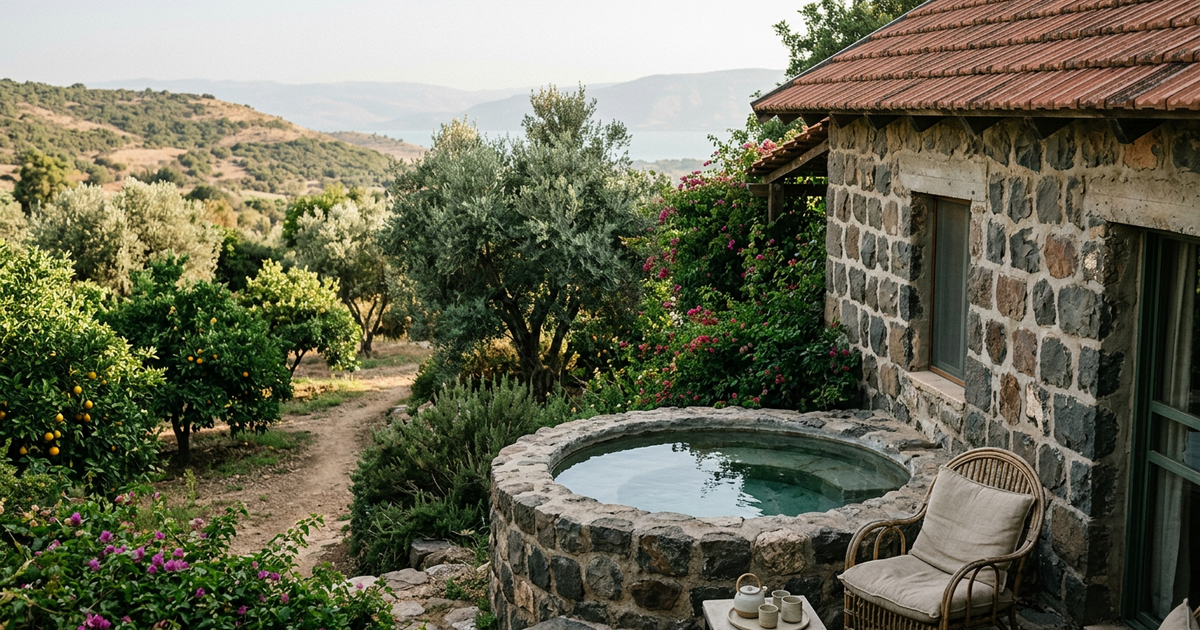
Mizpe Hayamim is the reference property, a historic farm-and-spa above the Sea of Galilee, with an organic farm, in-house dairy, kitchen garden, and integrated wellness program. The hotel has a serious following among Tel Aviv professionals who do not want to fly internationally to take three days off.
The Galilee's wine country is a maturing layer. The Yarden, Galil Mountain, Tabor, Tzora, and several smaller wineries have built tasting-room and visitor infrastructure that supports overnight stays at the surrounding boutique properties.
Pereh: The Modern Outlier
Pereh is the Galilee property that broke through internationally and rewrote the upper end of the regional positioning.
Built on the site of a former military observation post. Opened in the early 2020s. Roughly forty keys, adults-only, design-forward in a way the older Galilee boutique tradition was not. Price point among the highest in Israeli hospitality. Among the hardest single hotel rooms in the country to book.
Pereh proved that an Israeli operator could build an internationally competitive design hotel in a remote Galilee setting and command Aman-tier pricing. The right comparable is not the Israeli market: it is Aman, Singita, the better Como properties, the small Belmond houses. Pereh competes on that shelf.
The Christian Pilgrimage Overlay
The Galilee is one of the two anchors of the Christian pilgrimage circuit (the other being Jerusalem). The biblical geography is dense: the Sea of Galilee, Capernaum, Tabgha, the Mount of Beatitudes, Magdala, the Jordan River baptism sites, Nazareth, Mount Tabor, Cana. A pilgrimage tour through Israel typically includes three to four overnights in the Galilee.
The Galilee pilgrimage hotel layer, the Sea of Galilee Hotel, Nof Ginosar, the Tiberias Plaza, the Leonardo Plaza Tiberias, plus the Nazareth properties, runs on Christian-group economics. The segment collapsed through 2024 alongside the broader pilgrimage decline and is recovering at the same pace.
The October 7 Resilience
The Galilee's performance through the post-October 7 cycle was the surprise of the Israeli hotel sector.
The northern border was under active rocket fire through 2024. Tens of thousands of residents of the northern border communities, Metula, Kiryat Shmona, Avivim, and the kibbutzim along the Lebanese border, were evacuated. Many were housed in Galilee hotels on state-rate displaced-family contracts, which kept occupancy high but on subsidized economics.
Beyond the state contracts, Israeli domestic leisure to the Galilee held up. The wellness and country-house properties at the upper end (Mizpe Hayamim, Pereh, the wine-country hotels) ran on Tel Aviv weekend traffic. Israeli families who would normally travel internationally instead booked three- and four-day stays in the Galilee. That segment held remarkably stable.
Through 2025 and into 2026, the Galilee has been the most stable region of the Israeli hotel sector.
Why It Matters
- Older hospitality tradition than the Tel Aviv boutique class: kibbutz country hotels and natural-spa properties predate modern Israeli luxury
- Domestic-anchored demand base carried the region through October 7: Tel Aviv weekend traffic plus state displaced-family contracts
- Pereh proved that internationally competitive design hospitality could be built in remote Galilee, opening the door for more
- Christian pilgrimage flow into the Galilee is the inbound recovery variable: it tracks the broader pilgrimage curve
- The Galilee is the part of the Israeli hotel sector that proved domestically self-sustaining when international inbound disappeared
What Comes Next
The Galilee hospitality economy has the most defensible structural position in the Israeli sector. Three reasons.
One: the demand base is durable. Israeli domestic leisure to the Galilee is not cyclical the way inbound flows are. The Tel Aviv-to-Galilee weekend trip is a structural fixture of Israeli professional and family life.
Two: the supply side is restrained. Operators add Galilee capacity carefully and slowly. The wellness and country-house properties tend to be small, repeat-visit driven, and protected by their boutique scale.
Three: the upper end has room to grow. Pereh proved $1,500-a-night Galilee works. Six Senses or one of the other international ultra-luxury houses adding a Galilee sister property to Shaharut is a plausible move over the next five years.
The country-house tradition of Israeli hospitality. The wellness region that doesn't need international inbound to survive. The part of the map that proved most durable when the rest of the country's tourism economy was tested.
Index: this is the Galilee regional entry in the Israeli Hotels cluster, the Olam guide to the Israeli hotel sector. Capstone: Who Owns the Israeli Hotel Sector. Companion properties: Pereh Mountain Resort · Mizpe Hayamim · Six Senses Shaharut. Anchor: The Israeli Boutique Hotel Class.