
Aroma, the Israeli cafe chain, invests NIS 20 million in Kafe Yerushalmi, a black coffee brand with Fauda star Idan Amedi, aimed at Elite's Turkish coffee.
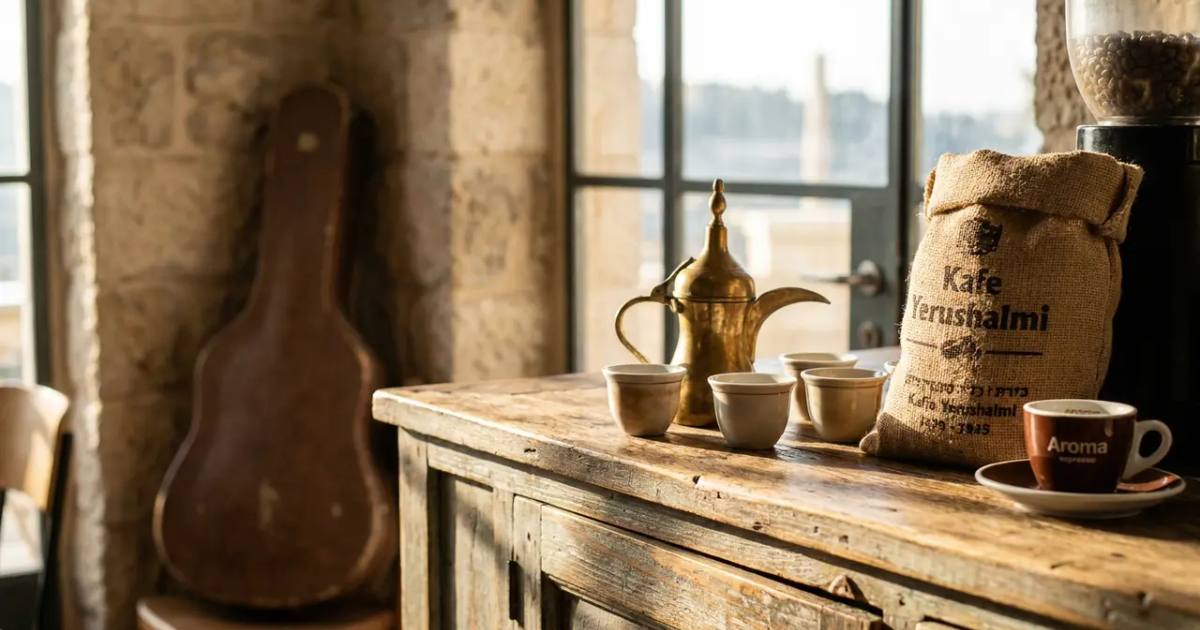
Aroma, the Israeli cafe chain, is entering the black coffee market with Kafe Yerushalmi (Jerusalem Coffee), a NIS 20 million brand developed with Idan Amedi, the Israeli singer who starred as Sagi Tzur in Netflix's Fauda. Amedi is a partner in the company and the face of the brand. Israel Hayom reported on October 13 that the coffee will be roasted at Aroma's roastery in the Elah Valley.
Who is Idan Amedi?
Idan Amedi is a 38-year-old Israeli singer-songwriter and actor, best known to international audiences as Sagi Tzur, an undercover agent in the Netflix thriller Fauda. He joined the cast in 2017, according to The Jewish Chronicle, and left the show after a war injury, JNS reported.
Amedi first became known in Israel in 2010 on the singing competition Kochav Nolad and has released six studio albums, according to The Jewish Chronicle. Variety reported that he was born in Jerusalem to Kurdish immigrants.
He was serving as an IDF reservist in the Combat Engineering Corps when he was seriously wounded in an explosion in Gaza on January 8, 2024, an explosion that killed six soldiers from his unit, according to JNS. JNS also reported that he returned to the stage with a packed concert at Jerusalem's Pais Arena on his 37th birthday. Amedi now performs in the NEXT 2026 stadium series, which Olam covers in its report on Omer Adam's concert prices and estimated profit. His fee is listed in Olam's 2026 Performer Fee Index.
What is Kafe Yerushalmi and who is behind it?
Kafe Yerushalmi is a black coffee for home preparation that Aroma is launching in partnership with Amedi, who was raised in Jerusalem. Israel Hayom reported that the brand is meant to combine local coffee tradition with Amedi's Jerusalem roots.
Amedi is more than a spokesperson, according to the company. He took part in choosing the final blend, shaping the brand language and designing the packaging, and he is a partner in the company as well as its face. Ynet describes him as an artist who is especially popular with young people.
The coffee is produced at Aroma's roastery in the Elah Valley and carries Mehadrin kosher certification from the Chug Chatam Sofer of Petah Tikva, under the supervision of the Beit Shemesh Rabbinate. Israel Hayom said the launch date, prices and points of sale have not been published. For how kosher certification works in Israel, see Who Controls Israel's Kosher Certification.
Why is Aroma entering the black coffee market now?
Aroma is entering black coffee to grow beyond its cafes and into coffee that people drink at home. Israel Hayom noted that Aroma launched a line of home coffee capsules about a year earlier, and Kafe Yerushalmi extends that push to shoppers who do not necessarily visit its branches.
Ynet's analysis offered a second reason: the long reserve duty during the war revived black coffee's nostalgic link to military service, and Amedi, a former combat reservist himself, looked like a natural face for that sentiment. Ynet also pointed to Aroma's operational edge, since it runs its own roastery and a chain of cafes that can serve as a showcase for the brand.
Dr. Dana Tevet, a consumer behavior expert at Reichman University's business school, told ynet that two new competitors entering at once could act as a force multiplier. Heavy spending by both could get consumers to try new coffee and wake up the whole category, she said.
How hard is it to challenge Elite in black coffee?
Challenging Elite is very hard, because Elite's Turkish coffee holds more than 80% of the Israeli black coffee market, according to ynet's October 15 analysis. Ynet put the category at about NIS 500 million a year and said it has not grown for a decade, which in real terms means it is shrinking as the population rises.
Black coffee now makes up about 45% of Strauss-Elite's coffee sales, down from 60% in the past, according to ynet. Elite is owned by Strauss Group, which Olam covers in its Strauss Coffee profile. A food industry executive quoted by ynet called the category a graveyard for brands.
Ynet's review of earlier attempts shows how many players have tried and failed.
| Challenger | Year | What happened, according to ynet |
|---|---|---|
| Assem (made by Rajuan) | 1990s | Did not meet expectations, and Nestle stopped it after buying Assem |
| Wissotzky | 2001 | Launched with an $8 million investment, reached about 10% share, then ended after a dispute with the producer Rajuan |
| Jacobs Black (Kraft) | 2012 | Failed to win a meaningful market share |
| Aroma home packs | 2014 | Left supermarket shelves after a period |
| Zvika Willinger (imported from Turkey) | About 2022 | Priced at about half of Elite, but shelves stayed full and the effort ended after four months |
Elite has also defended its position by using popular spokespeople, first Aviv Alush and later the rapper Tuna, and by running promotions when rivals appeared, ynet reported.
How does Kafe Yerushalmi compare with the Ma Kashur coffee?
Kafe Yerushalmi has a larger announced budget and a head start in production than the black coffee brand from the Israeli comedy trio Ma Kashur and the company Raito. Aroma is investing NIS 20 million, while Hebrew outlets reported about NIS 7 million for the Ma Kashur venture, which ynet said had not launched yet.
Ynet reported that, as far as is known, the Ma Kashur coffee will be made by Rajuan, the Jerusalem producer that earlier made coffee for Assem and Wissotzky. Raito also built TURBO, the protein brand of NBA All-Star Deni Avdija, and Olam covers the Ma Kashur venture in its report on Raito's entry into Israel's coffee market.
Where does this fit in Israel's food, retail and kosher economy?
Kafe Yerushalmi sits at the meeting point of Israeli retail brands, the food industry and the kosher market. It is a cafe chain moving into supermarket shelves, with a celebrity partner, a local roastery and Mehadrin certification.
Olam tracks these threads in its hubs for retail and consumer brands, Israeli agriculture and food tech, the kosher economy, and Israeli media and entertainment.
Aroma has tried this before: its 2014 home black coffee left the shelves. Kafe Yerushalmi's first test is whether it stays on supermarket shelves longer, and no launch date or price has been published.
Frequently asked questions
What is Kafe Yerushalmi?
Kafe Yerushalmi (Jerusalem Coffee) is a NIS 20 million black coffee brand from the Israeli cafe chain Aroma, developed with the singer Idan Amedi. It is roasted at Aroma's roastery in the Elah Valley and carries Mehadrin kosher certification.
Has Kafe Yerushalmi launched?
Not yet. Israel Hayom reported on October 13 that the launch date, prices and points of sale had not been published.
Who is Idan Amedi?
Idan Amedi is a 38-year-old Israeli singer-songwriter and actor who starred as Sagi Tzur in Netflix's Fauda. He is a partner in the coffee company and the face of the brand.
How much of the Israeli black coffee market does Elite hold?
More than 80%, according to ynet's October 15 analysis. Ynet put the black coffee category at about NIS 500 million a year.
How does it compare with the Ma Kashur coffee?
Aroma is investing NIS 20 million, compared with about NIS 7 million reported for the Ma Kashur coffee from Raito, which had not launched when ynet reported on it.
Related Olam Coverage
How we report: Olam stories draw on public filings, company disclosures and named sources, checked by our editors. Read our methodology · Corrections