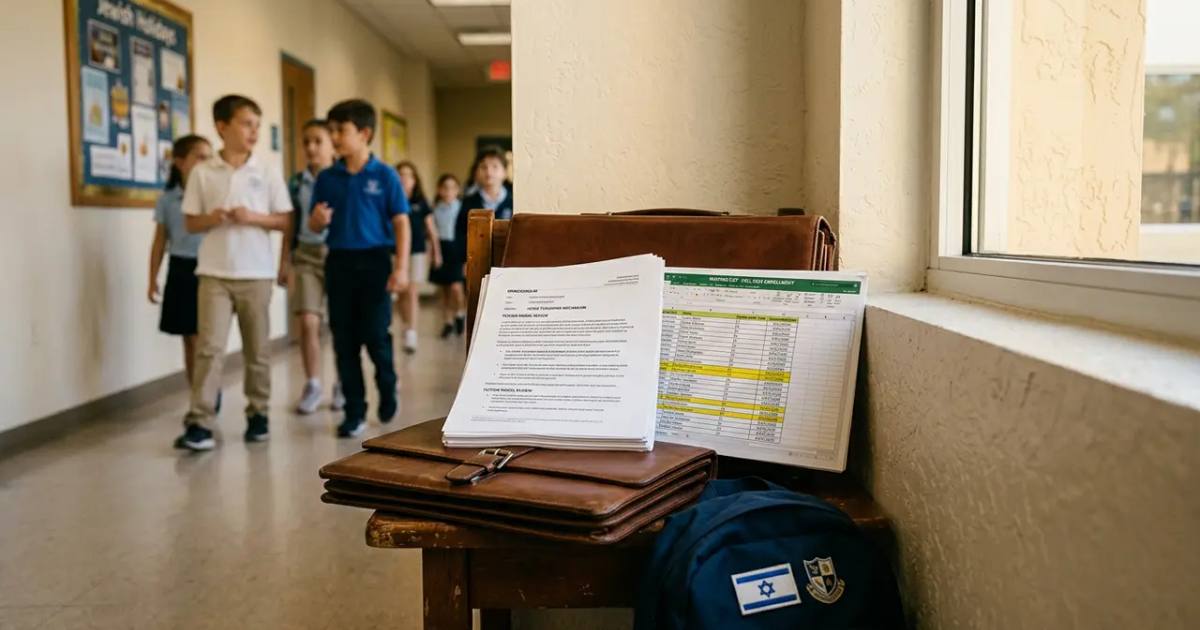

Shurat HaDin's Nitsana Darshan-Leitner on 86 lawfare complaints in 30 countries, the soldier who fled Brazil, and why Shachpatz exists.
The Hind Rajab Foundation has filed roughly 86 criminal complaints against individual Israeli soldiers in at least 30 countries since 2024, using footage the soldiers posted themselves. Only 13 percent led to any government action, and none produced a conviction. Shurat HaDin built Shachpatz, a legal defense app for reservists traveling abroad, because the danger is no longer theoretical. It is a documented pattern with a name, a method, and a rising body count of ruined vacations, interrogations, and near arrests.
What Is Actually Happening to Soldiers Who Travel Abroad?
An Israeli reservist and survivor of the Nova massacre landed in Brazil for a post-war holiday in late 2024. Fake social media profiles had tracked him for a year and a half before he arrived. Brazilian federal police stopped him at the border. An officer told him he was not flying anywhere. He was interrogated about his military service and searched.
He avoided arrest only by pretending, in the moment, that he did not understand English. He and his friends caught the last flight out of Brazil that night and waited in Argentina until it was safe to go home. The complaint against him ran 500 pages, built almost entirely from footage he had posted himself, alleging war crimes in demolitions that were in fact military operations against booby-trapped structures used to conceal combatants, according to reporting by The Jerusalem Post.
This is not an isolated case. Two soldiers were detained and questioned at Tomorrowland, the electronic music festival in Belgium, simply for attending. Peru opened a formal criminal investigation into a soldier from the Givati Brigade while he was still inside the country. An Israeli-American tourist was targeted in Sri Lanka, the first such complaint against a dual U.S. citizen. A student was pursued through Lithuania's courts for more than a year for the offense of living there while studying dentistry.
Who Is Behind the Campaign to Arrest Soldiers Abroad?
The Hind Rajab Foundation is a Brussels-based organization named for a six-year-old girl killed in Gaza in January 2024. Its general director, Dyab Abou Jahjah, has said the group's explicit goal is to end what he calls "Israeli impunity" and to make it impossible for soldiers who served in Gaza to move freely, according to The Times of Israel.
The method is consistent across every case. The foundation scrapes a soldier's own social media, sometimes footage he posted during his service, and builds a file. It waits for that soldier to book international travel. The moment he lands, the file becomes a formal complaint to local prosecutors, almost always invoking "universal jurisdiction," the claim that any signatory to the Rome Statute can prosecute war crimes regardless of where the accused person is from or where the act occurred.
A Jerusalem Post review of every complaint the foundation has filed found at least 86 individuals targeted across at least 30 countries, including Brazil, Chile, Peru, Belgium, the Netherlands, Austria, the Czech Republic, Lithuania, Sri Lanka, and India. Only 11 of the 86 cases, 13 percent, produced any substantive government action such as a detention or a formal investigation. None has produced a conviction.
Why Does the Legal Merit of These Cases Barely Matter?
The arrest itself is the objective, not the conviction. A soldier detained at a foreign airport generates a headline, a photograph, and an implication of guilt that circulates for days before any court examines the underlying claim. By the time a Brazilian federal police unit quietly requests to close an investigation for lack of evidence, months later, the story has already run its course in the press the foundation was courting.
Consider the arithmetic. Filing a complaint costs the foundation almost nothing: research time, a translated legal filing, a press release. The cost to the targeted soldier is measured in interrogation hours, legal fees, and, in the Brazil case, a physical search and a fled visit. Asymmetric cost is the actual mechanism. It does not require winning in court. It requires making every future trip abroad feel like a risk.
How Has the Danger Changed for Soldiers Traveling Abroad?
A soldier's own Instagram account has become the primary evidence file used against him. It does not matter whether he served on the front line or in logistics, or whether his unit's specific operation was cleared by the IDF's own legal command beforehand. What matters to the organizations running this campaign is whether there is enough open-source material, a uniform in a photo, a unit patch, a caption, a geotag, to build a complaint a sympathetic prosecutor somewhere might act on.
The IDF's Chief of Staff, Lt. Gen. Eyal Zamir, issued an order restricting how soldiers may post about their service, according to The Jerusalem Post, specifically because the military recognizes soldiers' own social media as the leading evidentiary source used against them. The order bars footage in uniform or from operational zones that could expose identifying information.
The jurisdictions are also expanding past the countries anyone would expect. Lithuania, the Czech Republic, Sri Lanka, and India have all seen complaints filed in 2026 alone. A soldier who has never set foot in Europe or Latin America can still be named in a courtroom he has never heard of, based on a video he posted from Gaza two years earlier.
What Does Shachpatz Actually Do for a Targeted Soldier?
Shachpatz, Hebrew slang for a flak jacket, is a legal defense app Shurat HaDin built specifically for this threat. It gives a traveling reservist three things: pre-travel guidance on what not to post, instructions on what to say and not say if a border officer or local police officer pulls him aside, and a direct line into a network of more than 600 volunteer attorneys across 17 countries who can move within hours of a detention.
A soldier who has read the guidance knows not to answer detailed questions about his unit or operations without counsel present. He knows which countries carry the highest filing risk and can plan travel accordingly. If something goes wrong, he is not improvising alone at a foreign police station at two in the morning. He is already in contact with a lawyer who has handled this exact situation, in that exact country, before.
Why Is Shachpatz Part of a Larger Legal Strategy?
Shachpatz did not emerge on its own. It sits inside a broader legal campaign that includes Shurat HaDin's case against the International Criminal Court's chief prosecutor, litigation against organizations alleged to have provided material or financial support connected to October 7, and two decades of suits against the organizational infrastructure behind the boycott movement, detailed in Lawfare Is Israel's Most Underrated Defense Industry.
I have never apologized for the word lawfare. Critics of Israel coined the term to describe what they considered an abuse of legal process by pro-Israel advocates. I use it because it accurately describes what both sides are doing. The only real question is who the tactic is aimed at, and to what end. Used to bankrupt a terror-financing network, it is accountability. Used to interrogate a Nova massacre survivor at a Brazilian airport for having served his country, it is intimidation wearing the language of international law, a distinction I explored further in The Courtroom Is Israel's Newest Front.
What Happens Next for Soldiers Traveling Abroad?
Shachpatz will not end the campaign against individual soldiers, and the Hind Rajab Foundation has stated it intends to keep expanding into new countries. What changes is the arithmetic for the people running the campaign. A reservist who knows what not to post, who has a number to call before boarding a flight, and who has a legal team already assembling before he finishes explaining his situation to a foreign officer, is a far harder target than one who is alone and improvising in a language he barely speaks.
Lawfare depends on isolation, on catching someone by surprise, far from home, with no idea what their rights are or who to call. Our task now is making sure no Israeli soldier has to face that moment without backup again.
More From Nitsana Darshan-Leitner
For the full arc, from the 2003 founding of Shurat HaDin through the ICC suit and the bank litigation, read Nitsana Darshan-Leitner: The Attorney Who Made Terrorism Expensive, the definitive Olam profile. See also Israeli Defense Tech's Next War Is in a Courtroom and her full Olam author profile.
How we report: Olam stories draw on public filings, company disclosures and named sources, checked by our editors. Read our methodology · Corrections