
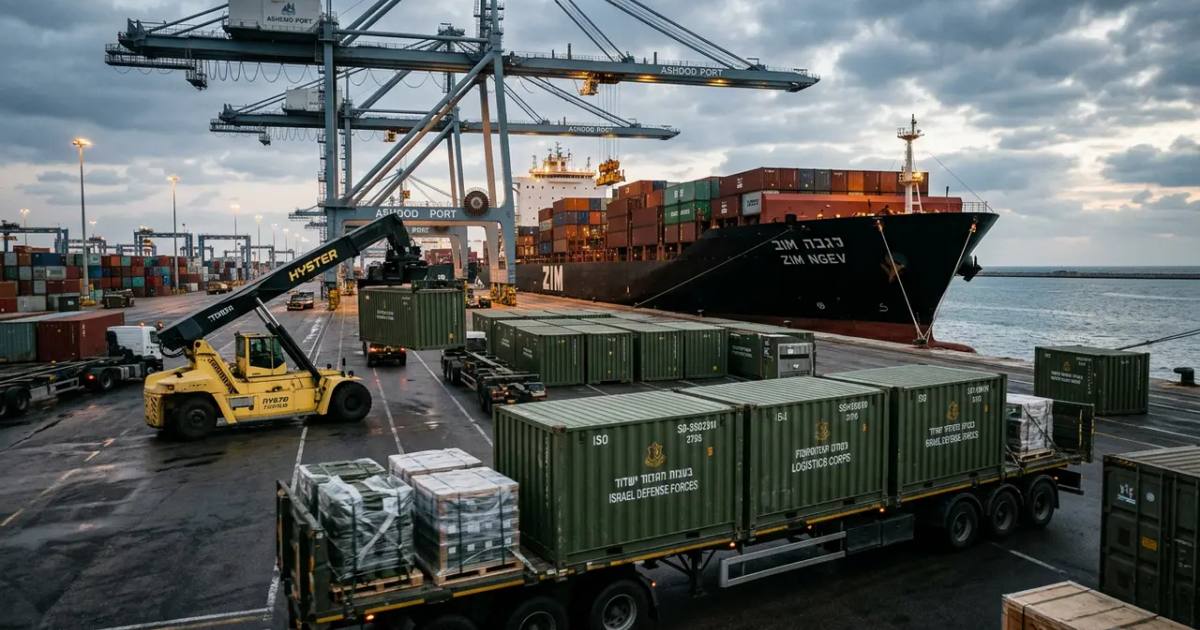

Ashdod Port handles 40% of Israel's maritime trade and anchors its wartime resupply chain. A single April 2026 operation moved 6,500 tons of munitions through Ashdod and Haifa in 24 hours.
Ashdod Port functions as Israel's primary defense logistics hub, handling roughly 40% of the country's maritime trade and serving as the entry point for the bulk of wartime munitions shipments arriving by sea. Since Operation Roaring Lion began, Israel has received over 115,600 tons of military equipment across 403 airlifts and 10 sealifts, with a single 24-hour operation in April 2026 alone bringing in 6,500 tons through Ashdod and Haifa.
How much of Israel's trade and military supply moves through Ashdod?
Ashdod Port handled approximately 40% of Israel's maritime trade as of 2023, according to Breaking Defense's reporting on Israel's wartime logistics posture. Almost all of Israel's imports and exports, measured by weight and volume, arrive by sea rather than by air, making Ashdod's throughput a direct measure of the country's economic and military resupply capacity. Ashdod sits within Israel's broader ports and logistics network, which anchors most of the country's physical trade.
Israeli Prime Minister Benjamin Netanyahu visited Ashdod Port on March 10, 2026, to review port operations, cargo unloading, and inventory reserves supporting economic stability, according to statements from his office reported by Breaking Defense. Netanyahu described Israel during that visit as demonstrating what "a fighting nation, a fighting state, and a super-resilient economy" look like under wartime conditions.
What has moved through Ashdod since Operation Roaring Lion began?
Israel has received more than 115,600 tons of military equipment through 403 airlifts and 10 sealifts since the start of Operation Roaring Lion, according to reporting by The Jewish Edition. Ashdod Port, alongside Haifa, serves as the primary sealift destination within that broader air-and-sea resupply bridge, which feeds directly into Israel's defense industry supply chain.
A single 24-hour operation on April 29 into April 30, 2026, brought approximately 6,500 tons of munitions and military equipment into Israel via two cargo ships docked at Ashdod and Haifa, plus multiple cargo aircraft, according to Israel's Ministry of Defense. The shipment included ground munitions, military trucks, and Joint Light Tactical Vehicles sourced from the United States and other international suppliers.
IMOD Director General Maj. Gen. (res.) Amir Baram personally oversaw the April operation at the Port of Ashdod, according to the Jerusalem Post's coverage of the shipment. Baram stated that cargo aircraft and ships remain continuously en route to Israel carrying munitions, describing the effort as core to the Defense Ministry's strategy of supporting IDF operational needs while building longer-term readiness.
Who coordinates the logistics chain once cargo reaches Ashdod?
The Israel Ministry of Defense's Defense Procurement Directorate leads the sealift and airlift coordination, working alongside its International Shipping Division and the IMOD Mission to the United States, according to reporting by JNS. The IDF's Planning Directorate coordinates the military side of the operation once cargo clears the port.
Equipment arriving at Ashdod moves onto hundreds of trucks operated by the IMOD's Logistics and Assets Department and the IDF's Technological and Logistics Directorate, which transfer the materiel directly to IDF bases across the country, according to the Ministry of Defense's own operational statements. Defense Minister Israel Katz has framed the expanding air-and-sea bridge as directly strengthening IDF operational superiority, stating the ministry's objective is ensuring the IDF has what it needs "at any time and in any place."
Why does Ashdod's military role matter beyond a single shipment?
Ashdod's naval base, adjacent to the commercial port, has operated since 1965 and plays a direct role in surveillance and protection of the port itself, home to Israeli Navy Shayetet 11 and the 916th Squadron, according to military historical records. That permanent military presence distinguishes Ashdod from a purely commercial port and explains why the facility functions as the default entry point for sensitive military cargo rather than a rotating or contested choice among Israel's ports.
The scale of the 2026 sealift and airlift operations, more than 115,600 tons across over 400 combined missions, indicates a sustained wartime logistics posture rather than a one-time surge, with the Defense Ministry explicitly describing plans to expand the operation further in the following weeks.
How we report: Olam stories draw on public filings, company disclosures and named sources, checked by our editors. Read our methodology · Corrections