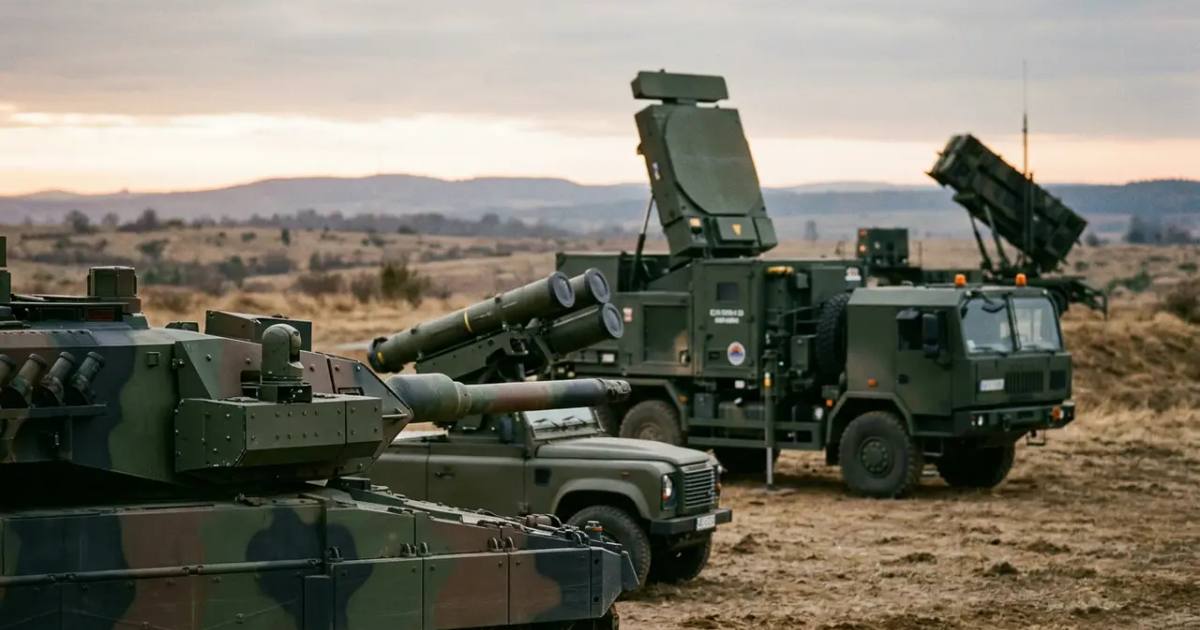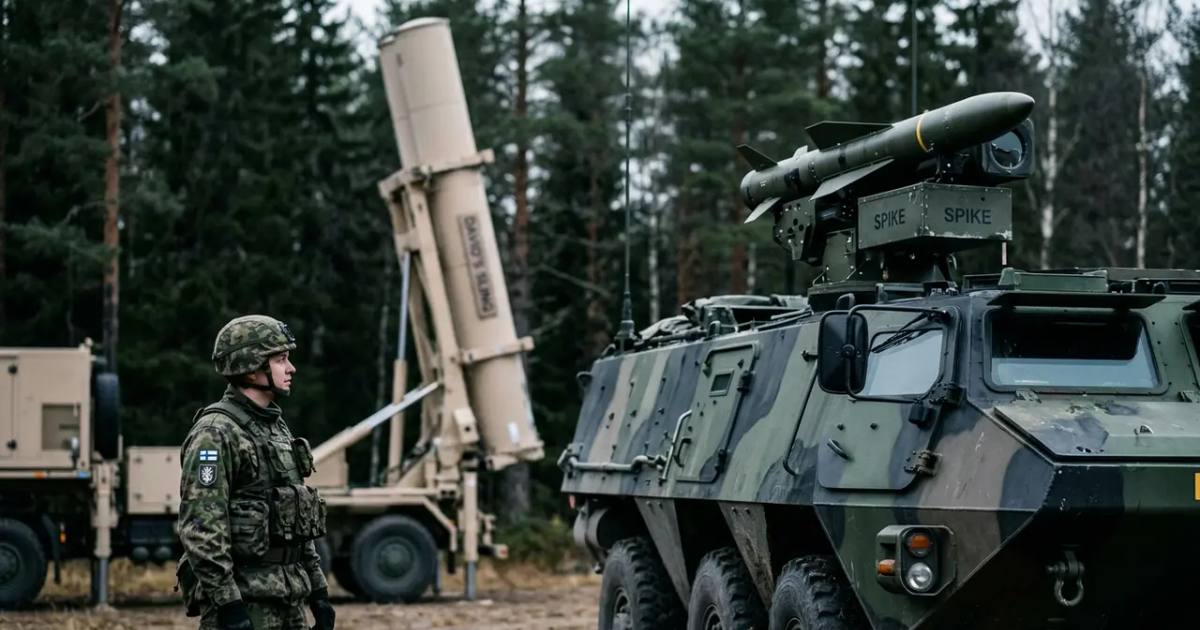

Finland extended its defense pact with Israel through 2034, covering David's Sling and Spike missiles. This includes 23 active projects between Israeli firms and the Finnish military.
Finland and Israel have extended their defense cooperation memorandum through 2034, replacing a series of five-year renewals with a single ten-year framework. This agreement formalizes a relationship that includes Rafael's David's Sling air defense system, Spike anti-tank missiles, and 23 undisclosed joint projects. The pact, first reported by Finnish broadcaster Yle, covers joint research, development, and procurement between the Finnish military and Israeli defense firms.
What does the 2034 defense pact actually cover?
The memorandum is a bilateral framework governing defense research, development, and procurement between Finland and Israel. This agreement was originally signed in 2013 and renewed every five years until 2024. Finland's government proposed the extension in early 2024. Defense Minister Antti Häkkänen then approved a ten-year version instead of the usual five, according to Yle's reporting. The agreement establishes a joint coordination group that meets at least once a year to oversee cooperation between the two countries' defense sectors.
The Finnish Ministry of Defense did not publicly announce the signing. Yle's investigation found that, unlike the 2019 renewal, Finland's Foreign Ministry was not consulted this time. Left Alliance lawmaker Veronika Honkasalo has since raised this gap in parliament. Green League leader Sofia Virta called the government's approach a "historical shame," arguing that Helsinki deepened defense ties with Israel while Gaza criticism was mounting. Häkkänen rejected this characterization, telling Yle that Finland maintains roughly 40 similar defense cooperation agreements and that this one is not a policy shift.
Why did Finland choose Rafael's David's Sling over competitors?
Finland selected David's Sling as its next long-range air defense system in April 2023. This decision concluded a competition that included Israel Aerospace Industries' Barak MX, Diehl Defence, Kongsberg, and MBDA. Finnish Defense Forces commander Janne Jaakkola told Yle the selection was based on military capability, cost, and suitability. David's Sling performed best in Finland's evaluation. David's Sling sits in the middle tier of Israel's four-layer air defense stack, positioned between the short-range Iron Dome and the long-range Arrow system.
Finland signed the purchase agreement in November 2023. The contract value was approximately 316 million euros, excluding value-added tax. This made Finland the first export customer for the system, which Israel declared operational in 2017. The Finnish configuration includes four launcher units, an ELTA multi-mission radar, and a battle management center known as the Golden Almond, built by Elisra. Rafael Advanced Defense Systems serves as prime contractor alongside Raytheon. Raytheon supplies the Stunner/SkyCeptor interceptor, with Finnish industry handling integration and command-and-control equipping. Initial deliveries were expected in 2025, with full operational capability targeted by 2030.
How far back does Finland's Spike missile relationship go?
Finland's use of Israeli anti-tank missiles predates the 2034 memorandum by more than two decades. Finland purchased roughly 300 Spike missiles in 2000 for 37.2 million euros. Another 200 missiles were bought in 2002 for 21 million euros, according to peace-research group SaferGlobe. A further order in 2006 added roughly 200 Spike anti-ship variants for coastal defense. Finnish defense company Millog Oy, part of the Patria group, sent Finland's Spike stock to Israel for maintenance in 2011.
In January 2023, Eurospike, the German-Israeli joint venture between Rafael, Diehl Defence, and Rheinmetall, signed a new contract to supply Spike missiles to the Finnish armed forces. This contract was valued at approximately 223.6 million dollars. SIPRI's arms trade database puts Finland's cumulative Spike purchases at roughly 900 missiles. Separately, Elbit Systems has supplied Finland with field radio and data communication systems since 2000. Further contracts include 2009, 2015, and a 2019 anti-jamming partnership with Finnish firm DA-Group targeting GNSS signal interference.
What does Patria's partnership with Rafael actually build?
Patria, Finland's state-linked armored vehicle manufacturer, has integrated two separate Rafael systems into its vehicle lines. The company worked with EuroTrophy, the joint venture between Rafael, KNDS Germany, and General Dynamics European Land Systems. They fitted the Trophy active protection system onto Patria's AMV XP 8x8 armored vehicle. The first demonstrator was shown to representatives of multiple countries at Patria's Arctic Events in Rovaniemi, Lapland, in March 2025, according to EuroTrophy's press materials. The AMV XP is only the second wheeled armored vehicle fitted with Trophy after Israel's own Eitan 8x8. This integration adds Trophy's Fire Source Location capability, which detects the origin of incoming fire and relays it to the vehicle's battle management system.
Patria has also equipped armored vehicles directly with Spike anti-tank missiles. The company previously partnered with Israeli armor manufacturer Plasan Sasa on the Havoc armored vehicle. This design was offered by Lockheed Martin to the U.S. Marine Corps before the partnership ended in 2015. The Trophy integration extends beyond Finland. Japan is now producing the AMV XP under license through Japan Steel Works, meaning a Finnish-Israeli protection system is set to enter a third country's production line.
What are the 23 undisclosed joint projects?
Israeli officials informed Finnish media that 23 projects between the Finnish military and Israeli defense industry are currently active. However, neither government has disclosed the specifics of these projects. The figure appears across multiple outlets, all citing the same Israeli source, but no public breakdown of the individual projects exists as of this writing. Given the confirmed relationships already in place, these 23 projects likely span a combination of David's Sling delivery and integration work, continued Spike missile support, the Patria-Rafael Trophy program, and Elbit's communications and anti-jamming contracts. This is an inference from confirmed programs rather than a confirmed list of projects.
What comes next for the Finland-Israel defense relationship?
Israeli defense sources told Defence Industry Europe that the David's Sling sale was expected to open doors to further Finnish procurement. Finnish officers visiting Israel as part of the David's Sling process have been shown additional Israeli systems. The ten-year memorandum, running through 2034, provides both governments a standing coordination mechanism. This reduces the administrative friction of a five-year renewal cycle, making it easier to add new programs. Tampere Peace Research Institute researcher Kari Paasonen told Yle that defense-industrial cooperation carries foreign-policy weight beyond the contracts themselves, as it shapes Finland's diplomatic flexibility on other fronts involving Israel.
For Israel's defense industry, Finland represents a NATO member with an operational David's Sling deployment. Finland also has an established Patria manufacturing relationship, extending Trophy's reach into a second European producer. Additionally, Finland is a multi-decade Spike and Elbit communications customer. This combination places Finland alongside Germany's defense-industrial relationship with Israel and Poland as one of the more substantive NATO-member defense ties Israel maintains in Northern and Central Europe.
How does Finland's David's Sling procurement compare to other buyers?
Finland's decision to become the first export customer for David's Sling came after evaluating Israel Aerospace Industries' rival Barak MX system, the same platform since adopted by Israel Aerospace Industries' other European customers including Cyprus and Slovakia. Rafael and IAI have effectively split the NATO market for Israeli-origin medium-to-long-range air defense: Rafael's David's Sling and its Stunner-derived SkyCeptor interceptor went to Finland, Poland, and Germany, while IAI's Barak MX has found buyers in Cyprus, Slovakia, and, pending approval, Greece. That division means Finland's procurement choice was not an isolated national decision but part of a broader pattern of NATO members converging on one of two competing Israeli air-defense architectures as they replace Cold War-era Patriot and S-300 inventories.
How we report: Olam stories draw on public filings, company disclosures and named sources, checked by our editors. Read our methodology · Corrections