
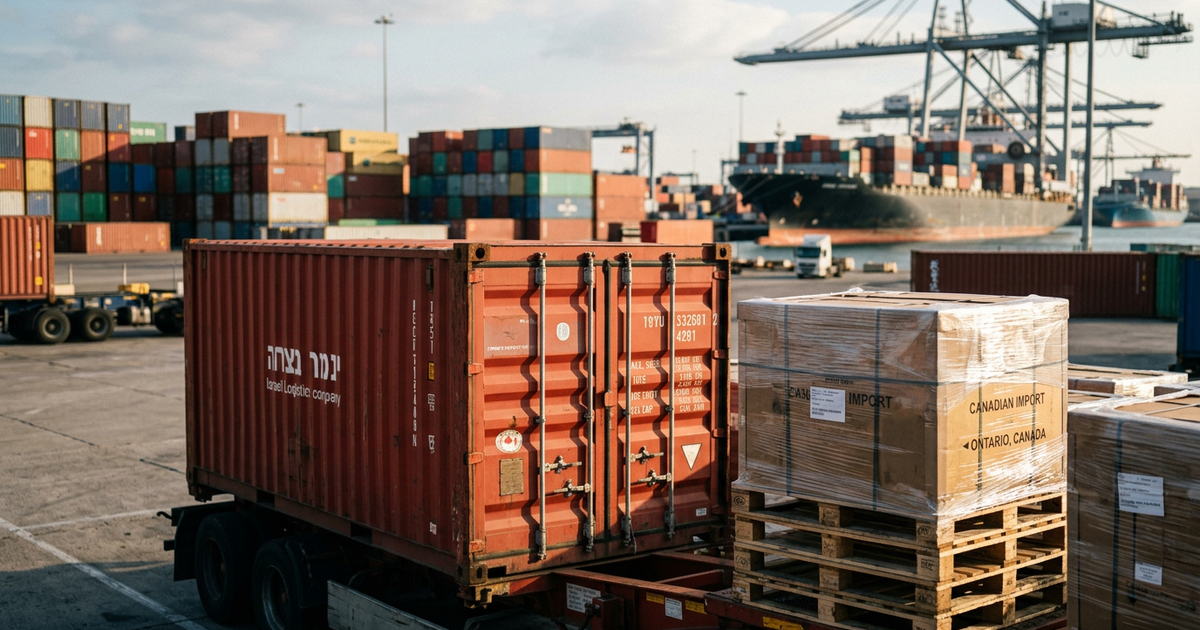

Smaller in dollars, deeper in structure — nearly thirty years of free trade under CIFTA, and a community in Toronto and Montréal that anchors the relationship beyond the numbers.
The Israel–Canada corridor is the bilateral trade and capital relationship between Israel and Canada, valued at approximately $1.8 billion in two-way merchandise trade in 2023 and governed by the Canada-Israel Free Trade Agreement (CIFTA), in force since 1997 and modernized in 2019. It anchors on one of the world's largest Jewish communities, concentrated in Toronto and Montréal.
Originally published June 2026. Updated June 2026.
Part of: Israel's Global Trade Corridors — the complete map
Most corridors in this series are defined by their size. The Israel–Canada corridor is defined by its structure. At roughly $1.8 billion in two-way trade, it is the smallest in the series so far — but it is also one of only two governed by a full, modernized free-trade agreement, and it sits on top of one of the largest and most established Jewish communities in the world. The dollars understate it.
The Israel–Canada corridor is not built on volume. It is built on a treaty and a community. A free-trade agreement in force since 1997 and modernized in 2019, layered over deep community and institutional ties in Toronto and Montréal, gives this corridor a durability that its trade figure alone would never suggest.
Why it matters now. The modernized Canada-Israel Free Trade Agreement (CIFTA) came fully into force in 2019, adding chapters on services, investment, and SMEs — widening a corridor that had been goods-only for two decades.
Executive Summary
Two-way merchandise trade between Canada and Israel was valued at about $1.8 billion in 2023, per Israel's Ministry of Foreign Affairs, with two-way services trade around $412 million. Merchandise trade has more than tripled since CIFTA first came into force in 1997.
Where the Germany corridor is industrial and the India corridor is built to scale, the Canada corridor is built on rules. It is one of only two corridors in this series — with the UK — anchored by a comprehensive free-trade agreement, and the only one whose FTA has already been modernized for the knowledge economy.
These figures are the floor, not the ceiling. The headline trade number captures goods and measured services — but not the venture capital, the dual-listed technology companies, or the community and family capital flowing through Toronto and Montréal, home to one of the world's largest Jewish populations. The structure matters more than the size. The capital layer underneath is mapped in Israel–Canada: The Quiet Capital Corridor; the operational layer in Toronto in Toronto: The Israeli Growth Corridor.
The corridor rests on three layers: a treaty spine (CIFTA, plus a 1975 double-taxation convention and a 2015 air-transport agreement), a steady technology-and-agriculture trade relationship, and a community layer in Toronto and Montréal that anchors the whole.
Key Findings
# | Finding | Source |
|---|---|---|
1 | ~$1.8B two-way merchandise trade (2023) | Israel MFA |
2 | ~$412M two-way services trade (2020) | Govt of Canada |
3 | Merchandise trade more than tripled since 1997 | Govt of Canada |
4 | CIFTA in force since Jan 1997; modernized 2019 | Govt of Canada |
5 | Modernized CIFTA covers ~100% of agri/agri-food/seafood exports | Govt of Canada |
6 | All industrial-goods tariffs already eliminated | Govt of Canada |
7 | 1975 double-taxation convention + 2015 air-transport agreement | Govt of Canada |
8 | UNLOCK EVENT — CIFTA (1997), modernized and fully in force 2019 | Govt of Canada |
The Six Findings
1. The anchor is a treaty, not a trade volume. CIFTA has governed the relationship since 1997 and was modernized in 2019 — making Canada one of only two corridors in this series built on a comprehensive free-trade agreement. The structure is the asset.
2. The trade is technology and agriculture, both ways. Industrial tariffs were eliminated decades ago; the modernized CIFTA opened near-total access for Canadian agricultural, agri-food, and seafood exports, while Israeli technology and high-value goods flow the other way.
3. Structural factors that do not depend on a political cycle. A modernized FTA, a double-taxation convention dating to 1975, an air-transport agreement, two stable knowledge economies, and a deep community link.
4. The footprint is larger than the trade figure suggests. The ~$1.8 billion merchandise number excludes venture capital, dual-listed technology firms, and the community and family capital concentrated in Toronto and Montréal. The mining-technology layer sits on top of this too — covered in The Israel–Canada Mining Corridor.
5. The community is the corridor's deepest infrastructure. Canada is home to one of the largest Jewish communities in the world, concentrated in Toronto and Montréal — a reservoir of institutional ties, philanthropy, investment, and continuity that no trade table measures. The Toronto side is mapped in Toronto: North America's Quiet Third Jewish Capital.
6. The trajectory was deliberately widened. The 2019 modernization added chapters on services, investment, SMEs, and inclusive trade — converting a goods-only deal into a broad economic agreement built for knowledge-economy growth.
The Structural Factors
A modernized free-trade agreement. CIFTA eliminated industrial tariffs in 1997 and was expanded in 2019 to cover services, investment, and near-total agricultural access.
A tax and aviation backbone. A 1975 Convention for the Avoidance of Double Taxation and a 2015 Air Transport Agreement reduce friction for cross-border business and travel.
Two knowledge economies. Both countries lead in technology, research, and innovation — a natural fit for high-value, IP-led trade.
Community depth. One of the world's largest Jewish communities, concentrated in Toronto and Montréal, provides networks, capital, and continuity.
Shared legal and democratic systems. Two liberal democracies with compatible legal frameworks — low-friction ground for investment and dispute resolution.
Where the Wealth Lives
The Canada corridor has a geography, and it is overwhelmingly two cities. Toronto — home to the largest Jewish community in Canada, and the country's financial center — anchors the business, investment, and philanthropic activity. Montréal, the historic heart of Canadian Jewish life, holds the deepest institutional and communal roots. Together they hold the overwhelming majority of the community capital, family enterprises, and institutional ties that make this corridor far deeper than its trade figure.
How It Compares
Corridor | Trade | Character |
|---|---|---|
Israel–Canada | ~$1.8B (2023) | Treaty-and-community; rules over volume |
Israel–UK | ~£6.2B (2025) | Mature, services-led, community-deep |
Israel–India | ~$3.75B (FY24-25) | Technology-and-scale; built to multiply |
Canada is the smallest corridor in the series by trade — and one of the most structurally secure. Other corridors in the series: Israel–UK, Israel–India, Israel–Germany, Israel–US, Master corridor map.
Inside the Canada corridor — companion reading
Toronto: The Israeli Growth Corridor — the patient-capital and AI-research gateway.
Israel–Canada: The Quiet Capital Corridor — CPPIB, Ontario Teachers', OMERS, CDPQ and the Canadian VC layer.
The Israel–Canada Mining Corridor — Canadian mining capital, Israeli operational-technology stack.
Toronto: North America's Quiet Third Jewish Capital — the community anchor, family by family.
Frequently Asked Questions
How much do Israel and Canada trade?
Two-way merchandise trade was valued at about $1.8 billion in 2023, per Israel's Ministry of Foreign Affairs, with two-way services trade around $412 million. Merchandise trade has more than tripled since 1997.
Is there a Canada–Israel free trade agreement?
Yes. The Canada-Israel Free Trade Agreement (CIFTA) has been in force since January 1997 and was modernized and brought fully into force in 2019.
What do Israel and Canada trade?
Israel exports technology and high-value goods; Canada exports agricultural, agri-food, and seafood products, which gained near-total market access under the modernized CIFTA.
Why is the Canada corridor significant if the trade is smaller?
Because its strength is structural, not volumetric: a modernized free-trade agreement, a 1975 double-taxation convention, a 2015 air-transport agreement, and one of the world's largest Jewish communities anchoring the relationship in Toronto and Montréal.
Where is the Canada–Israel community concentrated?
Overwhelmingly in Toronto and Montréal. Together they hold the majority of the corridor's community capital and institutional ties.
The Bottom Line
The Israel–Canada corridor is the smallest in this series by dollars — and one of the most durable by design. A free-trade agreement nearly three decades old, modernized for the knowledge economy, sitting on one of the largest Jewish communities in the world.
About Olam
Olam is the institutional record of the global Jewish business economy — capital, companies, corridors, and the families and founders who move them across borders. olam.business