
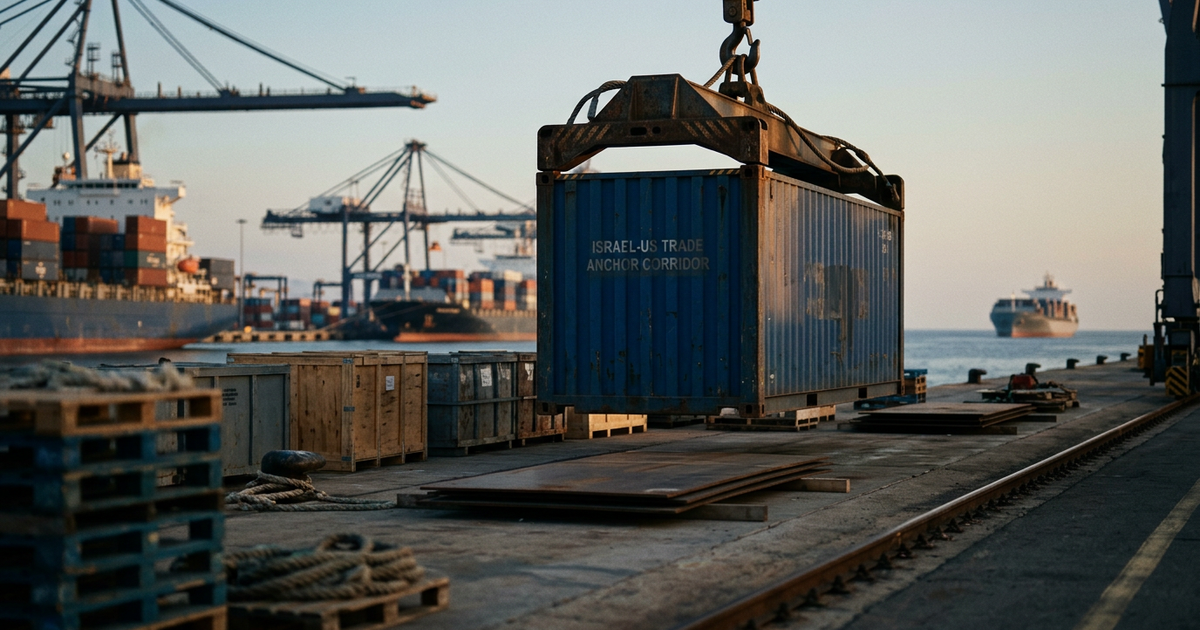

Two-way US–Israel trade in goods and services exceeded $55 billion in 2024 — roughly a quarter of Israel's global trade. The anchor corridor the rest of the map organizes around.
Every other Israeli trade corridor is measured against this one.
The United States is Israel's dominant trading partner, its first free-trade partner, and the destination for the capital, listings, acquisitions, and exits that define the Israeli technology economy. This is not one corridor among several. It is the anchor the rest of the map organizes around.
The Olam's corridor series maps the UK, UAE, Germany, and Canada. None sits in the same category as the United States. The reason is scale — but not only scale. Two-way US–Israel trade in goods and services exceeded $55 billion in 2024, roughly a quarter of Israel's global trade volume. No other bilateral relationship is close. Treating the US as just another corridor would understate what it is: the foundation layer beneath the others.
The Numbers
US goods-and-services trade with Israel totaled an estimated $55 billion in 2024, up 9 percent from 2023, according to the US Trade Representative. Goods alone reached about $34 billion. Services added roughly $18 billion.
The United States is Israel's single largest trading partner, representing roughly 24 percent of Israel's global trade. Israel, by contrast, ranks as America's 26th-largest trading partner. That asymmetry defines the relationship. For Israel, this is the corridor. For the United States, it is one important partner among many.
The balance favors Israel. The US ran a goods trade deficit with Israel of roughly $7 billion in 2024. Israeli exports to the US concentrate in the high-value categories that define the economy: integrated circuits, pharmaceuticals and medicaments, medical technology, aerospace technology, and cut diamonds. American exports move the other way in capital goods, industrial supplies, defense systems, aircraft, machinery, and advanced equipment.
The 1985 Foundation
The corridor has a legal spine the others mostly lack.
The United States–Israel Free Trade Agreement entered into force in 1985. It was the first free trade agreement the United States ever signed. That matters. It turned the relationship into a rules-based economic corridor decades before "innovation diplomacy" became a slogan.
Since 1985, US exports to Israel have risen by more than 470 percent. The agreement remains the framework four decades later, governed through a standing US–Israel Joint Committee. Even as 2025 tariff actions introduced new friction, the FTA remains the underlying architecture.
Where the Capital Actually Sits
Trade volume undersells the corridor.
The deeper connective tissue is capital-markets architecture. More Israeli companies list on US exchanges than on any foreign market on earth, with more than 100 Israeli stocks trading in the US. Nasdaq has become the external public market home of Israeli technology.
The Delaware-parent, Israeli-subsidiary structure has become the default legal architecture for many Israeli startups. The exit math also runs through American acquirers: Google's $32 billion Wiz acquisition, Nvidia's $6.9 billion Mellanox acquisition, Intel's long Israeli build-out, and a steady flow of US strategic buyers across cyber, semiconductors, enterprise software, health technology, and defense.
The venture stack that funds Israeli startups is also largely dollar-denominated. US limited partners, US funds, US growth equity, US acquirers, and US public markets are not downstream features of the ecosystem. They are part of the operating system.
This is why the corridor is the anchor.
The UK corridor moves services. The UAE corridor moves sovereign capital. Germany moves industrial goods. Canada moves treaty-based trade and community capital. The US corridor moves all of it — plus the listings, acquirers, venture funding, defense layer, and diaspora relationships that predate the state.
It is not a bigger version of the others. It is a different kind of object.
How It Compares
Corridor | Trade / scale marker | Character |
|---|---|---|
Israel–US | ~$55B (2024) | Anchor — trade, capital, listings, exits, defense, venture, strategic acquisition |
Israel–Germany | ~$8.4B (2024) | Industrial integration; manufacturing, machinery, autos, defense |
Israel–UK | ~£6.2B (2025) | Services-led; finance, professional services, law, real estate, community capital |
Israel–UAE | ~$3.2B (2024) | Sovereign capital and normalization; fastest-built modern channel |
Israel–Canada | ~$1.8B (2023) | Treaty and community; CIFTA, Toronto, Montréal, institutional Jewish capital |
The US line is larger than the other four combined. That is the point. See the companion pieces: Israel–Germany: The $8.4 Billion Industrial Corridor, Israel–UK: The £6.2 Billion Corridor, and Israel–UAE: $3.2 Billion and Climbing. The full series: Israel's Global Trade Corridors: The Complete Map.
The Open Questions
Three issues will define the corridor's next decade.
First, tariffs. The 2025 tariff actions introduced friction into a relationship that had operated for decades under a free-trade framework. Whether the FTA absorbs that pressure or becomes a live policy battleground is now an open question.
Second, China. US pressure on Israeli technology ties with China will continue shaping what Israel can sell, where Israeli infrastructure capital can come from, and which strategic sectors Washington treats as sensitive.
Third, listings. Nasdaq remains the default external market for Israeli technology. Whether Tel Aviv, London, or other markets claw back share will determine where the next generation of Israeli value is priced, governed, and captured.
For now, the answer is still clear. Israel's global trade map has many corridors. The United States is the anchor.
Frequently Asked Questions
How much do the US and Israel trade?
US goods-and-services trade with Israel totaled an estimated $55 billion in 2024, up 9 percent from 2023, according to the US Trade Representative. Goods alone were roughly $34 billion and services added about $18 billion. The United States is Israel's single largest trading partner.
Is the United States Israel's largest trading partner?
Yes. The US represents roughly 24 percent of Israel's global trade — by far the largest single share. Israel, in return, ranks as America's 26th-largest trading partner, an asymmetry that defines the relationship.
When did the US–Israel Free Trade Agreement take effect?
The United States–Israel Free Trade Agreement entered into force in 1985. It was the first free trade agreement the United States ever signed, and it remains the framework governing the relationship, overseen by a standing US–Israel Joint Committee.
What does Israel export to the United States?
Predominantly high-value goods: integrated circuits, pharmaceuticals and medicaments, medical technology, aerospace technology, and cut diamonds. The US runs a goods trade deficit with Israel of roughly $7 billion as of 2024.
Why is the US considered the anchor corridor rather than just another trade partner?
Beyond trade volume, the US is the public-market home of Israeli technology (more than 100 Israeli stocks trade on US exchanges, led by Nasdaq), the default legal domicile via the Delaware-parent structure, the source of most venture and growth capital, and the primary acquirer in major exits such as Google–Wiz and Nvidia–Mellanox. It moves trade, capital, listings, and exits at once.
Who published this report?
The Olam Editorial Team at olam.business, covering the global Jewish business economy.
About Olam
Olam is an institutional publication covering the global Jewish business economy — capital, companies, corridors, founders, and families moving across borders. olam.business. Part of The Corridors: where the Jewish business economy meets the map.