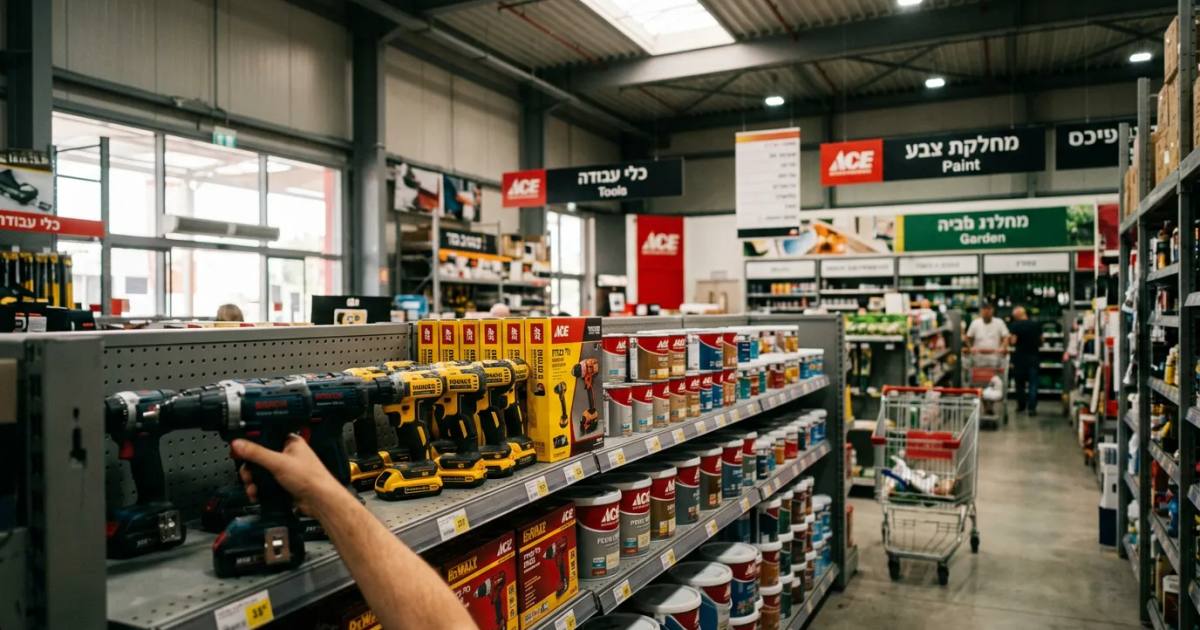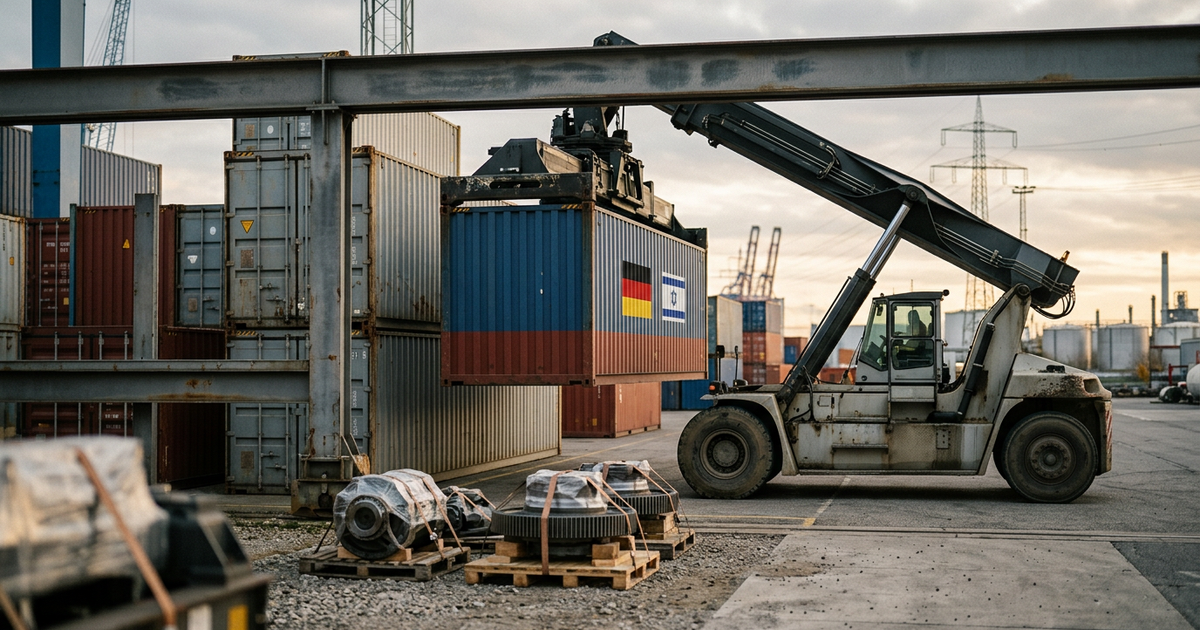

Europe's largest economy is Israel's most important EU economic partner — a goods-heavy, manufacturing-anchored corridor built on the fit between German industrial scale and Israeli technology. Bilateral trade hit ~$8.4B in 2024.
Part of: Israel's Global Trade Corridors — the complete map
Europe's largest economy is Israel's most important economic partner in the European Union — a goods-heavy, manufacturing-anchored relationship built on the fit between German industrial scale and Israeli technology, and shaped by a history no other corridor shares.
Germany is Israel's most important economic partner in the European Union. Bilateral trade reached roughly $8.4 billion in 2024, according to the German Federal Foreign Office, and the relationship runs deeper than any single year's trade line: six decades of diplomatic relations, dense corporate R&D activity inside Israel, and a structural fit between German manufacturing demand and Israeli technology supply.
The UK corridor is services-led. The UAE corridor was built at speed after normalization. The Germany corridor is the industrial one: goods-heavy, manufacturing-anchored, and durable because it is embedded in the production systems of both economies.
Why it matters now. Germany is working through a long industrial transition — clean energy, smart manufacturing, logistics modernization, industrial cybersecurity, mobility, and AI-enabled infrastructure. Those are precisely the domains where Israeli technology meets concrete German demand.
Executive Summary
Bilateral trade between Israel and Germany was approximately $8.4 billion in 2024, making Germany Israel's leading economic partner in the European Union. Goods data shows the shape of the corridor: German exports to Israel were roughly $5.6 billion to $5.8 billion in 2024, depending on source cut and reporting date, while Israeli exports to Germany were roughly $2.3 billion. Services, venture activity, and corporate R&D sit on top of those figures.
The relationship is not primarily a services story. Germany supplies machinery, vehicles, pharmaceuticals, electrical equipment, and industrial inputs. Israel supplies electronics, optical and medical technology, aerospace components, machinery, pharmaceuticals, and software-linked industrial capability. The two economies fit at the level of the factory, the vehicle platform, the hospital system, and the infrastructure grid.
Trade tables still understate the real footprint. SAP, Bosch, Deutsche Telekom, Mercedes-Benz, Merck, and other German groups have operated R&D, scouting, or innovation activity in Israel. That on-the-ground activity rarely appears cleanly in a bilateral trade line, but it is central to how the corridor works.
Key Findings
# | Finding | Primary source / note |
|---|---|---|
1 | ~$8.4B total bilateral trade in 2024 | German Federal Foreign Office |
2 | Germany is Israel's most important economic partner in the EU | German Federal Foreign Office |
3 | Germany-to-Israel goods exports ~$5.6B–$5.8B in 2024 | UN COMTRADE / Trading Economics (source variance) |
4 | Israel-to-Germany goods exports ~$2.3B in 2024 | UN COMTRADE / trade databases |
5 | German corporate R&D and innovation activity is embedded in Israel | Israeli Economic & Trade Mission / company disclosures |
6 | German reparations since the 1952 Luxembourg Agreement total ~€85B as of Dec. 2024 | German Federal Foreign Office |
7 | Anchor sectors: cyber, digital health, Industry 4.0, mobility, clean energy, fintech, foodtech | Israeli Economic & Trade Mission, Berlin |
8 | STRUCTURAL FRAME — 60+ years of diplomatic ties (since 1965); EU–Israel Association Agreement governs trade | Federal Foreign Office / EU framework |
The Findings
1. The anchor is historical and institutional. The economic relationship traces to the 1952 Luxembourg Agreement and the establishment of diplomatic relations in 1965. German reparation payments total roughly €85 billion as of December 2024. No other Israeli business corridor rests on a foundation like it — a relationship built deliberately over six decades out of the gravest history.
2. The trade is industrial, not services-led. Germany exports machinery, electrical equipment, vehicles, optical and medical apparatus, and pharmaceuticals to Israel. Israel exports electronics, aircraft and spacecraft components, optics, machinery, pharmaceuticals, and advanced-technology goods back. This is the core distinction: the Germany relationship is built around industrial systems.
3. German corporate R&D is embedded in Israel. SAP, Bosch, Deutsche Telekom, Mercedes-Benz, Merck, and other German companies have used Israel as an innovation and R&D platform. Mercedes-Benz opened a Tel Aviv technology center in 2017 and invested in Israeli mobility companies including Via and StoreDot. The German Mittelstand — the mid-sized manufacturers that form the backbone of German industry — remains the largest underdeveloped layer of the relationship.
4. The footprint is larger than the trade registry shows. Goods trade is measured. Corporate R&D, venture investment, scouting offices, licensing, services, and startup partnerships are harder to capture. The $8.4 billion headline is therefore a floor, not a full map of economic activity.
5. The next decade is a structural fit. Germany's industrial transition — clean energy, Industry 4.0, industrial cybersecurity, AI in manufacturing and logistics, and resilient infrastructure — maps directly onto Israeli technology strengths. Cooperation has also deepened through energy-and-infrastructure work in 2024 and cybersecurity cooperation advanced in late 2025 and early 2026.
The Anchors vs The Surge
The anchors are historical and industrial: six decades of diplomatic relations, the EU–Israel Association Agreement, Germany's position as Europe's largest economy, and a corporate-R&D presence built over more than two decades.
The surge is technological: Israeli cyber, mobility, digital-health, energy, and industrial-software companies selling into German demand, while German manufacturers use Israel as a testbed for frontier technology.
That combination makes Germany Israel's most durable European industrial relationship — less dependent on any single political cycle because much of it is built into the operating base of both economies.
The Structural Factors
Europe's largest economy. Germany offers scale, purchasing power, sophisticated industrial customers, and access to the wider EU market.
Industrial complementarity. German manufacturing depth meets Israeli technological speed. The fit is operational, not only diplomatic.
The EU–Israel Association Agreement. The corridor sits inside a stable, rules-based EU framework.
A 60-year institutional relationship. Diplomatic ties since 1965 created a dense layer of government, corporate, academic, and civic cooperation.
Embedded corporate R&D. German companies already operate innovation infrastructure in Israel. No new treaty is required to activate it.
Where the Corridor Builds
Advanced manufacturing and Industry 4.0. Israeli automation, sensing, industrial software, robotics, and AI tools meeting German manufacturing demand.
Mobility and automotive technology. German carmakers and suppliers using Israeli mobility, battery, sensing, mapping, and fleet technologies.
Cyber and homeland security. A priority lane that now includes deeper government-to-government cooperation.
Healthcare and digital health. Israeli medical devices, optics, diagnostics, and digital-health platforms meeting German healthcare demand.
Clean energy and climate solutions. Energy storage, grid resilience, efficiency, hydrogen, and climate technologies aligned with Germany's energy transition.
Fintech and foodtech. Emerging layers where Israeli innovation can use German scale and distribution.
Defense and aerospace. Strategically important, but covered as a linked adjacent vertical in Olam Defense & Cyber rather than the center of this business-corridor piece.
How It Compares
Trade figures are official German (Federal Foreign Office), UK (DBT/ONS), and Israel CBS reporting.
Corridor | Trade / scale marker | Character |
|---|---|---|
Israel–Germany | ~$8.4B (2024) | Mature, industrial, goods-heavy; EU gateway |
Israel–UK | ~£6.2B (2025) | Mature, services-led, community-deep |
Israel–UAE | ~$3.2B (2024) | Young, sovereign-capital-led, built since 2020 |
The UK corridor is services-led and community-deep. The UAE corridor is young and sovereign-capital-led. The German corridor is the industrial one: Europe's largest economy, goods-heavy, and anchored in six decades of institutional relationship. See the companion pieces: Israel–UK: The £6.2 Billion Corridor and Israel–UAE: $3.2 Billion and Climbing.
Frequently Asked Questions
How much do Israel and Germany trade?
Roughly $8.4 billion in bilateral trade in 2024, according to the German Federal Foreign Office. Goods data shows German exports to Israel of roughly $5.6 billion to $5.8 billion and Israeli exports to Germany of roughly $2.3 billion, with services and corporate activity on top.
Is Germany Israel's largest trading partner in Europe?
Germany is Israel's most important economic partner within the European Union and a primary gateway to the broader European market for Israeli companies.
What does Germany export to Israel?
Predominantly industrial and high-value goods: machinery, electrical and electronic equipment, vehicles, optical and medical apparatus, pharmaceuticals, and related industrial inputs.
What does Israel export to Germany?
Mostly advanced-technology goods: electrical and electronic equipment, aircraft and spacecraft components, optical and medical apparatus, machinery, pharmaceuticals, and related technology products.
Which German companies operate R&D or innovation activity in Israel?
Major German firms including SAP, Bosch, Deutsche Telekom, Mercedes-Benz, Merck, and others have run R&D, scouting, or innovation activity in Israel. Mercedes-Benz opened a Tel Aviv technology center in 2017 and invested in Israeli mobility startups including Via and StoreDot.
What sectors define the Israel–Germany corridor?
Cyber and homeland security, healthcare and digital health, advanced manufacturing and Industry 4.0, mobility and automotive technology, renewable energy and climate solutions, fintech, and foodtech.
What makes the Israel–Germany relationship different from other corridors?
It is anchored in a unique post-Holocaust history and a mature industrial fit. Diplomatic relations were established in 1965, the economic relationship traces to the 1952 Luxembourg Agreement, and the corridor remains the most goods-heavy of Israel's major European relationships.
Who published this report?
The Olam Editorial Team at olam.business, covering the global Jewish business economy.
Methodology & Sources
This report uses official government data and primary-source material where available. The headline trade figure comes from the German Federal Foreign Office. Goods-detail figures are drawn from UN COMTRADE-linked trade databases, with source variance noted where exact numbers differ by reporting cut. Corporate R&D and investment activity are based on Israeli Economic and Trade Mission material, company disclosures, and primary press reporting. Institutional-cooperation milestones are based on Israeli and German government announcements and reputable news reporting. Where comprehensive impact modeling does not exist, this report uses official trade data and does not invent a modeled total.
Named sources: German Federal Foreign Office; UN COMTRADE / Trading Economics; Israeli Economic & Trade Mission, Berlin; EU–Israel Association Agreement framework; Israeli Ministry of Energy and Infrastructure; Israel National Cyber Directorate; and primary press reporting for late-2025 / early-2026 cybersecurity cooperation.
The Bottom Line
The Israel–Germany corridor is not sustained by headlines. It is sustained by the fit between German industrial scale and Israeli technology, by German corporate R&D embedded inside Israel, and by a six-decade institutional relationship that no political cycle easily moves. As Germany works through one of the largest industrial transitions in its postwar history, the corridor is positioned to deepen — quietly, structurally, and on the production line.
About Olam
Olam is an institutional publication covering the global Jewish business economy — capital, companies, corridors, founders, and families moving across borders. olam.business. Part of The Corridors: where the Jewish business economy meets the map.
How we report: Olam stories draw on public filings, company disclosures and named sources, checked by our editors. Read our methodology · Corrections