Israel Can Plan Megaprojects. Can It Build Them?
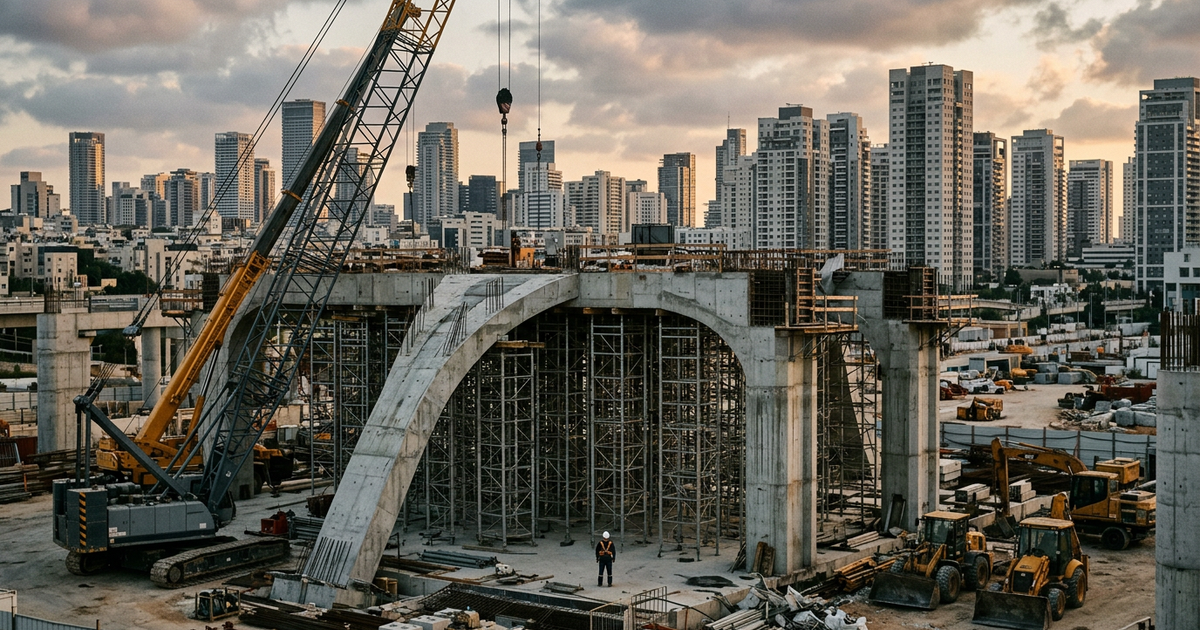
The country that engineers world-class technology is running its largest-ever civil program — and the early evidence suggests planning was never the hard part. Execution is.
Israel can design nationally significant infrastructure at enormous scale. The harder question is whether it can consistently execute it — on schedule, at cost, and with enough labor and contracting capacity to finish what it starts. That tension now sits at the center of the largest civil-construction cycle in the country's history, anchored by a Tel Aviv Metro set in law at 177 billion shekels, roughly a third of all state infrastructure investment for years to come. And in December 2025, the State Comptroller delivered the verdict that should frame how the whole program is read: the plans are sound; the machinery to execute them is not.
This is the argument of this pillar. Israel has proven, repeatedly, that it can conceive infrastructure on a scale far beyond its size — a national water grid, a metro to rival far larger economies, a renewable build-out. What it has not yet proven is that its institutions can deliver those projects on time, on budget, and without the financing and governance gaps that turn a visionary plan into a decade of delay. The civil cycle now underway is the test case, and the early results are a warning.
The plan is extraordinary
Take the ambition at face value first, because it is real. The Tel Aviv Metro — three underground lines (M1, M2, M3), about 150 kilometers, 109 stations, serving more than two million riders a day across 24 municipalities — would be a landmark project in any economy, and an outsized one for Israel. The first international tenders opened in November 2025, with an initial stage worth around 20 billion dollars. Around it sits a full civil cycle: the Tel Aviv Light Rail (the Red Line operational since 2023, Green and Purple under construction), Jerusalem Light Rail expansion, Israel Railways electrification, the Ben Gurion Airport build-out, and the continuing desalination program (covered in the Climate pillar — see Israel Solved Water. Now It Sells the Answer.). The implementing body, NTA, is profiled separately (see NTA: The Tel Aviv Metropolitan Mass Transit Implementation Authority).
The execution is the problem
Now the verdict. The State Comptroller's December 2025 report found 'grave deficiencies already at this stage' — most strikingly the absence of a fully functioning authority to coordinate the project at all. It flagged three financial risks that together define the gap between plan and delivery: a potential 12-billion-shekel cost overrun; a collapse in the dedicated betterment-tax revenue meant to fund half the project, from a projected 38–43 billion shekels down to 25–30 billion; and the absence of any government-approved mechanism to bridge the tens of billions in cash-flow gaps before those revenues arrive. The funding architecture is examined in its own piece (see The Metro Funding Gap).
The schedule tells the same story. The first lines were meant to operate from 2034; internal projections now point to 2040 at the earliest, with some assessments stretching toward the 2050s. A plan that looks visionary on paper is, in execution, already years behind before the major tunneling begins.
Why this is the real story
The gap between planning and building is not unique to Israel — large infrastructure runs late everywhere. But it matters more here for two reasons. First, scale: the Metro alone is a third of state infrastructure spending, so its delays and overruns cascade across the entire civil program. Second, the contrast: a country whose private technology sector is a global byword for fast, efficient execution runs its public megaprojects through institutions that the state's own auditor says are not yet built to deliver. The same nation manufactures world-class companies in three years and cannot reliably timetable a subway. That contrast is the subject worth examining.
There is a further complication that runs through every tender: who is allowed to build. Israel's procurement is increasingly squeezed between the foreign contractors with the capacity to deliver at this scale and the security politics that disqualify many of them (see The Foreign-Contractor Bind). And underneath the delays sits a genuine prize — a civil cycle that, executed well, would be one of the larger economic multipliers in the OECD (see The Civil Cycle as Economic Engine).
The argument, stated plainly
None of this is a case that the Metro should not be built. It is a case that building it is the actual challenge, and that Israel has not yet shown it has solved the unglamorous part — the authorities, the financing mechanisms, the coordination — that turns a brilliant plan into a working railway. The country has earned its reputation for engineering ambition. Whether it can match that reputation in execution is the question the next decade of construction will answer, and on current evidence the answer is not yet yes.