Florida–Israel Tech: The 429 Companies and Seven Sectors Driving a $7.3 Billion Corridor
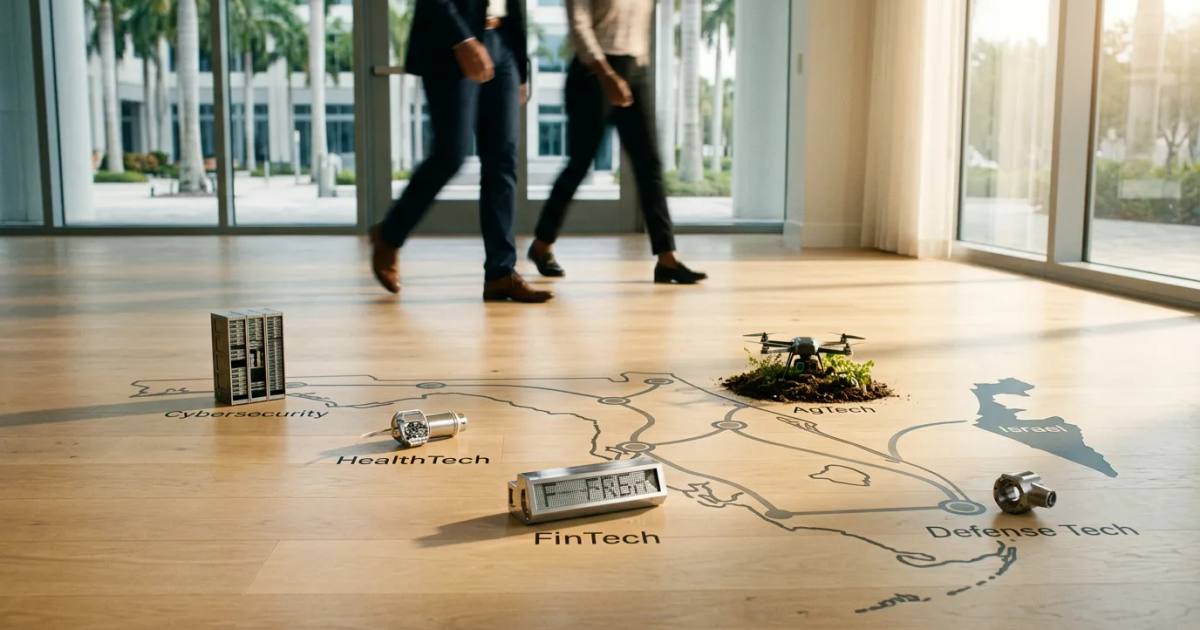
429 Israeli-founded companies, $7.3B economic output, 26,510 jobs. Cybersecurity, healthtech, fintech, agtech, defense tech. FIBA, Israel Tech Week. The sector map underneath Florida as Israel's new American address.
429 Israeli-founded companies. 26,510 jobs. $7.3 billion in economic output. Miami-Dade alone accounts for $6 billion — 2.78% of county GDP. These are the numbers from the 5WPR Israeli Tech in Florida Report, released in conjunction with Israel Tech Week 2026 in Miami. This directory maps the sectors, the companies, and the structural forces driving the concentration.
South Florida is now the primary US entry point for Israeli technology companies — not only Miami, but across a tri-county corridor spanning Miami-Dade, Broward, and Palm Beach. Five structural factors drive the concentration: zero state income tax, gateway access to Latin American markets, near-daily direct El Al flights between Miami and Tel Aviv, an established Israeli and Jewish community infrastructure, and a growing venture and family office capital base that relocated from New York post-2020.
Cybersecurity: The Largest Israeli Sector in Florida by Global Fundraising Share
Israeli companies account for over 20% of global cybersecurity fundraising. The Florida corridor captures a growing share of that activity. Xtend — the Israeli drone company validated during the Sinwar mission — operates its US production facility in Tampa, adjacent to MacDill Air Force Base and US Special Operations Command (SOCOM). The defense-tech/cyber overlap in the Tampa-MacDill corridor is a natural fit for Israeli dual-use companies.
Israeli cybersecurity firms use Florida as a US sales and business development base rather than an R&D center — Tel Aviv and Beer Sheva remain the engineering hubs. The Florida office is the market-facing operation: customer meetings, conference presence, Latin American expansion.
Healthtech and Life Sciences: The Navina-to-Baptist Health Pipeline
Navina — the Israeli AI physician copilot backed by a $55 million Goldman Sachs-led Series C — is expanding into Florida's value-based-care market. Biobeat, a Petah Tikva-founded wearable health monitoring company with FDA and CE approvals, moved its CEO to Miami in 2024. Israeli medtech companies selling into Florida hospital systems — Baptist Health, Memorial Healthcare, Cleveland Clinic Florida — represent a growing commercial channel.
The broader pattern: Israeli healthtech companies use Florida's large Medicare and managed-care populations as a proving ground for US market entry. Florida's elderly population creates demand for exactly the categories Israeli healthtech leads in — remote patient monitoring, AI-assisted diagnostics, chronic disease management.
Fintech: eToro, Lendai, and the Cross-Border Capital Layer
eToro (Nasdaq: ETOR) — the Israeli-founded retail trading platform — serves US customers from its multi-jurisdiction platform. Lendai, founded in Tel Aviv, provides US mortgages to foreign investors from offices in Miami and Aventura — processing over $150 million in transactions. The fintech layer serves both the Israeli business community in Florida and the cross-border capital flows between Israel, Latin America, and the US that pass through Miami.
Agtech, Cleantech, and Climate: ECOncrete and the Water-Tech Corridor
ECOncrete's bio-enhancing marine concrete brings Israeli water and coastal infrastructure technology to Florida's rising-sea challenge. Israeli agtech companies — including irrigation and precision agriculture firms — serve Florida's $8 billion agriculture industry. Netafim, the Israeli drip irrigation pioneer, has Florida agricultural distribution.
Defense Tech: The Tampa-MacDill-SOCOM Corridor
Tampa's proximity to MacDill AFB and US Special Operations Command creates a natural corridor for Israeli defense-tech companies. Xtend's US production facility in Tampa is the most visible example. Elbit America is headquartered in Fort Worth but Florida's defense infrastructure — Patrick Space Force Base, Cape Canaveral, Naval Station Mayport — creates procurement adjacency for Israeli defense exporters.
The Institutional Infrastructure: FIBA, Israel Tech Week, and the Miami-Israel Collective
The Florida-Israel Business Accelerator (FIBA) — based in South Florida — serves as the institutional bridge, helping Israeli companies establish US operations in Florida. Israel Tech Week Miami, launched in 2025 by the Miami-Israel Collective, drew 1,500 attendees and 150 speakers in its debut year. The 2026 edition covers nine verticals: defense tech, cybersecurity, AI/data, fintech, healthtech, life sciences, agtech, cleantech, and space technology.
The institutional layer matters because it converts individual company relocations into an ecosystem. FIBA provides soft-landing services. Israel Tech Week provides deal-flow visibility. The Miami-Israel Collective provides community infrastructure. Together they function as the welcoming committee for Israeli tech entering the US through Florida rather than the traditional New York or Silicon Valley gates.
Why Florida Over New York and California
The migration is structural, not cyclical. Zero state income tax saves Israeli founders and their employees 10-13% compared to New York or California. Near-daily El Al direct flights to Tel Aviv eliminate the connectivity disadvantage Florida once had. The post-2020 relocation of New York's financial and family office community to Palm Beach and Miami brought the capital base south. And the Israeli and Jewish community infrastructure in Aventura, Boca Raton, and Palm Beach provides the social fabric that makes relocation sustainable for families — not just founders.
The result: Florida is Israel's new American address. The 429 companies are the proof. This directory is the map.