
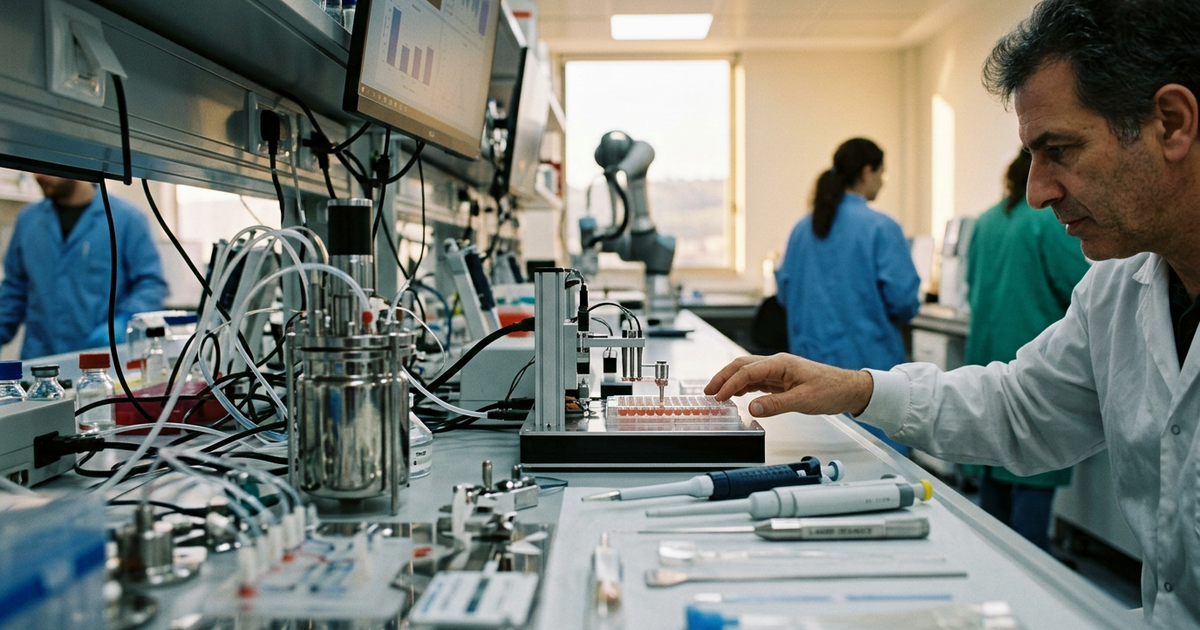

Israel has roughly 1,800 life-sciences companies and almost no original blockbuster drugs. That is not a gap in the ecosystem — it is the shape of it.
Israel is often described as a biotech powerhouse. But the shape of the sector is more specific than that. Israel has built one of the world's densest life-sciences ecosystems — roughly 1,800 active companies — yet comparatively few globally dominant drug companies. Its strength sits elsewhere: in the tools, platforms, diagnostics, imaging, devices, and clinical technologies around medicine. Israel builds the infrastructure around medicine more often than the medicine itself — and the one exception everyone names, Teva, proves the rule rather than breaking it.
This is the organizing argument of the pillar. Israeli life sciences is a components-and-platforms economy, not an originator economy. Its strengths cluster in medical devices, diagnostics, digital health, and AI for drug discovery — the picks and shovels of modern medicine — and its weakness in the one thing the industry rewards most richly: owning an approved, patented, blockbuster molecule. Understanding why explains both the sector's remarkable density and its conspicuous ceiling.
Where the strength actually is
Look at what Israel is genuinely world-class at and a pattern emerges. In devices: Insightec's focused-ultrasound systems for tremor and Parkinson's, the surgical-robotics expertise Medtronic bought with Mazor, a deep medical-laser and cardiac-device bench. In diagnostics and digital health: Aidoc's AI radiology, Tytocare's remote examination, a long roster of clinical-machine-learning firms. In drug discovery itself, the Israeli contribution is the tooling, not the molecule — CytoReason's AI disease models, sold into global pharma as a way to find and de-risk drugs faster. Every one of these is a capability that other companies' drugs and treatments run on. That is the lane.
Why the ecosystem selects for tools
The structure is not an accident; it falls out of the same forces that shape the rest of Israeli technology. Originating a drug takes ten-to-fifteen years, a billion dollars or more, and a tolerance for binary clinical failure that neither Israel's capital base nor its founder culture is built for — the same build-to-sell logic that governs Israeli venture broadly (see The Exit Is the Business Model). Tools, platforms, and devices, by contrast, reach revenue and acquisition faster, suit lean teams, and play to Israel's genuine edge in engineering, computation, and AI (see Why Global AI Built Itself in Israel). The ecosystem builds what its capital, talent, and timelines reward — and that is instruments, not pharmaceuticals.
The exception that proves the rule
Teva is always offered as the counterexample: a genuinely global Israeli pharmaceutical giant. But Teva built its scale on generics — manufacturing other companies' molecules at volume — not on originating blockbusters, and its near-death experience after the 33-billion-dollar Allergan generics deal nearly took the company down. Its current recovery rests on pivoting toward a handful of branded drugs while shedding the generics identity that made it. Teva is not evidence that Israel builds drug originators. It is evidence of how hard that path is even for the one company that tried it at scale — examined in its own piece (see The Teva Problem).
The model's real engine
If Israel does not originate drugs, where does its distinctive edge come from? Increasingly, from an unusual institution: the hospital as innovation platform. Sheba, Hadassah, Ichilov and others have turned their clinical floors into co-development environments where startups build alongside physicians — a genuinely differentiated model, and the closest thing Israeli health has to a structural advantage no one else easily copies (see The Hospital as Startup Factory). And running beneath the entire sector is a harder input, one the country would rather not have: the steady translation of military and combat medicine into civilian innovation (see The Combat-Medicine Dividend).
The argument, stated plainly
Calling Israel a biotech power and then asking where its blockbuster drugs are misunderstands what kind of power it is. It is a tools power — a builder of the instruments, intelligence, and platforms that the global drug industry increasingly cannot operate without. That is a smaller-margin position than owning the molecule, and it caps how much of the pharmaceutical value chain Israel can capture. But it is also a defensible, compounding niche that plays to the country's real strengths. The right question is not why Israel has no homegrown Pfizer. It is whether being the world's medical-tooling workshop is a ceiling or a strategy — and on the evidence, it is mostly the latter.
This is reporting on a health and biotech sector. Not medical advice. Not investment advice.