
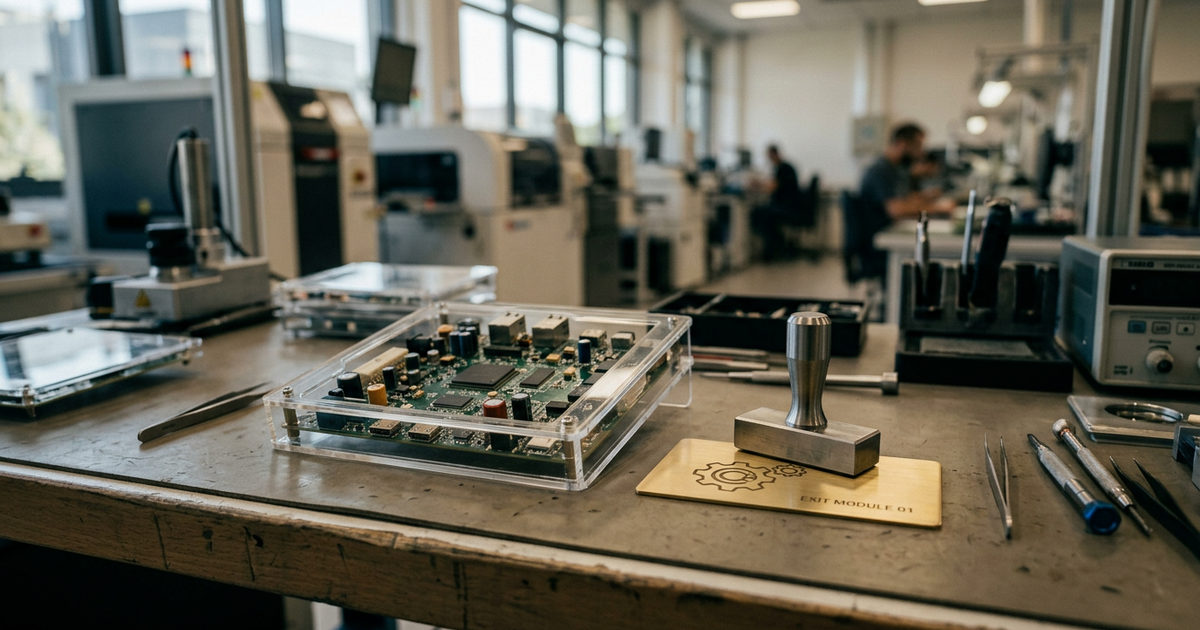

Israel's venture economy is not built to create lasting giants. It is built to manufacture companies worth buying — and that is a strategy, not a shortcoming.
Israel's record 2025 exit year looks like validation from a distance. Up close, it reveals something deeper: the exit is not the reward at the end of the system. It is what the system is built to produce. The $74.3 billion in exits, the largest cybersecurity acquisition in history, the reopened IPO window — read together, they are usually taken as proof that the Startup Nation has matured into a builder of world-scale companies. That reading is incomplete. Israel's venture economy is organized, from the seed stage up, to manufacture companies that get bought. The exit is not the happy ending of the Israeli model. It is the model.
What the record year actually shows
Of the $74.3 billion in M&A — per Startup Nation Central's year-end data — a single deal, Google's $32 billion purchase of Wiz, and a second, Palo Alto Networks' $25 billion acquisition of CyberArk, together accounted for the majority. Nine deals produced $53 billion of the total. The exits were real, but concentrated in a handful of trophy sales to foreign acquirers. The underlying capital data is covered in the Venture cluster. The concentration problem is its own piece.
Why the model selects for selling
The instinct to sell is not a cultural quirk; it is baked into the economics. Israel has a small domestic market, which means a company that wants to scale must go global almost immediately — and the fastest route to global scale is to be absorbed by a company that is already there. The capital base is overwhelmingly foreign, and foreign investors price for a clean, well-understood exit. And the founder pipeline, drawn heavily from elite military-technology units, is unusually good at building deep technical capability fast — exactly the kind of asset a strategic acquirer pays a premium for. Full analysis: How Israel Builds Companies to Sell: The Venture and Exit Architecture.
The cost of a selling economy
Every company sold to a foreign acquirer is a company that will not become Israel's standalone global champion. Value that could have compounded inside the Israeli economy for decades is crystallized once, at sale, and much of the long-term upside accrues to the acquirer's shareholders abroad. And as the legal center of gravity shifts — more than 80% of Israeli-founded companies now incorporate in the United States — even the question of whose value this is becomes harder to answer. See: The Delaware-Parent, Israeli-Subsidiary Structure.
The argument, stated plainly
Israel has built the most efficient company-manufacturing economy in the world, optimized end to end for the sale rather than the standalone. That efficiency is a genuine achievement and a genuine source of national wealth. But an economy that is brilliant at building things worth buying is, by definition, an economy that mostly does not keep what it builds. The record exit year is not evidence that Israel has outgrown that trade-off. It is the trade-off, operating at the largest scale it ever has.