
Israel's most distinctive contribution to medicine is not a drug or a device. It is a model: the hospital itself turned into a co-development engine that the rest of the world is now copying.
The most original thing about Israeli health care is not anything it has invented. It is the way it invents. Inside Sheba, the country's largest hospital, the infrastructure increasingly functions not only as care delivery but as product-development infrastructure — startups building their products physically inside the wards, alongside the clinicians who will use them. Hadassah, Ichilov and others run versions of the same model. It is a genuinely differentiated approach, arguably Israel's single strongest structural advantage in health, and it is now being exported as a template. It also has a ceiling worth being honest about.
The bedside-to-bench loop
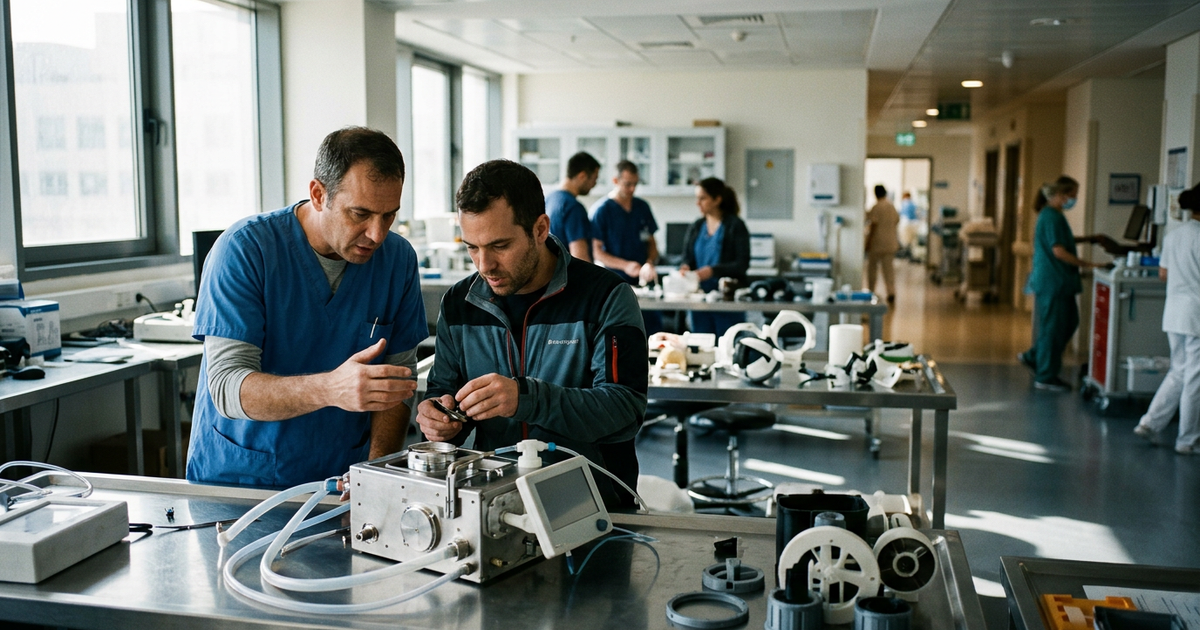
The flagship is Sheba Medical Center's ARC — Accelerate, Redesign, Collaborate — and its logic inverts the usual relationship between hospitals and vendors. Instead of buying finished equipment from outside suppliers, the hospital embeds startup teams on campus, gives them access to clinicians and de-identified data, and lets them pilot inside a working hospital that has been fully digital since 2004. A founder can watch a problem on the ward in the morning, prototype a response, and test it in simulation days later. That proximity collapses the 'valley of death' between a clinical insight and a deployable product — the gap where most medical startups die.
Why it is a real moat
This is hard to copy, which is what makes it valuable. The model depends on a specific combination: a top-ranked hospital — Sheba has been named among Newsweek's world's-best for seven consecutive years — with the institutional confidence to let outsiders build inside it, a regulatory and cultural willingness to pilot fast, and a steady supply of technical founders, many drawn from elite military units, comfortable embedding in a clinical environment. ARC has trained over a thousand clinicians in entrepreneurship and now exports the model itself, establishing partner innovation centers in London, Berlin, Singapore, Australia, Canada and the US. Israel is not just running the model; it is franchising it. The existing profile of this architecture is its own piece (see The Israeli Hospital Innovation Engine).
The capital and talent underneath
The hospital engine does not run alone. It sits on top of a dedicated life-sciences venture layer — aMoon, Pontifax, the Israel Biotech Fund, OrbiMed Israel, Peregrine — that funds what the hospitals incubate, and a research base across the Weizmann Institute, the Technion and the universities that feeds it. The distinctive piece is the clinical integration: in most countries the hospital is a customer at the end of the innovation chain; in Israel it has been moved to the center of it, as co-developer rather than buyer.
The ceiling
Honesty requires naming the limit. The hospital-innovation model is superb at producing devices, diagnostics, workflow tools and digital-health products — incremental, deployable, acquirable innovations that fit a clinical setting. It is not built to originate drugs, which require time horizons and capital structures no hospital incubator provides. So the model reinforces exactly the shape of the broader sector: it makes Israel even better at tools and even less likely to produce an original blockbuster medicine. The hospital as startup factory is a real and rare advantage. It is also a deepening of the country's specialization, not an escape from it.
The argument, stated plainly
If Israel has a genuinely defensible edge in health, this is it — not a product but a method, the hospital remade as a co-development engine that turns clinical proximity into commercial speed. It is the part of the ecosystem the rest of the world is actively trying to import, which is the clearest evidence it is real. The honest caveat is that the model amplifies Israel's existing strengths rather than filling its gaps: it builds better tools faster, and leaves the drugs to someone else. As a strategy, that is not a weakness. It is the country playing, harder, the game it actually wins.
This is reporting on a health and biotech sector. Not medical advice. Not investment advice.
How we report: Olam stories draw on public filings, company disclosures and named sources, checked by our editors. Read our methodology · Corrections