
Israel's grimmest input — a long history of war injury — has become a real engine of medical innovation. It is an uncomfortable fact, and an honest account has to hold both halves of it.
There is a difficult truth running beneath part of Israel's medical-innovation story, and it does no good to dress it up. A country with one of the higher trauma case-volumes in the developed world, sustained by decades of conflict and intensified by the war that began in October 2023, has built unusual expertise in treating catastrophic injury — and some of that expertise has translated into commercial medical innovation. This is not a triumph to be celebrated. It is a dividend extracted from tragedy, and an honest account has to hold both the human cost and the clinical output in the same frame.
Where the expertise comes from
Israel's trauma and combat-medicine capability is a product of necessity, accumulated through the IDF medical corps and the civilian hospital system that absorbs the wounded. Battlefield conditions impose problems that civilian medicine rarely faces at scale: uncontrolled hemorrhage at junctions of the body where a tourniquet cannot reach, the need for higher-quality blood transfusion under field conditions, mass-casualty triage, catastrophic limb injury. The October 2023–2025 period deepened that experience base in the worst possible way, through a large cohort of severely wounded soldiers and civilians. The clinical knowledge is real precisely because the suffering that generated it was.
How it becomes innovation
The translation runs through the same hospital-innovation machinery that drives the rest of the sector. Physicians who treated battlefield injury return to civilian practice with specific, hard-won problems and the motivation to solve them — and at institutions like Sheba Medical Center, the co-development model turns those problems into products. The visible outputs cluster in predictable areas: hemorrhage control, including hemostatic materials designed to stop severe bleeding rapidly; field-grade blood-transfusion and management systems; advanced trauma and emergency-medicine tools. WoundClot, a hemostatic gauze developed out of battlefield necessity, is among the named examples. The mechanism is not mysterious — it is combat experience feeding the bedside-to-bench loop (see The Hospital as Startup Factory).
The rehabilitation surge
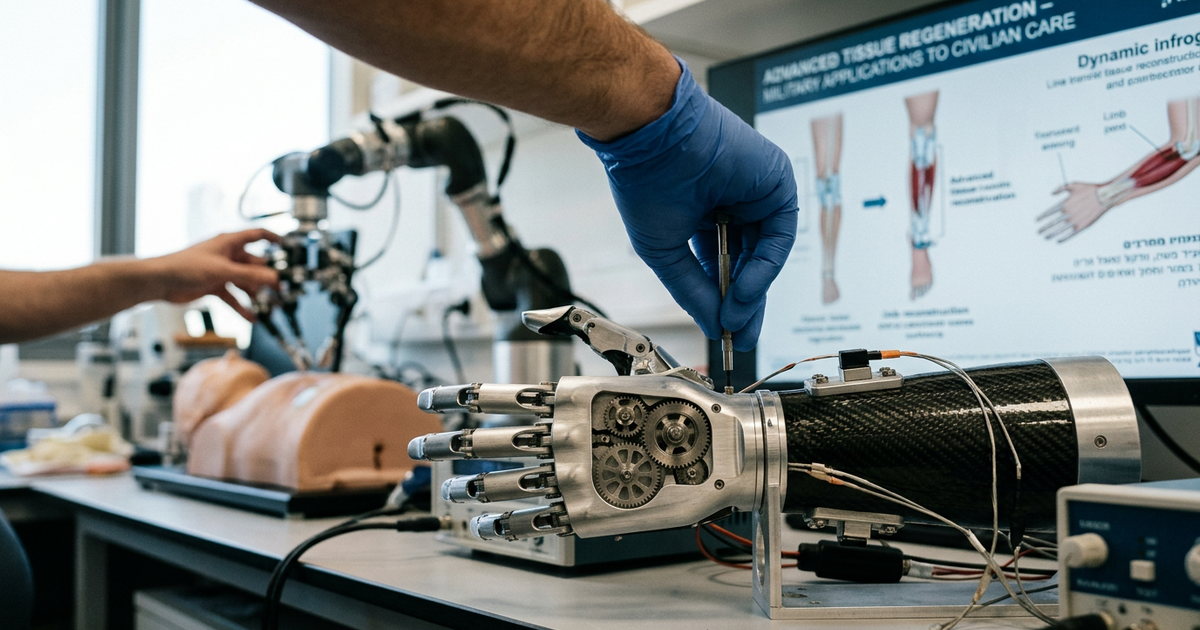
The most significant recent development is in rehabilitation, and it is inseparable from its cause. A large cohort of young, severely wounded veterans — many having lost limbs — has driven intense demand for advanced rehabilitation technology: bionic and prosthetic limbs, rehabilitation robotics, and increasingly VR-based treatment for PTSD and trauma. The result is genuine Israeli leadership in rehabilitation and mental-health technology. It is essential to be clear about what this means: the innovation exists because the injuries exist. The capability is a response to a national wound, not a windfall.
Holding both halves
This is the part that demands care. Combat medicine produces real, life-saving innovation that reaches patients far from any battlefield — hemostatic technology saves civilian accident victims; trauma protocols improve emergency care everywhere. That can be true without treating war as a desirable input. The human cost is a tragedy. The knowledge extracted from it is real and transferable. Both belong in the same paragraph, and the honest course is to leave them there — neither celebrating the output nor pretending it away.
The argument, stated plainly
The combat-medicine dividend is one of the more uncomfortable facts in Israeli health innovation, and the right response is neither to trumpet it nor to look away. Israel has, through grim necessity, developed world-class capability in trauma, hemorrhage control, and rehabilitation, and that capability is increasingly commercial and increasingly exported — helping patients globally, and forming one more layer of the tools-not-drugs economy that defines the sector (see Israel Builds the Tools, Not the Drugs). That is a genuine contribution to medicine. It is also a contribution no country should wish to be in a position to make. Both sentences belong in the same paragraph, and any honest account of Israeli medical innovation has to leave them there.
This is reporting on a health and biotech sector. Not medical advice. Not investment advice.
How we report: Olam stories draw on public filings, company disclosures and named sources, checked by our editors. Read our methodology · Corrections