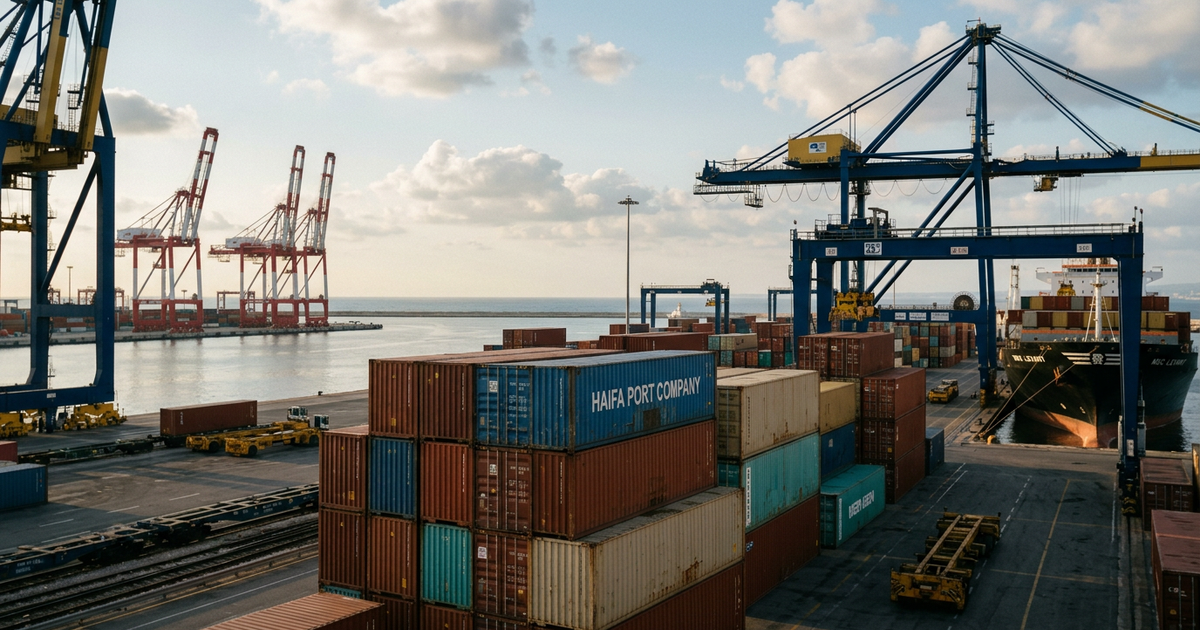

The Adani-Gadot consortium acquired Haifa Port Company in a deal that closed January 2023 at approximately USD 1.18 billion. It now competes for container volume with the adjacent SIPG-run Bayport terminal in the same bay.
Part of: Israel's Ports and Logistics, the complete map
By The Olam Editorial Team
TL;DR
The Port of Haifa is Israel's oldest deepwater commercial port and, since January 2023, has been controlled by an Adani-Gadot consortium that acquired the Haifa Port Company for approximately USD 1.18 billion. It operates alongside, and in competition with, the adjacent Bayport terminal, run by Shanghai International Port Group under a 2021 concession. Together the two facilities make Haifa Bay one of the most plurally owned port complexes in the Mediterranean.
Key Facts
- Haifa Port Company acquired by Adani-Gadot consortium; deal closed January 2023 at a reported USD 1.18 billion.
- Adani Ports & SEZ holds the controlling stake; Gadot Group is the local partner.
- Adjacent Bayport (Hamifratz) terminal operates separately under SIPG (Shanghai International Port Group) concession since 2021.
- Original Haifa Port handles containers, general cargo, vehicles, cruise calls, and project cargo.
- Bayport is a fully automated container terminal, the first of its kind in the Israeli system.
- Channel depth supports ultra-large container vessels above 14,000 TEU.
- The two operations are physically adjacent but commercially competing.
Original Haifa Port vs Bayport
Haifa Bay is a two-terminal complex with two distinct operators. The original Port of Haifa, on the Kishon side of the bay, has run continuously since before the establishment of the state and was sold to the Adani-Gadot consortium in a transaction that closed January 2023. The adjacent Bayport terminal, formally the Haifa Bayport Terminal, sometimes referred to locally as Hamifratz, is a 2021-vintage automated greenfield facility operated under concession by Shanghai International Port Group, the state-owned Chinese terminal operator.
The two facilities are not the same business. The original Haifa Port handles a diverse traffic mix, containers, general cargo, vehicles, cruise, project cargo. Bayport is a dedicated, automated container terminal designed to handle ultra-large vessels. They share the bay but compete for container volume, which was the explicit purpose of the structural reform that produced the current configuration.
What Haifa Handles
Haifa's traffic mix is the most diverse in the Israeli system. Containers remain the largest single segment, but the port also handles general cargo, vehicle imports, dry bulk, cruise calls, and project cargo. Proximity to the industrial north, including major chemical, refining, and manufacturing operations around Haifa Bay, makes it the natural inlet and outlet for the upper Galilee economy.
Container volumes at Haifa move with the broader Israeli economy and with the share captured by Bayport versus the legacy facility. Ashdod carries a stated annual capacity above 3.2 million TEU on its own, making it Israel's largest port by container volume, and Haifa Bay accounts for a substantial but minority share of total Israeli container throughput relative to Ashdod.
The Adani-Gadot Era
The Adani-Gadot acquisition placed the Haifa Port Company alongside a global Adani Ports network that includes Mundra, Hazira, Vizhinjam, and a growing African and Southeast Asian footprint. The strategic logic is integration: Indian-bound and Indian-origin cargo gains a routed pathway through Haifa into the European market.
Operationally, the new ownership has pushed Haifa toward faster turnaround, automation upgrades on the legacy quays, and tighter integration with regional inland logistics. The political dimension is real. Indian commercial control of an eastern Mediterranean port is a meaningful piece of the broader India-Middle East-Europe Economic Corridor proposition, and Haifa's positioning has become part of that diplomatic conversation.
Haifa in the Mediterranean Network
Haifa competes for trans-shipment volume against Piraeus (COSCO-controlled), Port Said East, Damietta, Limassol, and Mersin. It does not currently capture a meaningful share of trans-shipment traffic. Its commercial strength is its hinterland, the Israeli industrial and consumer market, rather than its position as a regional hub.
That balance could shift if the corridor model matures. A working IMEC route would establish Haifa as a corridor terminus rather than only an end-market port. Whether that materializes depends on Saudi normalization, sustained Gulf investment, and the political stability of the overland route. The port itself is closer to ready than the corridor it would anchor.
Bottom Line
Haifa is no longer one port, it is a two-operator complex in which Indian, Chinese, and Israeli interests sit on adjacent quays. That structure is the source of both its commercial dynamism and its geopolitical sensitivity, and it will define the port's role through the next investment cycle.
Related on The Olam
How we report: Olam stories draw on public filings, company disclosures and named sources, checked by our editors. Read our methodology · Corrections