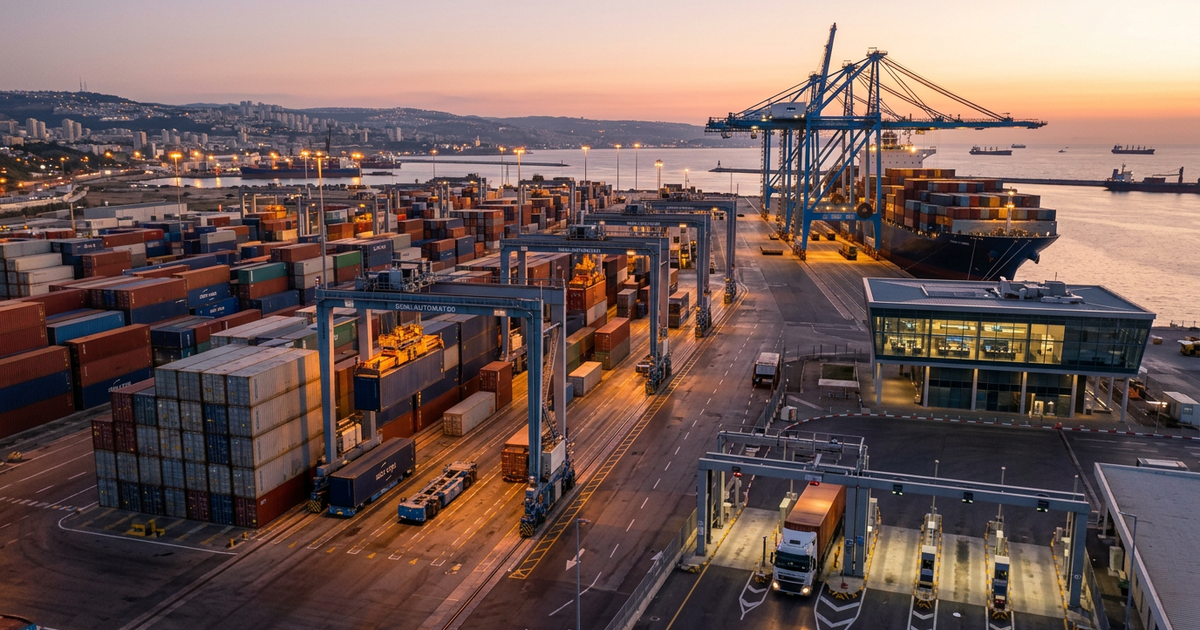

Bayport and Hadarom run semi-automated: ASCs in the yard, integrated TOS, OCR gate, AI yard optimization. Customs digitized via the Israel Tax Authority's SHAAM system. Maritime cybersecurity is an Israeli export specialty.
By The Olam Editorial Team
TL;DR
The two newest Israeli container terminals — Bayport (SIPG) at Haifa and Hadarom (TIL/MSC) at Ashdod — were designed from inception as semi-automated facilities running automated stacking cranes, integrated terminal operating systems, real-time gate management, and AI-driven yard optimization. Customs digitization by the Israel Tax Authority has reduced clearance times measurably. Israeli maritime cybersecurity is a globally exported specialty.
Key Facts
- Bayport and Hadarom commissioned 2021 as semi-automated container terminals.
- Automated stacking cranes (ASCs), terminal operating systems (TOS), and AI yard optimization in operational use.
- Israel Tax Authority has digitized customs declarations and integrated with port systems.
- Israel National Cyber Directorate works directly with port operators on infrastructure protection.
- Israeli firms export port digital twins, autonomous navigation, container tracking, and supply chain orchestration software.
- Maritime cybersecurity is a recognized Israeli export specialty.
Concrete Tech at the Terminals
Bayport and Hadarom run on integrated terminal operating systems (TOS) coordinating ship-to-shore (STS) cranes, automated stacking cranes (ASCs) in the container yard, and gate operations. Automation is concentrated on the yard side — ASCs lift and stack containers without human operators — while STS cranes remain semi-automated, with human operators handling the over-water portion of the cycle.
Truck appointment systems (TAS) coordinate gate arrivals with container availability. Optical character recognition (OCR) reads container numbers at gate-in and gate-out. Sensor networks on equipment feed condition monitoring and predictive maintenance. The data layer is integrated; the equipment is modern; the operational tempo is materially faster than the pre-2021 baseline.
Customs Digitization
The Israel Tax Authority has digitized customs declarations and integrated its systems with the port operators. Importers submit declarations electronically through the SHAAM system; the authority uses risk-targeting algorithms to identify shipments requiring physical inspection, allowing the majority of cargo to clear without manual intervention.
Combined with port-side digitization, the result has been a measurable reduction in the time between vessel discharge and goods release. Demurrage costs have fallen for Israeli importers. The customs layer is now one of the more digitally mature in the region.
The Trucker Layer
Gate management and trucker scheduling have been digitized through appointment systems. Real-time GPS tracking, integrated yard management, and predictive routing are in operational deployment. Several Israeli technology firms have built scheduling platforms that are now exported to ports in Europe and elsewhere.
Maritime Cybersecurity
Israeli ports operate under strict cybersecurity requirements driven by the country's broader security posture. The Israel National Cyber Directorate works directly with port operators on infrastructure protection. Israeli cybersecurity firms — many of which build for global markets — have developed specialized maritime offerings deployed both locally and internationally.
The 2017 Maersk NotPetya incident and subsequent attacks on global port systems have made maritime cybersecurity a board-level issue worldwide. Israel's position in cybersecurity technology, combined with the operational stakes of its own port system, has made the country a center of practice in this field.
The Israeli Maritime Tech Sector
The broader Israeli maritime technology sector includes companies building autonomous vessel navigation systems, port digital twins, container tracking platforms, and supply chain orchestration software. Operational deployments at home have supported export-led growth abroad. Maritime technology is now a recognized sub-segment of the Israeli industrial software economy.
Bottom Line
Israeli ports skipped the retrofit phase that older European facilities are still working through. Starting with newer infrastructure has produced a digital baseline that is unusually strong for the country's size — and that baseline is now exported as a product set, not just used at home.
Related on The Olam
- Adani at Haifa: The Three-Year View
- SIPG Ashdod — The Chinese Port Presence No One Talks About
- Inside Israel's Freight and Container Economy
- How Israeli Logistics Companies Are Expanding Regionally
- The Infrastructure Behind Israeli Trade
How we report: Olam stories draw on public filings, company disclosures and named sources, checked by our editors. Read our methodology · Corrections