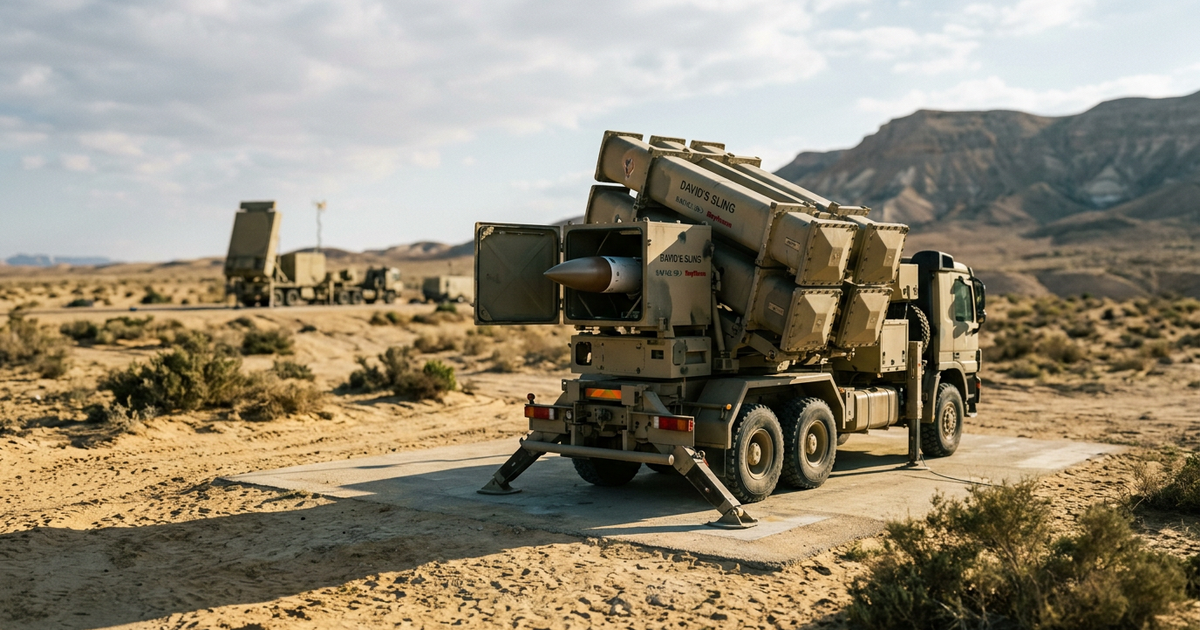

David's Sling is Israel's mid-tier interceptor, built by Rafael and Raytheon. Operational since 2017, it engages short-to-medium range ballistic missiles, rockets, and cruise missiles.
David's Sling is the mid-tier layer in Israel's integrated air defense architecture. It sits operationally between the short-range Iron Dome at the low end and the exo-atmospheric Arrow family at the high end. Built jointly by Rafael Advanced Defense Systems and Raytheon (now RTX) under a US-Israel co-development agreement, David's Sling has been operational with the Israeli Air Force since April 2, 2017, and engages short-to-medium-range ballistic missiles, large-caliber rockets, and cruise missiles in the 40-to-300-kilometer engagement envelope. It is the component of the Israeli air defense stack that engages the threats Iron Dome cannot reach and Arrow does not need to. The program began in the early 2000s as a joint effort between the Israel Missile Defense Organization and the U.S. Missile Defense Agency, and the system — originally known as Magic Wand — was declared operational at a ceremony at Hatzor Airbase.
Where does David's Sling sit in Israel's air defense architecture?
Israel's layered air defense operates across four interceptor categories. Iron Dome engages short-range rockets and artillery up to roughly 70 kilometers. David's Sling engages medium-range threats from 40 to 300 kilometers. Arrow 2 engages ballistic missiles in the upper atmosphere. Arrow 3 engages ballistic threats exo-atmospherically, above the atmosphere. The new Iron Beam laser layer engages rockets and drones below Iron Dome's effective interception cost-per-engagement, adding a fifth distinct technology tier.
The David's Sling envelope is the band that captures the threats Iron Dome cannot reach, Scud-class ballistic missiles, large rocket systems including the Iranian Fateh and Zelzal families, the Hezbollah arsenal at the upper end of its rocket inventory, and cruise missiles across the standoff-precision category. The system became operational just as the Iranian-proxy missile threat in Lebanon and Syria reached the inventory levels that justify the engagement category.
What is the Stunner interceptor and its dual-pulse motor?
The Stunner interceptor missile is the David's Sling munition, developed jointly by Rafael and Raytheon; the export variant is marketed as SkyCeptor. It is built as a hit-to-kill weapon, meaning it destroys the incoming threat by physical impact rather than by detonating a warhead at close range. The dual-pulse rocket motor allows the interceptor to maneuver aggressively in the terminal phase, which is necessary to defeat the maneuvering reentry vehicles increasingly common on modern medium-range ballistic missiles. The radar-and-electro-optical seeker provides terminal guidance across both ballistic and atmospheric targets.
The Stunner economics are favorable relative to comparison categories. Raytheon SM-3 Block IIA interceptors cost roughly $30 million per round. Stunner is reported in the $1-2 million range per round. The cost differential matters when the threat is sustained, a Lebanese rocket-and-missile inventory of tens of thousands of weapons cannot be defeated economically with $30 million interceptors. The David's Sling cost structure is one reason it has expanded across the IAF mission set since 2017.
What is David's Sling's combat record?
David's Sling's first attempted combat use came on July 23, 2018, against two Syrian OTR-21 Tochka short-range ballistic missiles that appeared headed toward the Israeli-controlled Golan Heights; the intercept was aborted after Israeli forces determined the missiles were not a threat to Israeli territory.
The system's first confirmed successful operational interception came nearly five years later, on May 10, 2023, during a five-day escalation with Palestinian Islamic Jihad in Gaza. The Israeli Ministry of Defense credited David's Sling with intercepting a rocket aimed at Tel Aviv; Janes reported the system achieved two operational interceptions during that escalation (May 9-13, 2023). David's Sling was used again in combat on September 24, 2024, intercepting a Hezbollah surface-to-surface missile fired toward the Gush Dan area — the system's first confirmed intercept of a Hezbollah missile. Operational engagements have continued through the post-October 7 conflict, including reported use against Iranian-launched ballistic missiles during the April 2024 and October 2024 Iranian attacks. There is no publicly confirmed David's Sling intercept dated to June 2025, and no public reporting describing a "first" operational tactical-ballistic-missile intercept at that time — the May 2023 intercept holds that distinction. The combat record validates the operational envelope the system was designed for.
How is David's Sling co-developed with the United States, and where has it been exported?
David's Sling is co-funded and co-developed under the US-Israel missile defense cooperation framework. Raytheon participates in the development and is the US prime for the program. US Missile Defense Agency funding flows through the program. US-Israel joint development of the Stunner technology has, in turn, fed into the broader Raytheon missile-defense interceptor portfolio.
Finland announced its intent to buy David's Sling on April 5, 2023, one day after formally joining NATO, in a deal valued at approximately €316-317 million (roughly $340-345 million), covering a main contract plus an immediately exercised option. The formal sale agreement was signed in Tel Aviv on November 12, 2023, making Finland the first export customer for the system. Germany separately signed a contract for David's Sling, reported at roughly $600 million, in September 2023. Exact interceptor unit cost, full engagement-envelope specifications, and system-level intercept rates in recent combat are not fully disclosed by Rafael, Raytheon, or the Israeli Ministry of Defense, and public figures vary by source.
Frequently asked questions
Who makes David's Sling?
David's Sling is built jointly by Rafael Advanced Defense Systems (Israel) and Raytheon/RTX (US) under a bilateral co-development agreement.
What is the range of David's Sling?
David's Sling engages threats in the 40-to-300-kilometer range, covering the gap between Iron Dome's short-range coverage and the Arrow system's exo-atmospheric interception.
How much does a David's Sling interceptor cost?
The Stunner interceptor used by David's Sling is reported to cost approximately $1-2 million per round, far less than comparable interceptors like Raytheon's SM-3 Block IIA at roughly $30 million per round.
When did David's Sling become operational?
David's Sling has been operational with the Israeli Air Force since April 2017 and was first reported in combat use in 2018, with its first confirmed successful intercept coming in May 2023.
What is the difference between David's Sling and Iron Dome?
Iron Dome engages short-range rockets and artillery up to about 70 kilometers. David's Sling engages medium-range ballistic missiles, large rockets, and cruise missiles from 40 to 300 kilometers, a longer-range and higher-altitude threat category.
Has David's Sling been exported?
Yes. Finland became the first export customer, signing a formal agreement in November 2023 following an April 2023 announcement valued at roughly €316-317 million. Germany signed a separate contract, reported at approximately $600 million, in September 2023.
This profile is part of Olam's Defense pillar. See also: the Israeli Defense Citation Share Index, Iron Dome architecture, Israel Aerospace Industries.
How we report: Olam stories draw on public filings, company disclosures and named sources, checked by our editors. Read our methodology · Corrections