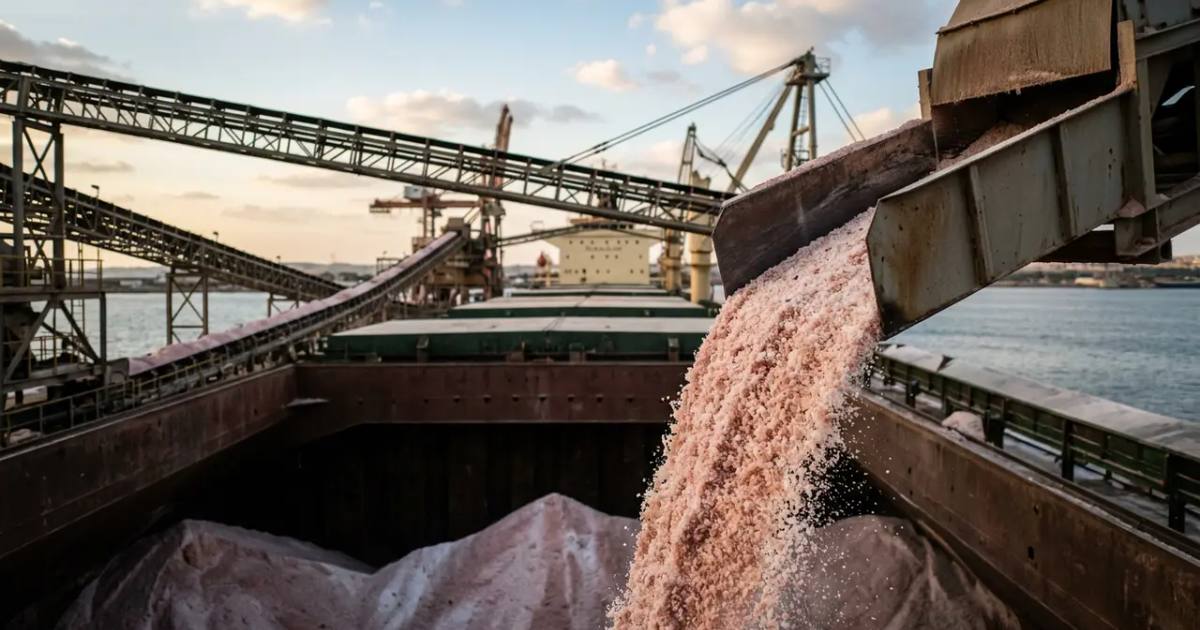

ICL ships Dead Sea potash to Asia via Eilat and to Europe via Ashdod, a split the Houthi Red Sea campaign disrupted. Pre-crisis Eilat volumes reached 1.8 to 2 million tons a year with no easy workaround.
ICL Dead Sea moves its potash from the lowest point on Earth to global markets using a purpose-built conveyor, rail lines to Ashdod, and truck routes to Eilat, splitting exports by destination: Europe and the Americas ship from Ashdod, while Asia-bound cargo has historically moved through Eilat. That geographic split became a liability when Houthi attacks shut down Eilat's commercial shipping lane in 2023, cutting off the direct route for roughly 1.8 to 2 million tons of annual potash exports to Asian markets.
How does potash physically get from the Dead Sea to a ship?
ICL constructed a conveyor belt in the 1980s that moves potash 18 kilometers from the Sdom site. This conveyor rises from 400 meters below sea level to 400 meters above it, reaching a railhead at Tzefa in Mishor Rotem, according to ICL's own sustainability reporting on the potash conveyor.
The conveyor transports an average of 1.4 million tonnes of potash annually. This represents a portion of ICL Dead Sea's total average annual production of approximately 3.7 million tonnes, per the same ICL disclosure. From Tzefa, potash travels by rail to the Port of Ashdod, as detailed in ICL's logistics and distribution disclosures.
The remaining potash from ICL's Dead Sea output, not moved by the conveyor, primarily travels by truck to the Port of Eilat, located roughly 180–200 kilometers south of ICL's Rotem and Sdom sites, per ICL's own logistics reporting.
Why does ICL divide its exports between Ashdod and Eilat?
ICL has historically routed shipments exiting Eilat to Asia, while sales to Europe, North America, and South America move through Ashdod, per ICL's own sustainability disclosures on its logistics and distribution network. This division is based on geography rather than production differences.
Eilat is situated on the Red Sea, offering Asia-bound cargo direct access to the Indian Ocean without transiting the Suez Canal. In contrast, Ashdod's Mediterranean location better serves European and transatlantic buyers. Prior to the disruption, Eilat's potash volumes reached an estimated 1.8 to 2 million tons annually, destined mainly for markets in Asia and East Africa.
What happened to Eilat's potash route after Houthi attacks?
Eilat is Israel's only Red Sea port, and Houthi attacks disrupted ICL's direct Asia-bound potash route through the port. This Houthi campaign also forced container lines to reroute around the Cape of Good Hope, as detailed in Olam's coverage of the Red Sea shipping disruption.
By mid-2025, the financial strain compounded the operational one: the port operator fell behind on municipal taxes and government concession fees after roughly 20 months of depressed commercial activity, and Eilat's municipality seized the operator's bank accounts, Marine Insight reported, citing Israeli Ministry of Transport officials. The port was set to halt all commercial operations from July 20, 2025, a closure the same report noted would directly affect the Europe Asia Pipeline Company and ICL's Dead Sea Works, both of which export potash through Eilat.
Eilat primarily handles bulk phosphate and potash freight for ICL, rather than general cargo, according to a 2023 analysis by Israel's Institute for National Security Studies (INSS). Upgrading the port for container traffic would require impractical dock-deepening work.
The INSS analysis notes that Eilat can, in an emergency, unload essential container cargo as a limited solution. However, this incurs financial and logistical costs for overland transport from Eilat to central and northern Israel. For ICL's bulk mineral exports, no comparable emergency workaround exists.
Potash that would have shipped directly from Eilat to Asian buyers must now reroute through Ashdod. This adds an overland leg from the Negev to the Mediterranean coast, which the original port split was designed to avoid.
How significant is potash to Israel's Red Sea trade?
Potash and phosphate exports represent one of the few bulk commodity flows that gave Eilat commercial relevance beyond vehicle imports. The port handles vehicle imports, animals, and passenger ships on the inbound side, with limited general cargo loaded for export apart from ICL's bulk freight, according to the INSS analysis.
This concentration means Eilat's commercial health has heavily relied on ICL's shipping decisions. It does not depend on a diversified base of exporters. Eilat's total traded cargo volume, including potash, has been estimated at roughly 5% of Israel's overall trade.
While a small share compared to Ashdod and Haifa, Eilat's route is structurally important for reaching Asian and East African buyers. It avoids Suez Canal transit fees or congestion risks.
What signals indicate recovery for ICL's Eilat-Asia potash route?
Track three signals to determine if ICL's Eilat-Asia potash route recovers. First, observe whether Eilat's broader commercial shipping activity resumes at a scale sufficient to support direct bulk mineral exports — a question complicated by Eilat's formal closure in 2025. This depends on Red Sea normalization, as discussed in Olam's coverage of the Red Sea shipping disruption.
Second, look for ICL to disclose a sustained shift of Asia-bound potash volume through Ashdod instead. Such a shift would suggest a permanent rerouting rather than a temporary wait for Eilat's reopening. Third, monitor if ICL's overall Dead Sea production volumes recover to the pre-disruption 3.7 million tonne average. Falling output would exacerbate the rerouting problem caused by Eilat's closure.
Related on The Olam
- Eilat Port and the Red Sea Crisis
- Red Sea Shipping Disruption
- Who Owns Israel's Ports? Haifa, Ashdod, and Eilat Mapped
Sources
ICL Group Sustainability, "Potash Conveyor"; ICL Group Sustainability, "Logistics & Distribution"; Marine Insight, on Eilat Port's 2025 closure.
How we report: Olam stories draw on public filings, company disclosures and named sources, checked by our editors. Read our methodology · Corrections