
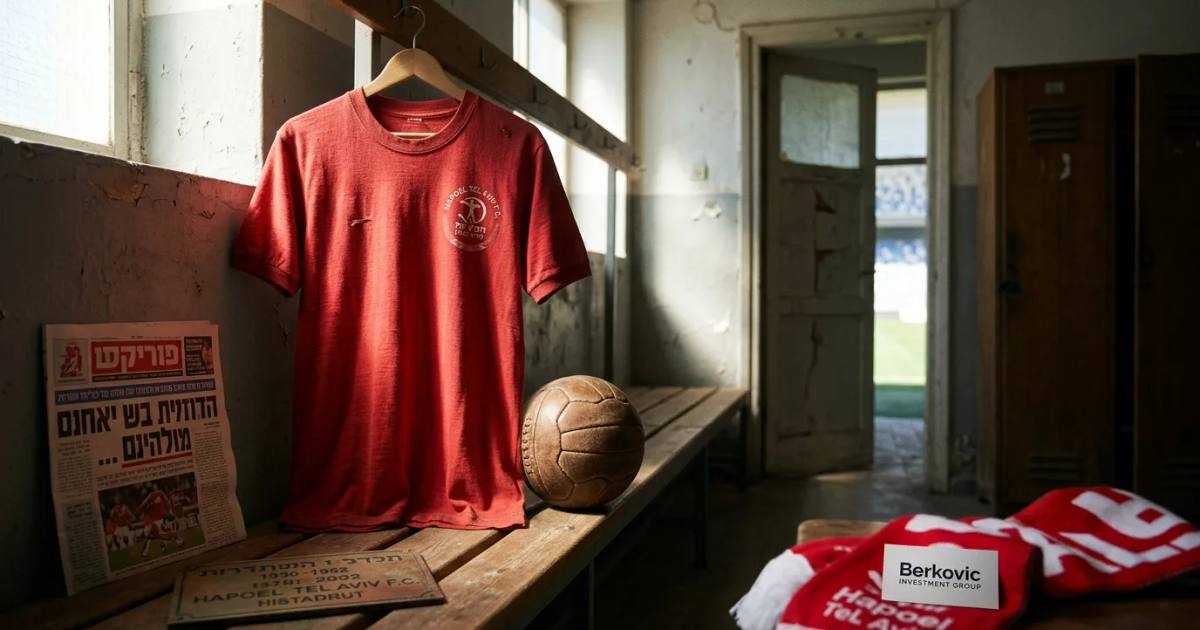

The labor-movement football club. Histadrut roots, 14 league titles, the 2010 Champions League run against Benfica and Lyon, the 2020 relegation, and the 2023 sale to an Eyal Berkovic-led investor group.
Hapoel Tel Aviv is Israel's original labor-movement football club — founded 1927 under the Histadrut, the country's federation of labor unions. For most of the 20th century it was the counter-flag to Maccabi Tel Aviv: red versus yellow, labor versus establishment, socialist Zionism versus liberal Zionism.
The club has 14 Israeli league championships, 16 State Cup titles — and in 2023 was sold to an investor group led by Eyal Berkovic, the former Israeli international footballer who spent his club career at Maccabi Haifa, Southampton, West Ham, Celtic, and Manchester City.
Ownership arc
- Histadrut era (1927–2001): the labor federation owned the club as a movement asset. Decision-making was collective. Budget was constrained.
- Yossi Sassi and successors (2001–2013): privatization era. Multiple owners. Championship in 2009–10.
- Eli Tabib (2013–2020): Israeli property investor. Conflict-heavy tenure. Financial deterioration. Relegated in 2020 for the first time in club history.
- Fragmented transition (2020–2023): promoted back to the top flight in 2022. Multiple investor conversations.
- Berkovic-led group (2023–present): Israeli investor consortium fronted by Eyal Berkovic — one of the most recognizable names in modern Israeli football. First time in the club's professional-era history that a former player of Berkovic's stature has led the ownership table.
The 2010 Champions League run
Hapoel Tel Aviv 2010–11 was the first Israeli club in the modern Champions League group stage era. Drawn with Benfica, Lyon, and Schalke 04. Beat Benfica in Lisbon (3-0 aggregate in the play-off round). Held the group with credibility. The campaign remains one of the highest single-season European achievements by any Israeli side.
Bloomfield Stadium
- Home: Bloomfield Stadium, Jaffa. Shared with Maccabi Tel Aviv and Bnei Yehuda. Capacity ~29,400.
- The three-club stadium model is unique in Israeli football and reflects the density of top-flight football inside Tel Aviv.
Structural picture
- Chronic financial fragility across previous ownership. The 2020 relegation was the low point.
- The Berkovic era brings both name recognition and a football-first ownership identity that the previous investor-only groups did not have.
- Player exports have narrowed relative to the Maccabi clubs. Rebuilding the academy pipeline is a stated priority.
The takeaway
Hapoel Tel Aviv is a legacy institution now under a football name. The Histadrut era gave it identity; privatization gave it volatility; the Berkovic-led group is the first attempt in two decades to align ownership recognition with the club's on-field story. The 2010 Benfica result and the 2020 relegation frame the fifteen-year arc — the next five years will be judged against that spread.
Related on Olam: