
Israeli football clubs have played all UEFA home games abroad since October 2023. This has imposed significant commercial costs for two seasons.
The four clubs carrying the European fixture, the Amsterdam inflection point, the UEFA arithmetic, and the commercial cost of playing every home game somewhere else.
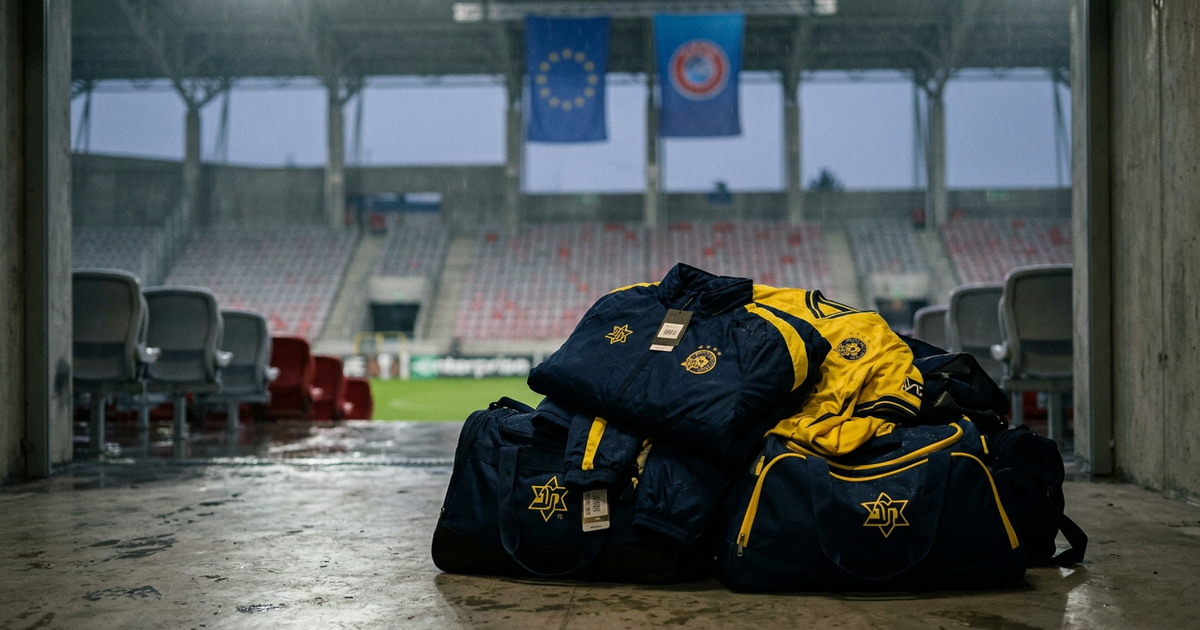
Every Israeli club home game in UEFA competition since October 2023 has been played somewhere else. Hungary, mostly. Serbia. Cyprus. Albania. The national team's qualifiers — the same. Two-plus seasons of fixture lists where the word "home" is a billing convention, not a location.
That is the operating reality of Israeli football in the post-October 7 era. Unlike basketball — where EuroLeague participation has held cleanly through the disruption — football is where the political, security, and commercial pressure on Israeli sport has been heaviest.
Four clubs carry the European fixture
Maccabi Tel Aviv FC is the country's most consistent European football export. Mitchell Goldhar, the Canadian-Israeli businessman behind SmartCentres REIT, has owned the club since 2009. Under his ownership Maccabi has reached the Champions League group stage and is now a regular in Europa League and Conference League play. Recent Israeli league champion. The franchise asset that anchors Israeli club football abroad.
Maccabi Haifa, owned by businessman Yaakov Shahar, is the other Israeli club to have reached the Champions League group stage in the modern era — most recently 2022-23, drawn against Paris Saint-Germain, Benfica, and Juventus. Subsequent European campaigns continued at neutral venues.
Hapoel Tel Aviv FC is the historical "people's club" of Israeli football — Bloomfield-based, working-class identity, decades of cycling between glory and decline. The club is again competing in European qualifying rounds after a period of stability. The Bloomfield brand still travels in cultural terms; the on-field business case is rebuilding.
Beitar Jerusalem is the populist asset. Six-time Israeli champion, capital-city base, La Familia ultras, ownership turnover through the late 2010s and 2020s. The December 2020 announcement that Sheikh Hamad bin Khalifa Al Nahyan of Abu Dhabi would take 50% — an early Abraham Accords commercial story — collapsed within months on questions about the structure of the deal. Beitar is the club most exposed to Israeli domestic politics and the one whose ownership story keeps generating headlines.
Amsterdam, November 2024
The inflection point of the away-fixture era was Ajax–Maccabi Tel Aviv in the Europa League. Post-match incidents involving Maccabi supporters across central Amsterdam — and the response to them — became an international story within hours. Dutch authorities deployed counter-terror resources. Israeli rescue flights to repatriate fans. Political condemnation across European capitals. Editorial wars about who attacked whom.
Two things are true regardless of the framing fight. First — Maccabi Tel Aviv supporters were physically targeted in a European capital. Second — the operating cost of Israeli football abroad (security, insurance, sponsorship optics, federation politics) was permanently reset upward from that night.
UEFA arithmetic
European federations from Norway to Ireland have pushed for Israel's suspension from UEFA competitions at various points across the cycle. The Norwegian FA voted internally. The Irish FAI made statements. Elements of the Spanish football establishment moved publicly. The Turkish federation refused fixtures.
The UEFA executive committee has held the line. Israeli clubs and the national team remain in European competition. The mechanism for maintaining participation has been the neutral venue — a workaround that satisfies the security argument without forcing the political call.
That arrangement is unstable by design. Every cycle of regional escalation produces a new round of federation pressure. UEFA's working assumption is that the cost of suspending Israel is greater than the cost of accommodating the away-fixture model. That math is recalculated every season.
The commercial cost
Playing every European home game in Felcsút, Debrecen, Budapest, Belgrade, Larnaca, or Tirana is not free.
The gate revenue from a sold-out Bloomfield or Sammy Ofer is lost — replaced by partial-capacity crowds in venues with no organic Israeli fan base. Traveling support is small, expensive, and increasingly the target of hostile counter-mobilization. Sponsorship optics shift — naming-rights partners weigh whether the asset still delivers the audience they bought. Broadcast deals renegotiate around fixture uncertainty. Insurance premiums on player travel and event staging have moved several multiples since 2023.
European prize money is the structural revenue case. Europa League and Conference League league-phase participation runs to multiple millions of euros per club, with eight-figure totals available for clubs that progress. Champions League access — for Maccabi Tel Aviv or Maccabi Haifa if either can navigate the qualifying rounds — sits in a different bracket entirely. That money is still on the table. The cost of collecting it has roughly doubled.
What separates football from basketball
The companion Olam piece on EuroLeague basketball described the cleanest case of Israeli sport as durable soft power. Football is harder. Three reasons.
Scale. Football crowds are larger, more politically mobilized, and harder to police. A Maccabi basketball trip to Belgrade is a managed event. A Maccabi football trip to Amsterdam is a logistics operation.
Federation politics. EuroLeague is a closed commercial league. UEFA is a continental federation with 55 voting members, each carrying domestic political pressure. The veto math is different.
The Beitar overlay. Israeli basketball has no equivalent of the La Familia-coded franchise. Beitar's domestic political identity travels with Israeli football into every European fixture, regardless of which club is on the road.
The asset that keeps showing up
For all of that — Israeli football is still in European competition. The national team is still in UEFA qualifying. Maccabi Tel Aviv is still a Europa League and Conference League fixture. Bloomfield still sells out the domestic league. The Israeli Premier League broadcast deal is intact.
The away years have raised the operating cost of Israeli football. They have not removed the asset from the board. For the Israeli sports business — and for the wider question of where the country's commercial fixtures sit inside European institutions — that distinction is the one that matters.
Israeli football continues to play. Just not at home.
This piece is part of Olam's Israeli Sports Business & Investment coverage.